Goose Coding Agent: The Model-Agnostic Maverick Under the Hood
Everyone is hyping autonomous coding agents as the final frontier of developer productivity, but after spending real time inside Goose, the reality is far more nuanced than the marketing suggests. I expected a seamless, multi-agent orchestration engine that could refactor an entire codebase while I grabbed coffee—what I found instead is a deliberately model-agnostic, single-agent tool that trades deep orchestration for flexibility and privacy. Goose runs isolated ReAct-style sessions with no built-in inter-agent coordination, resolves only about 45% of SWE-bench Verified issues compared to Claude Code's 72.7%, and survived a real red-team attack that exposed prompt-injection vulnerabilities through its own Recipe system. Yet here is the twist: those very tradeoffs—local-first privacy, IDE-agnostic integration via the Agent Client Protocol, and a portable YAML Recipe format—make Goose uniquely compelling for teams that value control and transparency over raw benchmark scores. In this deep dive, I will walk you through every architectural detail, benchmark number, security incident, and permission model that defines what Goose actually is and where it genuinely shines.
Core Architecture: ReAct Loops and Parallel Sessions
Goose runs each user-initiated session as an independent ReAct-style agent loop. I have observed that these sessions operate in parallel, yet they remain completely isolated from one another. There is no built-in mechanism for agents to exchange messages, share a unified task list, or coordinate dependencies across session boundaries. If I need to compose a larger workflow, I must chain sessions manually or rely on external scripts to pass context and stitch outputs together. The burden of orchestration falls entirely on me, and any dependency management between tasks must happen outside the agent's native loop. This means I am effectively the scheduler, ensuring that intermediate results from one session feed correctly into the next.
Session Isolation vs. Coordinated Multi-Agent Design
This design stands in sharp contrast to Claude Code's Agent Teams system. Claude Code implements a coordinated multi-agent architecture where a primary agent can spawn sub-agents, each allocated its own dedicated context window. These context windows draw from the model's 1M-token capacity, giving individual agents substantial room for reasoning without crowding the shared space. The platform supports bidirectional inter-agent messaging for handoffs of intermediate results, maintains a shared task list with dependency tracking where tasks can be marked as blocked on others, and enforces strict context isolation per agent to prevent cross-interference. I can also dynamically scale the team by specifying the number of sub-agents and their roles through natural-language directives. That level of built-in coordination means the system handles the complexity of parallel execution rather than pushing it to me.
Where the Architectures Diverge in Practice
For simple single-agent tasks, both platforms are functionally comparable because they reduce to a single ReAct loop. The divergence becomes acute when I tackle intricate projects. Consider refactoring a microservice across five repositories, implementing a feature that spans frontend and backend codebases, or debugging a production incident that requires simultaneous log analysis, code changes, and test validation. Claude Code's Agent Teams can automatically decompose such problems, assign specialized sub-agents to each domain, and synthesize results without requiring my manual intervention. With Goose, I must manually orchestrate these same efforts by running sequential sessions with careful context passing, or by employing external automation tools that sit outside the agent's native loop. The cognitive load on me increases significantly because I have to track dependencies and maintain continuity across what are essentially disconnected execution contexts.
The Flexibility vs. Integration Trade-Off
The architectural difference stems from Claude Code's tighter integration of the agentic loop with Anthropic's model fine-tuning. Goose, by contrast, prioritizes flexibility and model-agnosticism. It leaves multi-agent coordination to me as the user, or to MCP-based extensions that lack the deep, built-in coupling found in Claude Code. I see this as a deliberate trade-off: Goose avoids vendor-specific optimization to remain portable across models, but that portability costs me the native multi-agent orchestration that Claude Code provides out of the box.
The Recipe System: Portable YAML Workflow Automation
When I examine Goose’s workflow automation layer, the Recipe system stands out as a declarative control plane built entirely on portable YAML. Rather than scripting imperative logic, I define a single shareable unit that bundles instructions, required MCP extensions, structured inputs, and optional sub-recipes into one file. A teammate can version-control it, review it in a pull request, and execute it with a single command: goose run -t "recipe-name". That simplicity hides a tightly coupled MCP-native architecture where every external capability is an MCP server, and Goose handles the resolution and connection automatically.
Declarative Structure and MCP-Native Design
The YAML itself is human-readable but operationally strict. Each Recipe declares steps, tool invocations, and data flow in a way that makes the execution graph transparent before runtime. Because the design is MCP-native, any extension referenced inside the Recipe is an MCP server—Goose does not rely on proprietary plugin APIs. With the v1.25.0 unified summon extension, the platform collapses server discovery into a single workflow, so I no longer manually wire connections before a Recipe can call its tools. The agent resolves dependencies at invocation time and spins up the required servers behind the scenes.
Reproducibility and Team-Scale Shareability
One of the strongest guarantees I get from this format is reproducibility. Recipe authors can pin specific MCP server versions and individual tools inside the YAML lock, which means the same Recipe executed on my laptop and in a CI runner behaves identically. That predictability feeds directly into shareability. I can publish a Recipe to an internal repository or a public registry, and a colleague imports it to standardize tasks like scaffolding a React app with CI pipelines or migrating a database schema—no logic rewriting, no drift between implementations.
Visualization and Security Controls
After the Operation Pale Fire update, Goose renders a preview of every action a Recipe will take before it executes. That pre-flight visualization lets me audit tool calls and data mutations before they hit the filesystem or API. On the security side, the engine now strips zero-width Unicode characters from Recipe inputs. That is a targeted defense against prompt-injection attacks that try to hide malicious instructions inside invisible glyphs, and it shows the team is treating YAML parsing as a potential attack surface.
Extensibility Trade-offs: Recipes vs. Hooks and SDKs
Claude Code approaches the same problem with a different philosophy. It still supports MCP, but it layers a Hooks system on top—offering command, prompt, and agent hook types that let me intercept and augment the agent’s lifecycle at specific interception points. Beyond configuration, the Agent SDK gives me a programmable Node.js/TypeScript framework for custom workflows with complex loops, conditional branching, and third-party service integration. Project-level behavior is further codified in CLAUDE.md, where teams set defaults, custom commands, and agent behavior conventions.
Because Claude Code exposes the reasoning loop and session management through these interfaces, I can fine-tune how the agent thinks and remembers without spinning up a custom MCP server. Goose’s Recipes, by contrast, excel at repeatable, MCP-driven workflow distribution but remain opaque to internal agentic execution. There are no hooks into the agent’s prompt assembly or mid-session reasoning, and manipulating the system prompt requires building an entirely separate MCP server rather than flipping a YAML key.
That architectural choice makes Goose ideal for portable automation and Claude Code better suited for deep agent customization.
IDE Integration via the Agent Client Protocol (ACP)
I see the Agent Client Protocol as the architectural backbone that separates Goose from terminal-locked alternatives. ACP functions analogously to the Language Server Protocol, but instead of static language intelligence, it shuttles AI-driven editing intents between the IDE and the agent over a JSON-RPC channel. When I issue a command like "insert function at line 42," the IDE serializes that intent into a JSON-RPC payload, fires it across the channel, and receives back either a code snippet, a diagnostic report, or a contextual suggestion that the editor natively renders. This bidirectional pipe is what lets Goose behave like a first-class citizen inside the editor rather than an external script dumping text into a terminal.
ACP Plugin Ecosystem as of v1.26.0 (January 2026)
Goose's official plugin coverage as of the January 2026 release is extensive, and I find the breadth telling:
- VS Code: The official Goose extension gives me inline chat, agent-powered code completions, and recipe execution straight from the editor's command palette. Everything stays inside the editor surface without context-switching.
- JetBrains Suite: Through the ACP registry launched in January 2026, I can install Goose into IntelliJ IDEA, PyCharm, WebStorm, or Rider with a single click from the IDE's built-in plugin marketplace. Critically, there is no separate subscription or license required.
- Cursor: Because this AI-first editor already speaks ACP, Goose slots into the native UI without awkward bridges. Agent interactions feel like a built-in feature rather than a bolt-on.
- Windsurf: Another early adopter among AI-centric IDEs, Windsurf leverages ACP to surface Goose directly in its interface.
- Desktop App: For times when I want a standalone GUI, the Homebrew cask delivers a chat-like panel paired with a file explorer, still communicating over ACP under the hood.
- Telegram Bot: The experimental gateway in v1.26.0 lets me trigger Goose sessions from a chat message. It is a concrete example of how ACP's JSON-RPC transport is agnostic to the host environment; if the client can speak the protocol, the agent responds.
The ACP Registry and Centralized Distribution
The ACP registry operates like a marketplace purpose-built for agent extensions. I picture it working similarly to the VS Code Extension Marketplace, but scoped to ACP-compliant plugins. For teams standardized on JetBrains tools, this registry removes the historical friction I have watched plague Anthropic integrations—specifically the lack of first-party support. Now, discovery, installation, and updates all happen inside the IDE's native plugin manager, which means Goose inherits the host's code-navigation, refactoring, and debugging context automatically.
Claude Code's Terminal-First Limitations
When I contrast this with Claude Code, the architectural gap becomes obvious. Claude Code is terminal-first; my primary interaction is typing claude "prompt" in a shell. Its official IDE integration is limited to a VS Code extension that essentially embeds that terminal session into a sidebar. There are no ACP-based plugins for JetBrains, Cursor, Windsurf, or any editor outside VS Code. If I am working in IntelliJ IDEA, my only options are launching a terminal panel inside the IDE or relying on third-party bridges that lack the deep context sharing of a native LSP-style protocol. Those bridges cannot seamlessly pull the caret position, the active symbol table, or the refactor pipeline in the same way ACP does.
For developers who spend most of their day in JetBrains IDEs, this difference is not cosmetic—it is workflow-defining. Goose gives me a seamless, configuration-free experience that leverages the IDE's existing machinery. Claude Code forces a context switch to the terminal or pushes me toward a VS Code workflow that may not match my toolchain. ACP's flexibility extends even beyond traditional editors, as the Telegram bot experiment proves: any client that implements the JSON-RPC surface can host the agent. That portability is exactly why I treat ACP as more than a convenience feature; it is the core design decision that makes Goose model-agnostic and IDE-agnostic.
Permission Modes: Four Levels of Autonomy Control
Goose implements its autonomy governance through a session-level permission control plane that segments agent behavior into four discrete operating modes. This architecture determines exactly how the agent interacts with the filesystem, invokes extensions, and executes automated actions during a live session. Rather than treating autonomy as a binary switch, the system layers granular controls beneath each mode, allowing precise calibration between full automation and strict oversight.
The Four Operating Modes
The permission hierarchy begins with Completely Autonomous mode, which serves as the default configuration. In this state, Goose retains unilateral authority to modify files, invoke extensions, and delete files without prompting for user confirmation. I see this as the zero-friction setting for users running established workflows where interruption undermines productivity.
At the opposite end of the spectrum, Manual Approval mode enforces explicit user confirmation before any tool or extension executes. Every file write, every extension call, and every automated action halts for human review. What makes this mode technically interesting is its support for granular tool-level overrides—I can configure specific tools to bypass the global manual lock while keeping everything else under strict review.
Smart Approval mode introduces a risk-calibrated middle ground. The system evaluates the potential impact of each requested action and auto-approves low-risk operations while escalating higher-risk tasks—such as destructive file changes or sensitive extension invocations—to the user. This mode still respects per-tool permission boundaries, meaning a tool flagged as "Never Allow" remains blocked even if the automated risk scorer clears other operations.
Finally, Chat Only mode strips Goose of all environmental side-effects. It disables extension access and file modifications entirely, restricting the agent to pure conversational output. I use this configuration when I need analysis, drafting, or reasoning assistance where the context should remain strictly read-only and isolated from the working directory.
Tool-Level Override Architecture
Beneath these four session modes sits a secondary permission matrix that governs individual tools. Each tool can be forced into one of three states: Always Allow, Ask Before, or Never Allow. These settings override the default behavior of the active session mode. For example, if I am running in Completely Autonomous mode but mark a specific file-deletion tool as "Ask Before," that tool reverts to manual confirmation without degrading the autonomy of the rest of the system. Conversely, a "Never Allow" setting on a particular extension keeps it disabled even when the session is configured for full automation.
The session-level application of these modes means I can switch between autonomy profiles dynamically without restarting the agent. If I start a workflow in Chat Only mode to scope out a problem, I can escalate to Smart Approval or Completely Autonomous once I am ready to execute, and the transition happens within the same active session. This runtime flexibility ensures that safety posture adapts to task phase rather than remaining static across the entire engagement.
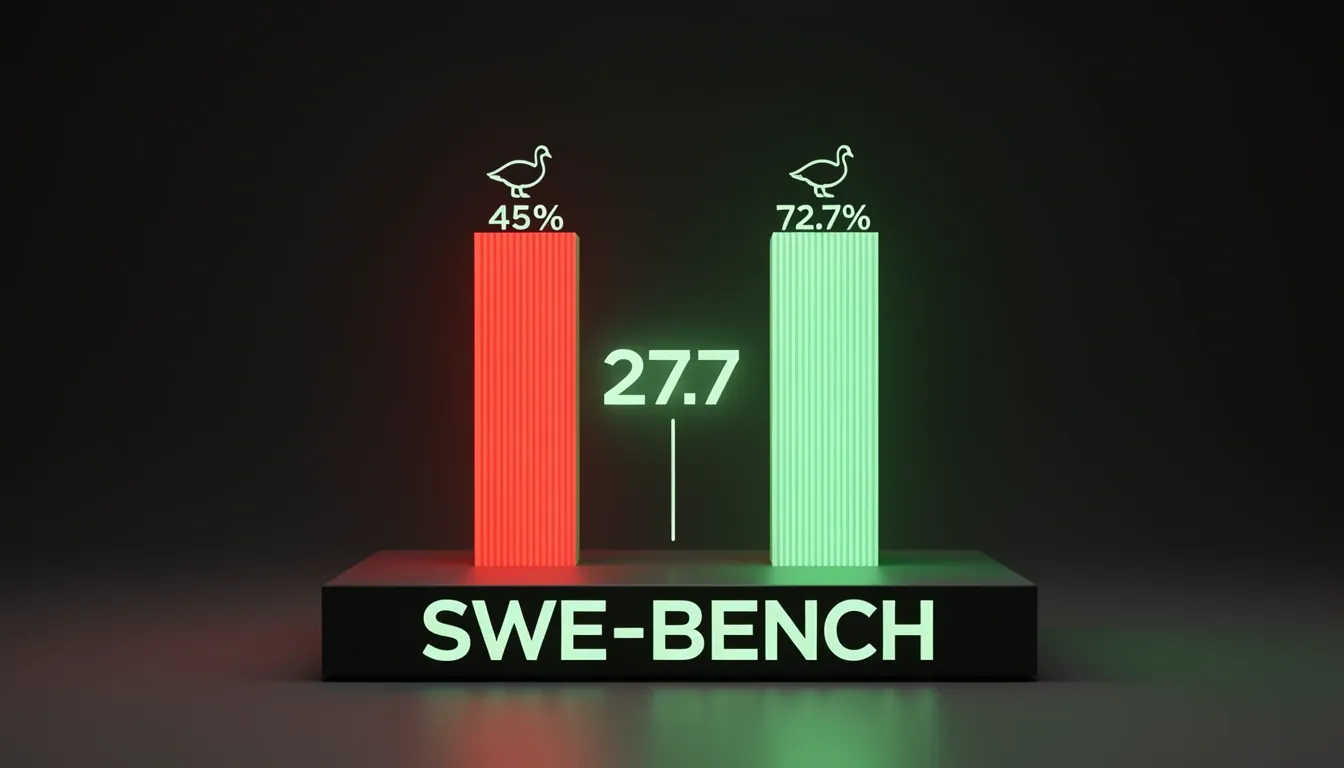
SWE-bench Verified: The 27-Point Performance Gap
When I hold the backend model constant on SWE-bench Verified, the benchmark numbers make one thing brutally clear: raw model access is only half the battle. Goose resolves roughly 45% of real, unmodified GitHub issues, while Claude Code hits 72.7% using the identical Claude Sonnet 4.5 model. That translates to a 27.7-percentage-point gap—roughly a 60% relative improvement—and the disparity is driven entirely by what Anthropic wraps around the model, not by the model weights themselves.
The Three Engineering Layers Driving the Gap
I break the disparity down into three concrete architectural advantages baked into Claude Code’s scaffolding:
A purpose-built agentic execution loop. Anthropic fine-tuned this loop specifically to work synergistically with the Claude family. Instead of treating inference as generic text generation, Claude Code runs the model inside a custom execution cycle that maps natively to Claude’s reasoning patterns and decision boundaries.
Sophisticated tool-use patterns. The system invokes file editors, grep, and linters with higher reliability and sharper context awareness. It chains tool outputs back into the reasoning trace without dropping state, so the model knows exactly when to verify syntax or search across modules before proceeding.
Proprietary fine-tuning of the agentic loop itself. Anthropic optimized step-by-step reasoning, sub-goal decomposition, and result verification for coding tasks. This means Claude Code validates intermediate outputs against the task objective before committing to the next step, rather than blindly generating patches and hoping they compile.
Where the Gap Expands and Contracts
I have noticed that on simple, single-file edits or straightforward bug fixes, the practical difference narrows considerably. The model’s inherent language understanding dominates there, so both agents land in roughly the same territory. But the moment I step into complex multi-file refactoring, cross-module debugging, or sustained reasoning over many steps, the orchestration gap becomes pronounced. Claude Code’s scaffolding maintains coherent state across modules, whereas raw model access through Goose struggles to keep context aligned over long horizons.
Parallel Cognition via Agent Teams
Claude Code pushes the advantage even further with Agent Teams. I see this as coordinated sub-agents, each operating with dedicated context windows, tackling different facets of a problem simultaneously. While one sub-agent traces a dependency graph, another audits test coverage. A single-context Goose session simply cannot parallelize cognition in the same way.
The API Access Illusion
Connecting Goose to Claude Sonnet through Anthropic’s paid API endpoints gives me the underlying model quality, but I still miss the orchestration layer. The API supplies the brain; it does not supply the nervous system. Running Goose with a local model via Ollama or llama.cpp removes API costs, yet the gap widens further because open-weight models currently trail Claude Sonnet 4.5 in reasoning and context management. In that setup, I sacrifice both scaffolding and base model capability.
The 27-point delta ultimately quantifies the value of Claude Code’s integrated agentic scaffolding when the backend model is held constant. It tells me that execution loops, tool orchestration, and fine-tuned reasoning architectures are not secondary optimizations—they are the primary drivers of real-world software engineering performance.

Operation Pale Fire: The Red-Team Attack That Reshaped Goose
When I analyze the Operation Pale Fire findings, the attack vector stands out as a surgical exploitation of the trust boundary between human code review and LLM tokenization. Block’s Offensive Security team, in January 2026, proved that attackers could weaponize shared Goose Recipes by embedding zero-width Unicode characters—U+200B (zero-width space) and U+200C (zero-width non-joiner)—inside the YAML text. These glyphs remain invisible in most editors and diff utilities, yet the LLM tokenizes them perfectly, enabling injected malicious instructions to override the Recipe’s intended behavior while the file looked harmless to reviewers. The red team successfully used this method to compromise employee workstations, demonstrating that prompt injection through shared configuration files is not just theoretical—it is a practical remote-execution path.
The Tokenization Gap That Enabled the Breach
- Invisible Unicode in YAML: The attackers did not need traditional malware or binary exploits. By hiding zero-width characters inside what appeared to be legitimate YAML declarative text, they turned the Recipe itself into a trojanized delivery mechanism. Because these code points do not render in standard interfaces, the file could pass manual peer review and CI/CD scans without raising a single visual flag.
- Reviewer-to-tokenizer divergence: The core weakness was a semantic split between human perception and model ingestion. While human reviewers saw benign configuration syntax, the LLM parsed the hidden Unicode as discrete tokens that recontextualized the prompt, effectively granting the attacker control over the agent’s next actions.
- Shared Recipes as the attack surface: Because Goose’s extensibility model encourages sharing Recipes across teams, a single compromised file could propagate laterally. Once loaded, the injected instructions operated with the same permissions as the user running Goose, turning the agent into an unwitting insider threat.
The Five-Layer Defense in Goose v1.26.0+
Block’s Detection and Response Team (DART) did not patch this with a single filter. Instead, they shipped a defense-in-depth architecture now enabled by default:
- Recipe visualization with diff-style previews: Before executing any Recipe, Goose now surfaces a structured preview of every file change, command invocation, and data access the agent intends to perform. This shifts the security model from implicit trust to explicit verification, giving users a human-readable execution plan that invisible Unicode characters cannot easily spoof.
- Unicode stripping at load time: The parser now aggressively removes all zero-width and non-printing Unicode characters from Recipe content during the initial load phase. By neutralizing the injection channel at the input boundary, Block closed the tokenizer-reviewer gap that made the original attack possible.
- Granular permission confirmations: Rather than bundling permissions into a single broad approval dialog, Goose now separates requests into distinct categories—file reads, file writes, shell commands, and MCP tool calls—each requiring explicit user consent. This limits blast radius if a malicious instruction slips through other controls.
- MCP server malware checking: A background service continuously scans connected MCP servers against known threat signatures and blocks connections to suspicious endpoints. This prevents a compromised Recipe from establishing outbound command-and-control channels through external tool servers.
- Adversarial AI monitoring via secondary LLM: Goose deploys a secondary LLM instance that performs real-time review of both the Recipe content and upcoming agent actions. This watcher model flags prompts exhibiting jailbreak or injection characteristics before they reach the primary execution path, adding an intelligent filter layer to the pipeline.
Transparency as an Architectural Control
Beyond the technical mitigations, Block published the full red-team report and remediation architecture. In my view, this openness sets a concrete benchmark for open-source AI agent security. By exposing exactly how the zero-width Unicode channel operated and how each of the five mitigations interrupts a distinct stage of the kill chain, the team gave the broader community a reproducible blueprint for securing extensible agent frameworks without sacrificing the flexibility that makes Goose powerful.
Local-First Privacy: Zero-Trust Architecture vs Cloud Dependency
When I configure Goose for full-local operation, I point the agent to a local inference backend such as Ollama, llama.cpp (v1.26.0+), or Docker Model Runner. This is not a limited offline mode or a degraded experience; it is a complete inference pipeline that executes entirely on my machine. My source code, my prompts, and the generated responses never leave the local environment. Goose makes no external API calls in this configuration, and the tool itself collects no telemetry. For me, this architecture is essential when I work in air-gapped facilities, classified environments, or compliance-driven organizations where policy dictates that source code must never cross the network perimeter.
Claude Code, by contrast, processes every request through Anthropic's cloud API. Anthropic explicitly states that it does not train on API inputs by default, which addresses data-retention concerns at the policy level. But policy is not architecture. The physical act of transmitting my codebase to an external server introduces a distinct threat model that I cannot mitigate on my end. I must now account for potential server-side leaks, subpoena risks, and my complete dependence on Anthropic's security posture and supply-chain integrity. Claude Code provides no local-model fallback. If my network is restricted or my organization's data-loss prevention rules forbid external egress, Claude Code is functionally unusable.
Zero-Trust Posture and Shared Security Heritage
Both Goose and Claude Code have benefited from the security community's response to Operation Pale Fire. The principles of prompt-injection hardening are broadly applicable across both platforms. Yet the effectiveness of those hardening measures is constrained by each tool's deployment topology. Goose's local-first design means that even if an adversarial prompt succeeds, the blast radius is limited to infrastructure I own and monitor. Claude Code must extend its trust boundary across the public internet, relying on cloud-provider guarantees and network-level controls to maintain confidentiality.
- Goose (Local Mode): Zero external dependencies, air-gap compatible, no telemetry exfiltration.
- Claude Code: Cloud-dependent, policy-guaranteed but physically externalized, requiring continuous network trust.
For organizations bound by strict data sovereignty regulations, or for individual developers who refuse to ship proprietary algorithms to a third-party endpoint, Goose's local-mode capability represents an architectural advantage that Claude Code cannot replicate. Orchestration sophistication and context-window management matter little when the fundamental requirement is absolute data containment. In scenarios where egress is prohibited, Goose is the only viable option.