
Qoder Explained: The Hybrid Retrieval Engine That Actually Understands Your Codebase
I used to think generic embedding-based code search was good enough—until I spent an hour debugging why my AI assistant kept suggesting code from a branch I'd switched off three commits ago. That's when I realized the entire retrieval pipeline was fundamentally broken for real-world development workflows. Qoder takes a radically different approach: instead of relying on a single vector database that lags behind your codebase, it combines a server-side vector search engine, a client-side code graph, and a pre-indexed knowledge base into one hybrid system that updates in seconds, not minutes. In this article, I'll walk you through what Qoder is, how its architecture actually works under the hood, and the best practices I've found for configuring it to get the most accurate, cost-efficient results from your AI coding workflows.
What Is Qoder? A Codebase-Aware Retrieval System for AI Coding
When I look at how generic embedding-based code search tools operate, I see a brittle pipeline that collapses the moment a codebase evolves. These systems typically rely on external APIs and remote vector databases, which forces multi-minute update intervals into the workflow. If I switch a branch or rename a function, the index is immediately stale, feeding AI assistants irrelevant context while completely missing the structural reality of the code. Worse, they reduce every search to a flat textual similarity score, ignoring whether a call-site actually maps to its function definition, how inheritance hierarchies connect classes, or whether the same algorithm lives across multiple languages. And from a security standpoint, shipping raw proprietary code to a third-party embedding API is a non-starter for most organizations I work with.
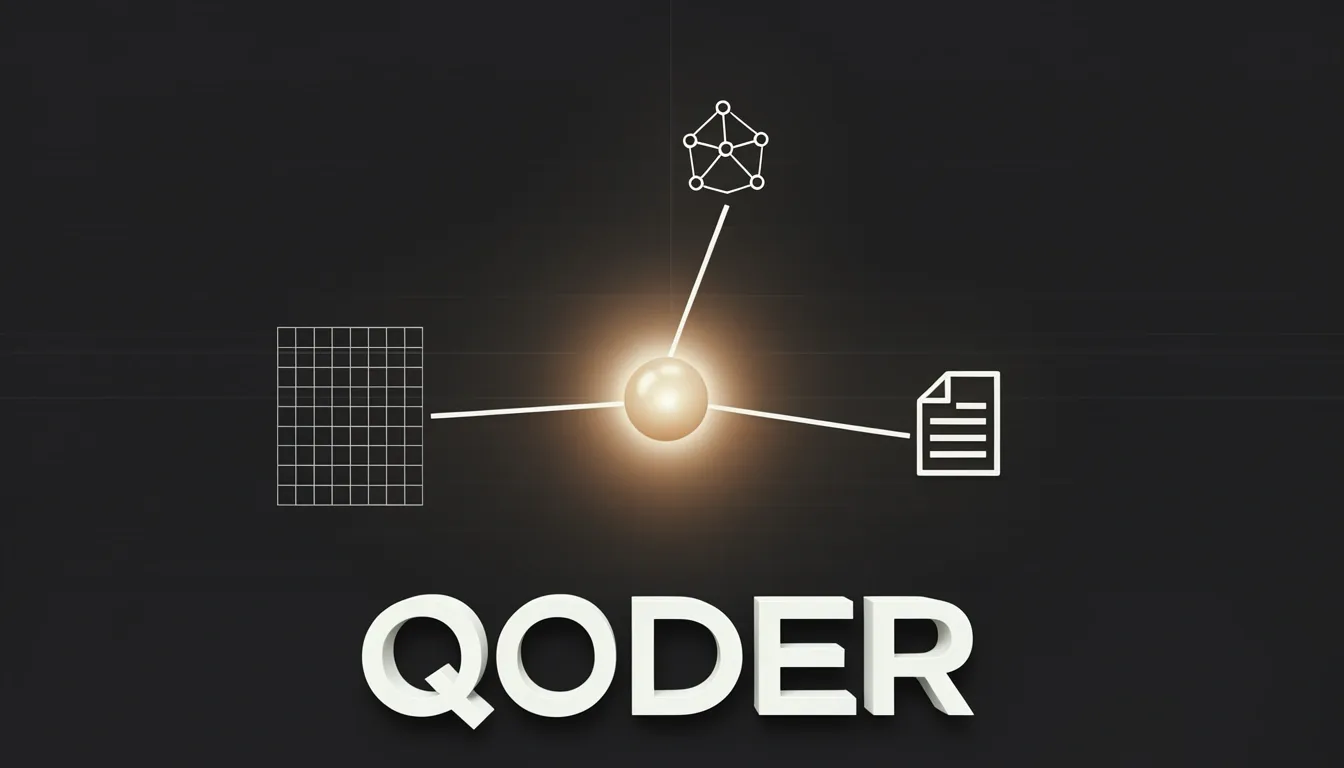
Qoder addresses these gaps by functioning as a codebase-aware indexing system built on a hybrid architecture that fuses three distinct layers. Instead of treating code as plain text, it treats the repository as a living system with semantic, structural, and organizational dimensions.
The Three Pillars of Qoder's Architecture
The first layer is a server-side vector database that stores embeddings for code snippets, documentation, and other codebase artifacts. What matters here is that these embeddings are computed using custom AI models trained specifically on code and domain knowledge. Unlike off-the-shelf models that optimize for superficial textual similarity, Qoder's models prioritize helpfulness and semantic relationships—meaning they capture what a block of code actually does, not just the tokens it shares with a query.
The second layer is a client-side code graph that lives where the code lives. This graph explicitly models functions, classes, and modules, along with their relationships: call graphs, inheritance hierarchies, and cross-language links. Because this graph is client-side, it can reflect structural changes immediately without waiting for a remote re-indexing cycle.
The third layer is a pre-indexed codebase knowledge base, or Repo Wiki, that ingests design documents, architecture diagrams, and internal wiki pages. This grounds the retrieval process in the higher-level design intent behind the implementation, not just the implementation itself.
How the Pipeline Fuses Semantics and Structure
When I send a query into Qoder, the system first computes an embedding using that same custom model, then performs a vector search to pull the top-N similar snippets. But here is where the architecture gets interesting: instead of returning those results directly, Qoder routes them through the client-side code graph to expand or refine candidates based on structural relationships. If a retrieved snippet references a function definition that is textually dissimilar but structurally bound, the graph pulls that definition into the candidate set.
The final ranking then combines traditional similarity scores with graph-based relevance signals. This hybrid scoring ensures that results are not merely semantically close but also structurally pertinent. I get the function definition referenced by a call-site sitting right next to semantically similar snippets, even if the two share almost no surface-level text. That is the difference between searching text and actually understanding a codebase.

How the Hybrid Architecture Works: Vector DB + Code Graph + Pre-Index
I see the architecture as a three-tier retrieval stack where each layer handles a specific dimension of code understanding. At the top, a server-side vector database handles broad semantic similarity. Beneath it, a client-side code graph enforces structural precision. The foundation is a pre-indexed knowledge base that anchors concepts to documented design decisions. Together, these components resolve queries through a pipeline that balances recall, accuracy, and speed.
Server-Side Vector Search with Custom Code Embeddings
The backend runs on a high-performance vector database deployed entirely within Qoder's own infrastructure. Unlike systems relying on generic natural language models, this setup uses custom AI models trained specifically on code and domain knowledge to generate embeddings. This specialization matters because the semantic relationships in source code differ fundamentally from prose.
The system indexes three primary content categories:
- Code snippets – functions, classes, and methods
- Documentation files – Markdown, comments, and docstrings
- Codebase artifacts – configuration files, build scripts, and API specifications
Indexing operates in real-time. The backend processes requests as files change, incorporating new or modified content within seconds of detection. For scale, the architecture is designed to scale horizontally, accommodating both large repositories and sustained high query volumes without bottlenecking retrieval.
Client-Side Code Graph for Structural Precision
While vector search captures semantic similarity, it does not inherently understand call hierarchies or inheritance chains. The client-side code graph fills this gap by representing the codebase as a traversable structure built through static analysis.
The graph defines nodes as functions, classes, methods, modules, and individual files. Its edges encode multiple relationship types:
- Call graphs mapping function-to-function invocation patterns
- Inheritance hierarchies tracking extends and implements relationships
- Interface implementations spanning across different files
- Import and export dependencies
- Cross-language links, such as a Python function connected to its Java counterpart in a microservice architecture
- Variable usage and data flow between components
Because the graph is stored in an optimized local format, traversal achieves lookup times measured in microseconds rather than milliseconds. This speed is critical because it allows structural validation to happen on the client without round-trip latency to a remote server.
Pre-Indexed Knowledge Base and Concept-Based Lookup
The Repo Wiki layer acts as a structured semantic anchor. It ingests and indexes material that pure code analysis often misses, including:
- Design documents such as architectural decision records, system design specifications, and technical proposals
- Architecture diagrams representing system components, data flows, and deployment models, parsed from Markdown or image descriptions
- Internal wiki pages generated automatically from code analysis
- Configuration files detailing environmental dependencies and operational parameters
- Build scripts including Makefiles, Gradle, Maven, and npm configurations
This layer enables concept-based lookups, where a query resolves by matching against documented architectural concepts rather than relying solely on code signatures. When I ask about "authentication flow," the system can surface the relevant ADR and deployment diagram even if my query does not mention specific function names.
Architectural Synergy: Combining Recall, Precision, and Context
The real power emerges from how these layers interact during query execution. Vector search provides broad semantic recall across large codebases, returning an initial set of semantically similar snippets. However, similarity alone can miss structural context.
Once the server returns those candidates, the client uses the local code graph to expand results with structurally related elements: callers, callees, parent classes, related functions, and linked documentation or configuration files. This expansion adds structural relationship validation that vector similarity cannot provide on its own.
Simultaneously, the pre-indexed knowledge base supplies immediate contextual information for common architectural queries, grounding code-level results in design rationale and operational constraints.
Because the entire graph and pre-indexed knowledge reside locally on the client, this graph-based expansion operates with ultra-low latency. In my experience, the local traversal typically adds less than 10 milliseconds to the overall query processing time. The result is a hybrid pipeline that feels instantaneous while delivering results validated by both semantic meaning and structural reality.
Real-Time Personalization: Per-Developer Indexing and Branch Awareness
I find that most "context-aware" tools treat working state as an afterthought, but Qoder's personalized indexing strategy makes it a first-class citizen. Instead of forcing the entire team into a single monolithic index, the system maintains a separate index for each developer that is tightly bound to their specific working state. My personal index incorporates my current Git branch and commit position, tracks my locally modified files whether they are staged or unstaged, logs my recent file edits and refactorings, monitors my active search and navigation history, and even accounts for my current file open set in the IDE. Because of this, two developers working on different branches of the same repository see completely different, contextually appropriate suggestions—each grounded in their actual code state, not some generic repository snapshot.
Update Triggers and Sub-Second Latency
When I switch Git branches, Qoder doesn't wait around. The client immediately detects my change through Git's filesystem hooks and fires off a notification to the server indicating my new working context. The server then updates embeddings, but only for files that actually differ between branches, and it completes this within seconds. At the same time, my client-side code graph is updated to reflect branch-specific structural differences, so my autocomplete and navigation context shifts instantly.
For my day-to-day file modifications, Qoder relies on efficient file watching mechanisms to catch my saves, modifications, and deletions as they happen. The system uses incremental processing: only the embeddings for my changed files are regenerated and sent to the server. The code graph is also modified on the fly to reflect changes in function signatures, class structures, or import relationships. In practice, embedding updates occur within seconds of a file save.
Search-and-replace operations get special treatment too. When patterns match code structural elements, Qoder processes affected elements individually rather than blindly reindexing the entire file. It then propagates those changes through the code graph—so if I rename a function, the system updates all its call sites without forcing a full re-parse.
Technical Implementation Optimizations
Under the hood, Qoder uses batched updates to group multiple changes and minimize network overhead. It also leverages client-side caching to store my code graph locally, which avoids redundant computation when I switch contexts or reopen files. Selective synchronization ensures that only the delta between my previous and current states crosses the wire.
The system is also resilient: it handles scenarios where server and client states temporarily diverge, such as during network interruptions, without falling over. On the server side, embedding updates typically finish in under two seconds for average-sized codebases and under five seconds for large monorepos. Meanwhile, the client-side overhead stays minimal, typically consuming less than 5% of CPU and memory resources on my development machine.
Performance Deep Dive: Throughput, Latency, and Client-Side Optimizations
I look at Qoder's retrieval backbone and the first thing that stands out is how aggressively it pushes throughput at the storage layer. The vector database backend processes thousands of files per second during peak indexing loads, which immediately tells me the embedding pipeline is not confined to a single instance. Instead, the architecture scales out across multiple server nodes, distributing incoming indexing requests evenly across available backend instances so that no single node becomes a chokepoint when a massive repository lands or when multiple teams kick off concurrent re-indexing jobs.
The embedding generation algorithms are explicitly optimized to minimize computational overhead per file, so the system is not simply throwing hardware at the problem. Horizontal scaling is the mechanism that lets the system accommodate repositories of virtually any size. The concrete partitioning example is telling: a codebase with 500,000 files can be partitioned across 10 servers, each handling approximately 50,000 files. That linear split proves the backend treats repository size as a scaling dimension rather than a hard ceiling.
Backend Throughput and Horizontal Partitioning
- Peak indexing velocity: The vector database sustains thousands of files per second during heavy ingestion because the workload fans out across multiple server nodes rather than stacking up behind a single process.
- Even request distribution: Incoming indexing requests are balanced across backend instances, preventing hot-spotting and keeping per-node load predictable.
- Computational efficiency: Efficient embedding generation algorithms reduce the per-file CPU cost, so horizontal scaling adds capacity without creating a proportional overhead penalty.
- Repository-size elasticity: Partitioning 500,000 files across 10 servers at roughly 50,000 files each demonstrates that the system handles very large codebases through straightforward horizontal expansion.
Client-Side Resource Optimizations
On the client side, Qoder avoids the trap of treating the developer machine as a dumb terminal. Graph caching stores the client-side code graph in memory, which means the local environment never wastes cycles reparsing and reconstructing the entire graph during frequent updates. Once the code graph is generated for a session, it is stored in memory and incrementally updated as changes occur, rather than being reconstructed from scratch. That design choice is what keeps the local footprint tiny.
Batched network operations group multiple file changes into single transmission units, cutting HTTP overhead dramatically. Selective transmission sends only the delta—changed files—to the server rather than retransmitting the entire index. When change frequency spikes, update throttling intelligently throttles updates to prevent system overload while maintaining eventual consistency. The payoff is concrete: these optimizations ensure client-side overhead remains minimal, typically consuming less than 5% of CPU and memory resources on a modern development machine.
Latency Characteristics and Query Performance
Latency is where the architecture's separation of concerns really pays off. Approximate nearest neighbor searches complete in milliseconds even with millions of embeddings, which indicates the vector index is optimized for approximate search at scale rather than exact brute-force comparison. Client-side graph operations occur in microseconds because the data structures are localized in memory, so traversal and expansion never hit the network.
Code changes are reflected in the search index within seconds of detection, and end-to-end retrieval latency remains under one second for typical queries. That sub-second boundary is critical for preserving developer flow. Even when the retrieval pipeline uses graph-based expansion to enrich the context, the overhead is negligible—graph-based expansion adds less than 10 milliseconds to overall query processing time. In practice, that means I can trigger a semantic search, get results enriched with structural relationships, and never feel the system lag behind my typing.

Security and Privacy by Design: Zero-Trust Code Protection
I treat every code retrieval system as a potential exfiltration vector until proven otherwise. Qoder addresses this with a zero-trust boundary where raw code never transits to third-party embedding or vector-search providers. All embedding computation stays inside Qoder's SOC 2 Type II compliant infrastructure, and explicit network isolation blocks external access to the vector databases. That single design choice removes an entire class of supply-chain data-leakage risks.
Air-Gapped Processing and Infrastructure Isolation
Qoder runs every stage of the retrieval pipeline on owned infrastructure. Embedding computation, vector storage, and search operations never touch external hosts, which means code stays inside the trusted environment during both indexing and retrieval—true air-gapped processing. Sensitive components live in isolated network segments enforced by strict access controls, so unauthorized processes cannot cross tenant boundaries or reach administrative planes.
Cryptographic Proof-of-Possession for Retrieval
Before the server returns any snippet, the client must prove it actually holds the file. I do this by sending a SHA-256 hash of the file's exact bytes. The server hashes its own copy and verifies the digest; only a match authorizes retrieval. This challenge-response mechanism binds access to legitimate codebase possession rather than coarse session tokens, preventing unauthorized code leakage even if credentials are stolen. To block replay attacks, each hash includes a nonce or timestamp, so intercepted payloads expire immediately and cannot be reused.
End-to-End Encryption and Key Management
All embedding vectors, query parameters, and search results move across the wire encrypted under TLS 1.3 or equivalent cipher suites. At rest, stored embeddings and metadata sit behind AES-256 or equivalent encryption. The keys themselves are managed inside a dedicated hardware security module that enforces regular rotation and maintains granular access logging. If storage media were ever compromised, the encrypted vectors remain unreadable without the HSM-bound keys.
Data Minimization and Developer Control
Qoder never stores raw source code on its servers; only embeddings and structural metadata persist. Because the actual text never sits on disk in plaintext, the blast radius of any breach shrinks dramatically. Any data collected is used strictly to improve retrieval accuracy and is never repurposed for unrelated services or model training. I also retain the ability to disable indexing or delete my personal index at any time, which keeps me in control of my footprint.
Continuous Compliance and Auditability
Every access attempt and indexing operation generates an audit log for security monitoring. Administrative functions are locked behind role-based permissions, so only authorized personnel can modify infrastructure or inspect logs. The system also respects .gitignore and .qoderignore files, ensuring intentionally excluded content never enters the processing pipeline. On top of that, regular security scanning and penetration testing keep the retrieval infrastructure under continuous validation.
This architecture treats the retrieval engine itself as an untrusted component and mitigates risk at every layer—from network segmentation to cryptographic authorization—so my codebase stays visible only to those who already own it.
Model Configuration: Context Windows and Thinking Effort
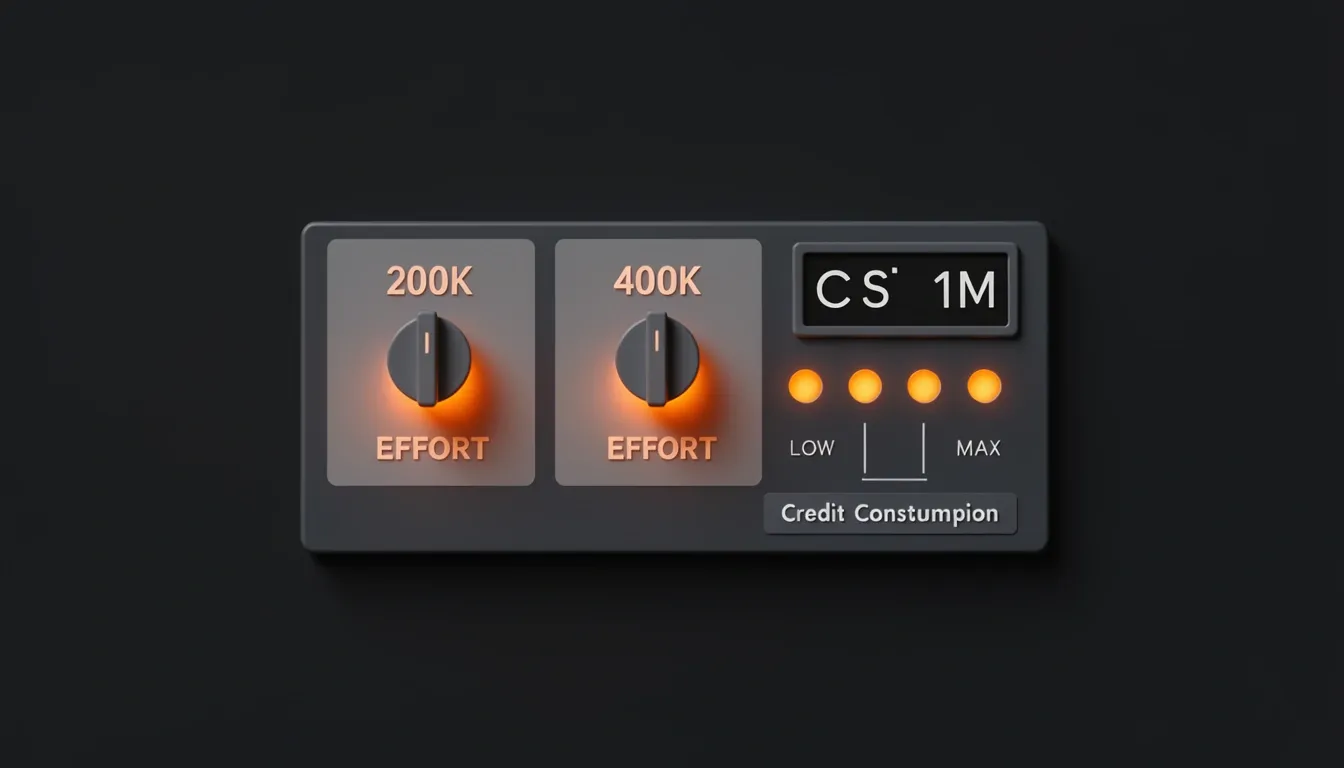
I configure Qoder's behavior through two precise levers: context window size and thinking effort depth. These are not generic quality sliders—they directly control how much of my codebase the model can ingest at once and how hard it works to reason about what it finds.
Context Window Tiers
Qoder exposes three distinct context configurations that I match strictly to task scope. The 200K standard window handles single-file edits, small-to-medium codebases, and routine queries without burning unnecessary resources. When I need to perform cross-file refactoring or discuss detailed architecture across medium-to-large projects, I switch to the 400K extended window. For extremely large-scale work—monorepo navigation, whole-system design, or extensive log analysis—the 1M maximum window becomes essential to avoid truncation.
Thinking Effort Levels
Beyond raw token capacity, I can dial reasoning depth across five effort levels. Low minimizes reasoning for the fastest responses, which I use for simple code generation, unit test scaffolding, or quick fixes. Medium strikes a balance for general development and feature implementation. I bump to High when I need thorough reasoning for bug root-cause analysis or critical design decisions. XHigh pushes into deep analysis territory for mathematical proofs and complex algorithm design. Finally, Max unleashes maximum reasoning depth for research-level problems and novel system architecture exploration.
Model-Specific Support Matrix
Not every backend exposes both parameters. The Ultimate and Performance tiers support the full 200K/400K/1M context range alongside all thinking effort levels from low through max. DeepSeek-V4-Pro, DeepSeek-V4-Flash, and GLM-5.1 also unlock the complete context spectrum and every thinking depth. Qwen3.6-Plus and MiniMax-M2.7 currently support 200K/400K/1M context only, with no thinking effort adjustment available for Qwen and planned support for MiniMax. Kimi-K2.6 is the outlier—its available context sizes and thinking capabilities vary by specific version, so I always verify the model card before planning a session.
Credit Cost and Resource Consumption
These knobs have real billing implications. Larger context windows increase credit consumption linearly with token count, but the relationship is steeper than it appears—because of quadratic attention complexity in transformers, a 1M context request can burn roughly 5x the credits of a 200K request for the same input size. Higher thinking effort also drives up costs through extended compute time and additional internal reasoning tokens.
The practical math is telling. When I run a large refactoring job on DeepSeek-V4-Pro at 400K context with high thinking, I pay approximately 1.5x baseline credits. A quick bug fix using DeepSeek-V4-Flash at 200K context and low thinking drops that cost to roughly 0.07x baseline credits. At the extreme end, an architecture review on the Ultimate tier at 1M context with max thinking effort consumes approximately 9.6x baseline credits.
I treat these parameters as part of my project's infrastructure budget. Matching the right model, context window, and thinking depth to the actual complexity of the task keeps my workflow both accurate and cost-predictable.
Intelligent Model Switching and Cost Control Best Practices
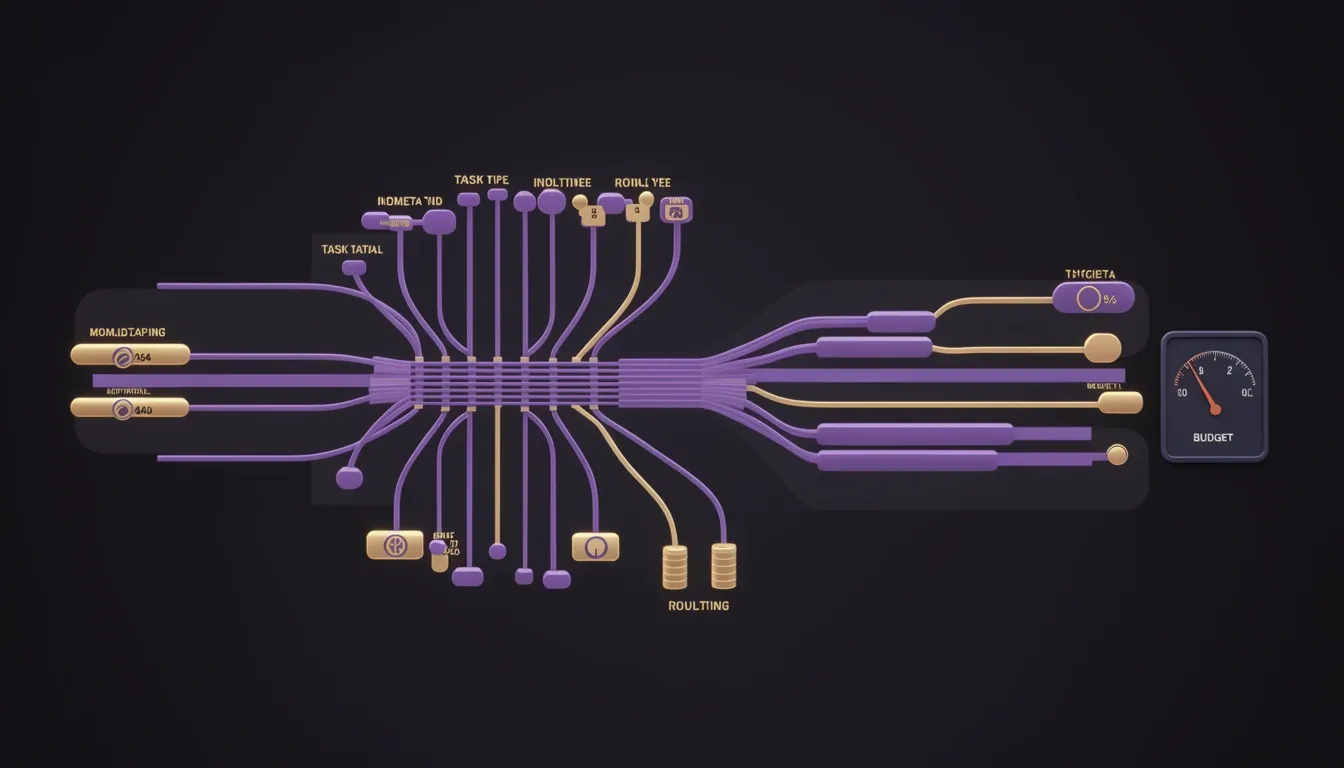
Qoder's programmable intelligent model switching is driven by JSON-based configuration files that automate policy-driven model selection within agentic workflows. Rather than hardcoding API calls or manually negotiating endpoints for every operation, I define declarative rules that bind specific task types to optimal models, while reserving a fallback model for any unspecified scenario. This creates a deterministic routing layer that sits between the agent's intent and the underlying inference providers, eliminating ad-hoc decision making at runtime.
In practice, the configuration starts with auto_switch set to true. I then map task types to models using a clear capability-to-cost hierarchy:
code_completion→ claude-3-haiku for low-latency, economical outputcode_review→ claude-3-5-sonnet for quality-critical scrutinyarchitecture_design→ gpt-4-turbo for complex structural reasoningdocumentation→ gemini-pro for long-form content generationquick_questions→ claude-3-haiku for rapid, lightweight responses
For anything falling outside these explicit mappings, the fallback_model defaults to claude-3-haiku. This means routine coding tasks and minor queries stay on the fastest, most economical tier, while quality-critical reviews and architectural planning automatically claim the heavier models they need without me micromanaging each request.
Budget Guardrails and Distribution Quotas
Cost control works through daily budget settings and percentage-based model distribution quotas, which I configure alongside the switching rules to enforce hard financial boundaries. These settings persist across sessions when applied via the GUI or CLI, so the policy remains active without repeated manual entry and can be standardized across an entire team.
For everyday development, I use a $10 daily budget with a distribution of 70% claude-3-haiku, 25% claude-3-5-sonnet, and 5% gpt-4-turbo. I pair this with auto_downgrade: true, which triggers automatic demotion to cheaper models as the spend approaches the daily ceiling. This prevents budget overruns while keeping the workflow alive. When the project demands higher fidelity, I switch to the high-quality profile: a $25 daily budget allocated as 50% claude-3-5-sonnet, 30% gpt-4-turbo, and 20% claude-3-haiku, with quality_priority: true. In this mode, Qoder favors higher-capacity models even when the budget nears its limit, preserving output quality at the expense of exhausting the quota rather than silently degrading results.
The net effect is a standardized, zero-touch governance layer. My team defines the policy once, and every agentic workflow inherits it. The system evaluates task type, checks the distribution quota, respects the daily budget, and selects the appropriate model without per-task manual intervention. This aligns agentic behavior directly with organizational budgets and quality objectives, optimizing the cost-quality trade-off dynamically rather than treating it as an afterthought.
Best Practices for Getting the Most Out of Qoder
I always treat context windows and compute budgets as finite resources, not unlimited taps. Qoder's configuration surface gives me precise levers to control cost, privacy, and model behavior, so I match the tool's architecture to the task at hand instead of blasting every request through the most expensive pipeline.
Isolate Sensitive Code from Embedding Pipelines
Qoder respects both .gitignore and .qoderignore, but the latter gives me an explicit kill-switch for secrets and proprietary algorithms. Even if Git tracks a file, adding it to .qoderignore guarantees that content is never processed or embedded. I use this to fence off credential stores, internal encryption schemes, and experimental algorithms that should never leave my local environment.
Calibrate Context Windows to Task Scope
Credit burn is real, so I map window size directly to scope. For routine single-file edits and quick fixes, I stick with the 200K context window, which consumes a 1.0x baseline credit rate. When I navigate cross-file refactors or medium-large codebases, I bump to 400K and accept the ~2.0x credit multiplier. I only unleash the 1M token window for monorepo-wide navigation and whole-system design sessions where the ~5x cost is justified by the sheer surface area I need to reason across.
Tune Thinking Effort Like a Knob, Not a Switch
Thinking effort is where I fine-tune compute versus output quality. For simple code generation, unit tests, and quick patches, I dial in low thinking effort at roughly 0.7x credit factor. General feature implementation runs at medium. I reserve high (~1.5x) for bug root-cause analysis and architectural design decisions. I only touch xhigh or max when I'm tackling mathematical proofs, complex algorithm design, or research-level problems where reasoning depth matters more than token economy.
Automate Model Routing with JSON-Based Switching
Manual model selection doesn't scale, so I configure Qoder's JSON-based auto_switch mappings to route tasks automatically. I always define a fallback_model to catch unspecified task types gracefully. My typical pipeline sends code_completion and quick_questions to economical tiers like DeepSeek-V4-Flash at roughly 0.1x baseline rate, routes code_review to mid-tier models, and pushes architecture_design to high-capacity endpoints. This keeps latency low where I don't need heavyweight reasoning.
Enforce Daily Budgets with Auto-Downgrade Logic
For everyday development, I set a $10 daily budget with a 70/25/5 model distribution and keep autodowngrade enabled. When I'm working on high-quality deliverables, I shift to $25 daily with a 50/30/20 split and flip on qualitypriority. These profiles persist across sessions via both GUI and CLI, so I don't reconfigure them every morning.
Trust Per-Developer Indexes for Branch-Local Context
Qoder maintains personal indexes per developer, ingesting my current Git branch, uncommitted changes, and local modifications in real time. If my teammate and I are on different branches of the same repository, we each receive contextually appropriate suggestions that reflect our actual working state. I switch branches aggressively because updates propagate fast: under 2 seconds for average codebases and under 5 seconds for monorepos.
Exploit the Client-Side Graph for Structural Navigation
For structural queries, I bypass the server entirely and lean on Qoder's client-side code graph. It delivers microsecond-level traversal for call-chain tracing, inheritance hierarchy navigation, and cross-language link discovery. Because the graph lives locally, it adds less than 10ms to query processing time with zero server round trips. When I need to understand how a method fans out across modules, this local graph is my first stop.