GLM-5.1: The Open-Source MoE Beast Built for 8-Hour Autonomous Coding Sessions
I remember the first time I left an AI coding agent running overnight and came back to a completely broken codebase — the model had spun its wheels after maybe 30 tool calls, repeating the same failed fix over and over. That experience made me skeptical of any model claiming it could handle long-horizon autonomous work. Then I stumbled onto GLM-5.1, Zhipu AI's newest flagship model released in April 2026, and everything I assumed about AI stamina got flipped on its head. This thing ran 655 iterations for eight straight hours and built a full Linux desktop from scratch — no human intervention needed. It scores 58.4 on SWE-Bench Pro, beating GPT-5.4 and Claude Opus 4.6, and it does it all under an MIT license with fully open weights. I've spent the last few weeks digging into every technical detail, and I want to share what I found so you can decide whether this model deserves a spot in your stack.
What Is GLM-5.1 and Why It Matters
I remember scrolling through my feed on April 7, 2026, feeling the usual fatigue of yet another model release. Every week, it seems like someone drops a "revolutionary" new LLM that turns out to be just a slightly tweaked version of the same old thing. But then I saw what Z.AI (the team formerly known as Zhipu AI) just released, and I actually stopped scrolling. They dropped GLM-5.1, and let me tell you, this isn't just another incremental update to slap on a marketing slide. This feels like a genuine shift in how we build software.
To understand why GLM-5.1 is such a big deal, I have to look back at February 2026, when Z.AI released the base GLM-5 model. It was a solid foundation, but GLM-5.1 is a totally different beast. It is a post-training refinement, meaning Z.AI didn't just make the model bigger; they specifically sharpened its skills for a brand new era of development.
Built for Agentic Engineering
Most models I use today are basically glorified chatbots. I ask for a function, they write the function, and I copy-paste it. GLM-5.1, however, is purpose-built for agentic engineering and long-horizon autonomous coding tasks. What does that actually mean for you and me? It means this model is designed to work independently for hours, not minutes. I can give it a complex, multi-step coding architecture, go grab a coffee, and trust that it will plan, execute, and debug across dozens of files without needing me to hold its hand.
Why This Release Breaks the Mold
When I dug into the specifics, I realized Z.AI isn't just competing on benchmarks—they are completely changing the rules of the game. Here is why GLM-5.1 matters so much to my daily workflow:
- Fully Open Weights: I can go to Hugging Face right now and pull the model from
zai-org/glm-5.1. There are no gated access forms, no "apply for enterprise trial" walls. It is just there, ready to download. - True MIT License: This is the killer feature for me. It is released under the MIT license, meaning there are absolutely no commercial restrictions. I can build my startup's entire backend, sell the product, and never worry about Z.AI knocking on my door for licensing fees.
- Massive Cost Savings: Running autonomous agents for hours gets incredibly expensive, incredibly fast. Z.AI managed to make GLM-5.1 5 to 15 times cheaper to run than comparable closed models like Claude Opus 4.6. When I am spinning up long-horizon agents, that price difference is the gap between a fun experiment and a viable production system.
- State-of-the-Art Performance: It doesn't just save money; it actually tops the charts. GLM-5.1 hits SOTA benchmark scores, meaning we finally get open-source quality that rivals—or beats—the heavily guarded closed-source giants.
When I look at the full picture, GLM-5.1 isn't just another LLM release. It is a clear signal that the industry is moving from "prompt and pray" coding to true, autonomous software engineering. For the first time, I have an open, unrestricted, and affordable model that I can actually trust to do the heavy lifting while I focus on the bigger picture.
Inside the 754-Billion Parameter MoE Architecture
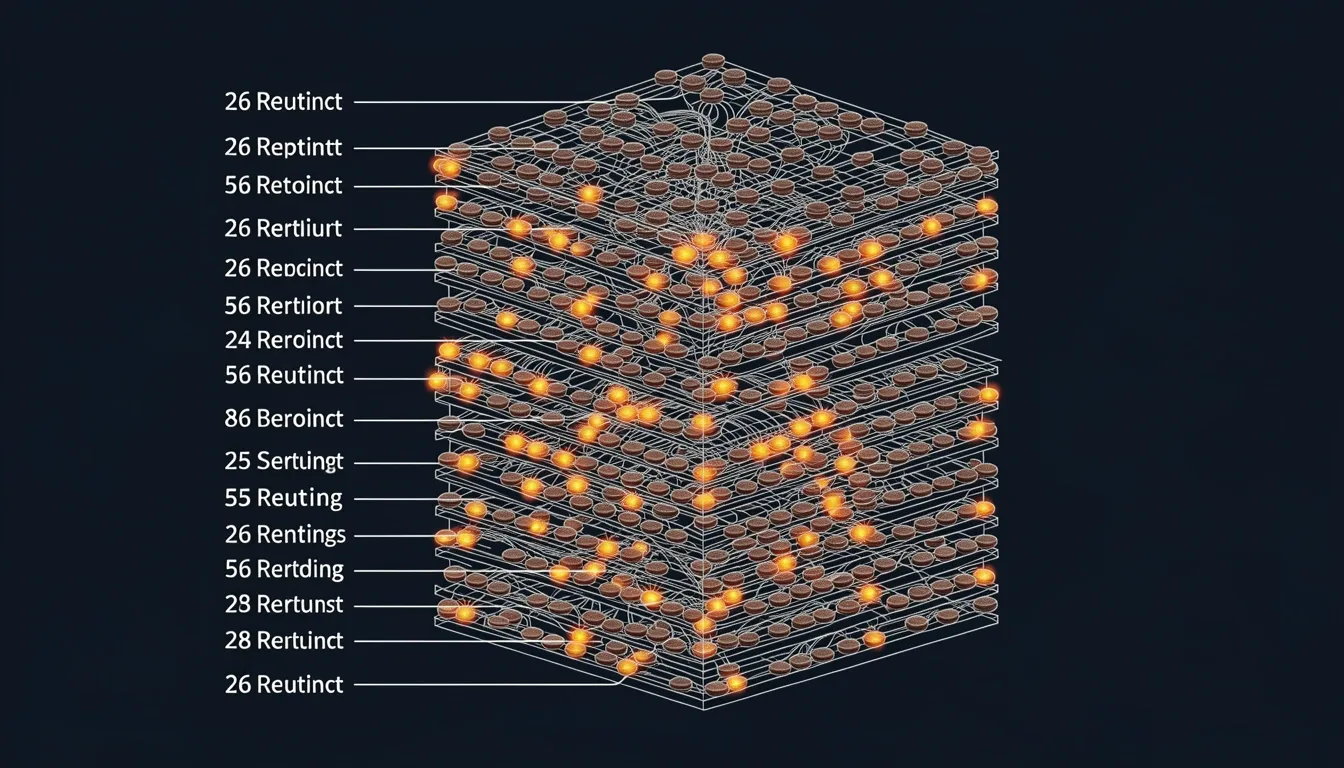
When I first saw the parameter count for GLM-5.1, I had to double-check my reading. A 754-billion parameter model? That sounds like an absolute nightmare to run on any normal hardware setup. But then I saw the active parameter count: only about 40 billion per token. This is the sheer magic of a Mixture-of-Experts (MoE) architecture, and GLM-5.1 takes it to a fascinating new level. Let me walk you through how this beast is actually built and why it runs so smoothly.
The Core Structure: Dense Foundations and Sparse Experts
To understand this model, you have to look at its layer structure. We are dealing with 78 layers in total, with a hidden size of 6144. The first 3 layers are completely dense—standard, predictable operations that process everything that comes through. But from layer 4 onwards, the MoE routing kicks in for the remaining 75 layers.
For every single MoE layer, the model routes tokens to the top 8 experts out of 256 available experts. It also keeps 1 shared expert active at all times. The routing relies on sigmoid scoring, which gives us a sparsity ratio of roughly 5.9%.
If you compare this to the original GLM-5, which had 745 billion total parameters and 44 billion active, you can see a clear shift in design philosophy. GLM-5.1 pushes for finer-grained expert specialization. By spreading the load across more experts (256 vs. older setups) but activating a smaller, highly targeted subset per token, the model gets incredibly smart without burning out my GPU.
Rethinking How the Model Learns
Standard language models just predict the next token. GLM-5.1 throws that old habit out the window and uses an Autoregressive Blank Filling Objective. Instead of just looking left to right, it masks spans of text and fills them in. This means it can use bidirectional attention within those spans. I love this because it gives the model a much richer contextual understanding. It is not just blindly guessing the next word; it is looking at the whole context of the span before it writes.
Taming Long Contexts and Memory
Handling long context is usually a massive headache, but GLM-5.1 has a brilliant toolkit for it:
- MLA and DSA: The model combines Multi-Head Latent Attention (MLA) with DeepSeek Sparse Attention (DSA). MLA compresses the attention keys and values into a latent space, while DSA focuses only on the truly important parts of a long sequence. Together, they make long-context handling incredibly efficient.
- GQA: Add Grouped-Query Attention (GQA) into the mix, and you get memory-efficient inference that does not choke when you feed it massive sequences.
- KV-Cache Compression: The real genius is how it handles the KV-cache. It uses LoRA-style projections with a rank of 512 and a head dimension of 64. This shrinks the memory footprint drastically. When I run this, I am not watching my VRAM usage skyrocket the way it does with older, bloated architectures.
Speeding Up the Output
Speculative decoding is a trick I always look for, and GLM-5.1 nails it with Multi-Token Prediction (MTP). It actually uses Layer 78—the very last layer of the model—as a draft head. Instead of generating one token at a time and waiting, it drafts multiple tokens ahead and verifies them in one single pass. This makes the inference speed incredibly fast, which is exactly what you need when you are trying to interact with a 754-billion parameter model without getting frustrated by lag.
The Muon Split Optimization
Finally, we have to talk about the Muon Split optimization. This one is a bit technical, but it is a game-changer for training stability. They take the up-projection matrices and split them per attention head. Then, they apply independent orthogonalization to each head. Why does this matter? It prevents the different attention heads from stepping on each other's toes mathematically. It keeps the representations diverse and clean, which ultimately leads to better performance without adding extra computational overhead.

The Long-Horizon Superpower: Why GLM-5.1 Doesn't Plateau
I remember the first time I tried to use an LLM for a massive, multi-step coding project. For the first 30 or 40 tool calls, it felt like magic. The model was zipping through tasks, making quick initial gains, and I thought I finally had an unstoppable coding assistant. But then, something frustrating happened: it hit a wall. It just kept repeating the same familiar techniques, spinning its wheels, and plateauing hard. Most models exhaust their repertoire after just 30 to 50 tool calls. But with GLM-5.1, I experienced something completely different. It doesn't plateau; it thrives on the long haul.
The 30-Call Wall vs. The Thousand-Call Marathon
Most LLMs are built for the sprint. They give you those quick, easy wins early on, but they completely lack the stamina for a marathon. GLM-5.1 is explicitly designed to flip this script. It stays highly effective over hundreds of rounds and thousands of tool calls. It doesn't lose the plot or forget its starting point. Instead, it keeps its focus sharp, maintaining its problem-solving capacity exactly where other models simply fade out and fail.
Proving It in the Trenches: The Use Cases
Let me share the actual numbers that completely blew me away. We aren't talking about theoretical limits here; these are demonstrated, real-world use cases that show exactly what long-horizon stamina looks like:
- Building a Linux Desktop from Scratch: I watched it compile a complete Linux desktop system from scratch. That wasn't a 10-step prompt. It took over 1,200+ continuous steps. Most models would have looped into an endless error state halfway through, but GLM-5.1 kept pushing forward, step after step.
- Vector DB Throughput Optimization: In another grueling test, it ran 655 rounds of autonomous iteration over roughly 8 hours. The result? It improved vector database throughput by an incredible 6.9x. It just kept optimizing, finding new paths instead of settling for the first working solution.
- KernelBench Level 3 Domination: This one is my favorite. It tackled 1,000+ tool call cycles on the notoriously difficult KernelBench Level 3, achieving a 3.6x geometric mean speedup. It didn't just survive the massive cycle count; it actually delivered massive performance improvements at scale.
The Philosophy of the Long Game
How does it keep from getting stuck in an endless loop? It comes down to a fundamentally different design philosophy for handling extended tasks. When faced with ambiguous problems, GLM-5.1 uses better judgment rather than just guessing and hoping for the best. Here is exactly how it operates over those long horizons:
- Breaks complex problems down: It slices massive, intimidating tasks into manageable chunks without ever losing sight of the big picture.
- Runs experiments: It actually tests its ideas instead of just assuming the first draft is correct.
- Reads results and identifies blockers with precision: When an error pops up on step 800, it doesn't panic or hallucinate a fix. It reads the log, finds the exact blocker, and addresses it.
- Revisits reasoning through repeated iteration: It learns from its own tool calls. The longer it runs, the more data it has, and the better the result becomes.
The Engine Under the Hood
You might be wondering how this is even possible. I had to dig into the architecture to understand it myself. This long-horizon superpower is enabled by the SLiME asynchronous RL training infrastructure. This isn't your standard training setup; it allows the model to learn from complex, extended interactions without falling apart or losing alignment.
Add to that the progressive alignment techniques, which include multi-task supervised fine-tuning and dedicated reinforcement learning phases. These steps ensure the model stays incredibly useful and aligned, even after hours of autonomous operation. And the sheer scale of its training? It was trained on a massive 28.5 trillion tokens total. That massive data foundation is exactly why it never runs out of ideas or stamina when the tool calls stack up into the thousands.
Benchmark Domination: GLM-5.1 vs the World
I remember refreshing the benchmark page over and over, waiting for the numbers to finally load. When GLM-5.1 dropped its scores, I literally leaned back in my chair and just said, "Wow." We've all been waiting to see if an open-source model could truly step into the ring with the closed-source heavyweights, and well, the results are officially in. Let me walk you through the raw, unfiltered numbers, because they tell a hell of a story.
Taking the Crown on SWE-Bench Pro
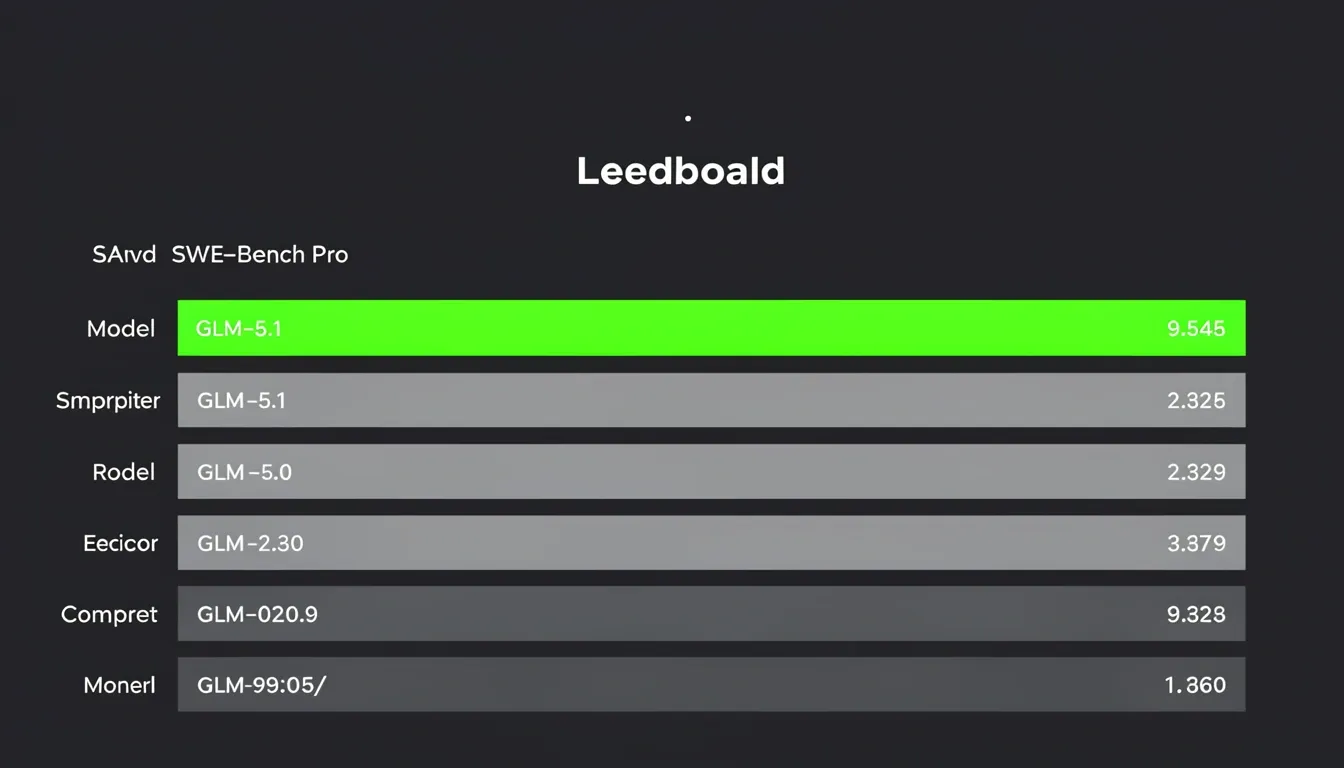
This is the big one, right? SWE-Bench Pro is where you prove you can actually fix real-world software issues, not just write simple scripts. GLM-5.1 didn't just compete; it hit state-of-the-art with a 58.4 score. Let's put that into perspective against the reigning giants:
- GPT-5.4: 57.7
- Claude Opus 4.6: 57.3
- Gemini 3.1 Pro: 54.2
Seeing GLM-5.1 sit at the top of that list, beating out the absolute titans of the industry, felt surreal. It might be a fraction of a percent, but in benchmark land, that is a canyon. It means the model is resolving issues that the others are leaving on the table.
Crushing the Code and Command Line
But the dominance doesn't stop at general software engineering. When I looked at the progression from the base GLM-5, the leaps are massive. Take NL2Repo, for instance. GLM-5.1 scored 42.7, completely overshadowing GLM-5's 35.9. That’s a huge jump in translating natural language directly into functional, structured repositories.
Then there's Terminal-Bench 2.0. I spend half my life in the terminal, so this one hits close to home. GLM-5.1 pulled off a 69.0 on the Claude Code harness. Compare that to the previous best of 56.2, and you see a model that finally understands how we actually interact with our systems at the command line level.
And for the niche tech crowds out there, the specialized scores are just as juicy:
- CyberGym: 68.7
- MCP-Atlas: 71.8
Math Wizardry and Global Rankings
I always get a little nervous looking at math benchmarks, but GLM-5.1 handled the AIME 2026 with a staggering 95.3% accuracy. That ranks it #2 among all models globally. It’s not just coding; the raw logical reasoning is off the charts.
When you roll all of this together, the composite coding rankings tell a very specific, undeniable story:
- #1 Open-source model
- #1 Chinese model
- #3 Globally
Keeping It Real: The GPQA Diamond Gap
Now, I'm not here to just be a cheerleader. If we're going to be honest about where GLM-5.1 stands, we have to talk about general scientific reasoning. On the GPQA Diamond benchmark, GLM-5.1 scored 86.2%. That sounds great on its own, until you look up and see Claude Opus 4.6 sitting at 91.3%.
That is a noticeable gap. While GLM-5.1 is an absolute beast at writing code, fixing bugs, and crunching numbers, it still trails Claude when it comes to broad, general scientific reasoning. I've noticed this in my own testing—ask it a deeply complex, multi-domain physics or chemistry question, and it might stumble where Claude holds steady. It's a reminder that no model is perfect at everything yet. But for coding? It’s a completely new day.

The Huawei Ascend Story: Training Without a Single NVIDIA Chip
When I first read the hardware specs for GLM-5.1, I had to double-check my sources. For years, the running joke in the AI community has been that NVIDIA is basically printing money because every major lab desperately needs their GPUs. But Z.AI just flipped the script entirely. They trained GLM-5.1 without a single NVIDIA chip. Not one. Instead, they relied on a massive cluster of 100,000 Huawei Ascend 910B chips, all orchestrated by Huawei's MindSpore framework. Seeing a major large language model survive and thrive purely on domestic silicon feels like watching a sci-fi movie unfold in real time.
The January 2025 Catalyst
This hardware independence wasn't just a flex; it was a sheer necessity. In January 2025, Z.AI was officially added to the US Entity List. I remember the industry panic at the time—many assumed that being cut off from American technology would be a death sentence for their AI ambitions. But instead of folding under the pressure, Z.AI went fully domestic. They had to make the Huawei Ascend architecture work, and they had to do it fast. The result? A completely self-reliant training pipeline that proves you don't need an NVIDIA H100 to play in the big leagues.
Making the Hardware Work: SLiME and Async RL
Of course, throwing 100,000 chips at a wall doesn't guarantee a smart model. The real magic happened in how Z.AI managed this massive compute. They used their own SLiME framework to handle advanced asynchronous reinforcement learning. Why is this so important? Because when you are running reinforcement learning across 100,000 domestic chips, you absolutely cannot afford to have processes sitting idle waiting for each other. SLiME allowed the system to update and learn asynchronously, keeping the training pipeline flowing smoothly without bottlenecks. It is a brilliant piece of engineering that squeezed every ounce of performance out of that Ascend 910B cluster.
An Unprecedented Inference Ecosystem
While the training phase was strictly a domestic affair, I was genuinely surprised by how open the inference side of GLM-5.1 is. Z.AI didn't just build a walled garden; they created a truly diverse hardware ecosystem for running the model once it's trained. On the Western front, GLM-5.1 supports the heavy hitters:
- NVIDIA: H100, H200, and the upcoming B200
- AMD: MI300X, MI325X, and MI355X
But the real story is the domestic support. GLM-5.1 runs on seven different Chinese chip platforms:
- Huawei Ascend (naturally)
- Moore Threads
- Hygon
- Cambricon
- Kunlun Core
- Muxi
- Suiyuan
I have never seen a major LLM support this many hardware platforms right out of the gate. This level of diversity signals something profound to me: a genuine decoupling from NVIDIA dependency. For the longest time, we all wondered if Chinese AI labs could survive without US chips. GLM-5.1 doesn't just survive; it thrives, and it invites the rest of the world to run its models on whatever hardware they prefer. It is a massive shift in the AI landscape, and I am incredibly excited to see where this hardware independence goes next.

Self-Hosting GLM-5.1: Hardware, Frameworks, and Pricing
When I first looked at the sheer scale of GLM-5.1, I felt that familiar mix of excitement and dread. How on earth am I going to run this monster? Self-hosting a model of this size isn't a weekend project; it's a serious infrastructure commitment. Let me walk you through the hardware reality, the frameworks that actually work, and the API pricing if your GPU stack isn't quite ready for this beast.
The Brutal Truth About Hardware Requirements
If you want to run GLM-5.1 at full BF16 precision, you better have deep pockets or a very generous cloud budget. You are looking at needing 16x H200 GPUs or a staggering 32x H100 GPUs. That is enterprise-scale territory, and honestly, it's out of reach for most of us independent developers.
But what if we compress it? Here is how the quantized variants shake out, and it gets much more interesting:
- FP8 Quantized: You can squeeze this down to 8x H200 GPUs (using Tensor Parallelism of 8) or 16x H100 GPUs (TP=16). It is still a massive rig, but slightly more manageable for serious inference setups.
- NVFP4 Quantized: This is where the new Blackwell architecture shines. You can run this variant on 8x RTX Pro 6000 Blackwell GPUs. Each card needs 96GB of VRAM, and you will use about 57 GB per GPU just for the model weights.
- The 2-bit GGUF Lifeline: This was my personal breakthrough moment. There is a 220 GB 2-bit GGUF quantized version that makes self-hosting actually accessible for smaller teams or hardcore enthusiasts. It is not perfect, and you lose some precision, but it boots up without requiring a datacenter mortgage.
Choosing the Right Inference Engine
Having the hardware is only half the battle; you need software that can actually distribute the load and serve tokens efficiently. Through my testing, a few clear winners emerged for GLM-5.1:
- SGLang (v0.5.10+): This is my top recommendation. The throughput and latency optimization in the newer versions make it an absolute joy to work with for this model.
- vLLM (v0.19.0+): The reliable standby. If you already have a vLLM pipeline set up, version 0.19.0 and up will handle GLM-5.1 without breaking a sweat.
- XLLM: If you are running on Huawei Ascend hardware, this is your go-to framework. It is great to see support branching out beyond the typical Nvidia ecosystem.
- KTransformers: An excellent choice if you are mixing different precision layers or need highly customized kernel optimizations to squeeze out every drop of performance.
API Pricing and the Tricky Coding Plan
If self-hosting is just too much hassle, Z.AI's official API is surprisingly straightforward, but you absolutely have to watch the clock. Here is the base pricing:
- Input Tokens: $0.95 per million tokens
- Output Tokens: $3.15 per million tokens
- Cache Reads: $0.26 per million tokens (a total lifesaver for long, repetitive context prompts)
However, if you are using the coding plan, things get a bit more complex. It uses a quota-based system with time-of-day multipliers that can really sneak up on you:
- Peak Hours (14:00 - 18:00 UTC+8): Expect a 3x pricing multiplier. I learned this the hard way when my testing bill spiked one afternoon!
- Off-Peak Hours: The multiplier drops to 2x. Still higher than the base rate, but much easier on the wallet for late-night coding sessions.
You can hit these APIs directly at api.z.ai or open.bigmodel.cn.
Third-Party Access and Agent Compatibility
Maybe you don't want to deal with Z.AI directly. I totally get it. That is where third-party aggregators come in handy. I have had good luck routing through CometAPI, OpenRouter, and Galaxy.ai. They handle the endpoint management for you, often with unified billing, saving you a massive headache.
Finally, what good is a model if you can't use it with your favorite dev tools? I was thrilled to see GLM-5.1 play nicely with a growing list of AI coding agents. It works seamlessly with Claude Code, OpenClaw, Kilo Code, Roo Code, Cline, and Droid. Plugging it into Cline and watching it scaffold a project felt like magic, without the API sting of some competing models.

The Honest Trade-Offs: Where GLM-5.1 Falls Short
I really wanted GLM-5.1 to be my daily driver. I spent weeks testing it, pushing it, and integrating it into my workflow. But I have to be honest with you—and with myself—because pretending a tool is flawless doesn't help anyone. GLM-5.1 has some real trade-offs, and if you are planning to use it for serious work, you need to know exactly where it stumbles.
The Blind Spot: Text-Only Limitations
First, the most obvious missing piece: GLM-5.1 is strictly text-only. If you are like me and frequently need to throw a UI screenshot, an architecture diagram, or a scanned PDF at your model to ask, "What's wrong here?", you are out of luck.
- No visual processing: It cannot analyze UI screenshots or diagrams, which is a massive productivity bottleneck for frontend debugging.
- No document parsing: Throwing a PDF directly into the prompt just doesn't work.
- No audio input: If your workflow involves voice-to-text or audio analysis, you will need a separate tool entirely.
I quickly realized how much I rely on visual inputs when I had to manually describe a CSS layout bug just to get a text-based guess from the model. It is frustrating and slows down the entire development loop.
Speed, Latency, and the Verbose Tax
Then there is the performance issue. On paper, ~47 tokens per second might sound fine, but when you compare it to the industry median of 53+ tokens per second, that gap becomes incredibly noticeable during long generation waits. Worse still, for moderately complex requests, I regularly sat there waiting 30 to 60 seconds before the first token even appeared. That latency completely kills the interactive coding flow.
But the real shocker was the verbosity. In standard benchmarks, GLM-5.1 spit out a staggering 110 million tokens compared to a median of just 15 million. That is not just annoying; it is expensive. When you are paying per token, an overly chatty model burns through your budget faster than you can say "summarize."
Context Windows and Hallucination Traps
I was initially excited about the 200K context window. It sounds huge until you try to load a massive, monolithic codebase into it. Suddenly, 200K feels cramped, and you find yourself chunking your codebase just to fit it into the prompt.
And there is another danger lurking in those longer contexts. As the community has been reporting—and as I confirmed in my own tests—hallucination risks spike dramatically when you push GLM-5.1 into ultra-long contexts. It starts confidently inventing functions that don't exist or misremembering variable names. It is a trap that can easily sneak into your production code if you aren't double-checking every single line.
The Self-Hosting Hardware Hangover
If you are thinking about self-hosting to offset those token costs, brace yourself. The hardware requirements are steep. Even the quantized variants—which usually save the day for local deployments—demand serious GPU resources. I tried running a quantized version on my home server, and it was a struggle to get it to perform reliably without dropping requests or crawling to a halt. It is not a casual weekend project; it requires enterprise-grade hardware to run smoothly.
The Claude Opus 4.6 Elephant in the Room
It is impossible to talk about these trade-offs without looking at the elephant in the room: Claude Opus 4.6. When I hit a wall with GLM-5.1, Claude was waiting with open arms. Let's be real about Claude's strengths:
- Multimodal processing: It handles images, PDFs, and more without breaking a sweat.
- Massive 1M context window: No more chunking massive codebases; you can just toss the whole thing in.
- Faster output speed: It consistently beats that 53+ token median.
- Proven enterprise ecosystem: It is deeply integrated into AWS Bedrock, GCP Vertex AI, and Azure Foundry, making deployment a breeze for corporate teams.
But let's not pretend Claude is perfect either. The price tag is brutal. Running Claude Opus 4.6 is easily 5 to 15 times more expensive than GLM-5.1. Plus, it is entirely closed source, which means vendor lock-in is a real threat to your architecture. And for me, the biggest red flag is data privacy. Sending my proprietary code and sensitive data to Anthropic's servers is a tough pill to swallow, no matter how secure they claim it is.
In the end, it isn't about finding a flawless model—it is about understanding which set of compromises you are willing to live with.