Paperclip AI Review: The Control Plane That Tames Autonomous Agent Chaos
I used to think the biggest risk with autonomous AI agents was that they'd go rogue and do something catastrophic — turns out, the real danger is far more mundane: they burn through your budget, drift off-task, and duplicate work without anyone noticing. That's exactly the problem Paperclip AI was built to solve, and after digging deep into its architecture, I'm genuinely impressed by how ruthlessly it focuses on governance over hype. Most agent frameworks promise you a self-driving company; Paperclip promises you a board of directors for one, and that distinction matters more than you'd expect. It's an open-source, self-hosted control plane — not an execution plane — that orchestrates agents through heartbeat-driven execution, hierarchical goal ancestry, and per-agent budget enforcement. If you've ever watched an autonomous agent spiral into an expensive, misaligned mess, you'll understand why this approach caught my attention.
What Paperclip AI Actually Is (And Isn't)
When examining the Paperclip codebase, what strikes me immediately is the discipline in its scope. This isn't another monolithic AI framework trying to own the entire stack. It's an open-source Node.js server—written in TypeScript at 97.6% of the codebase—with a React frontend, and it has one job: act as the control plane for autonomous AI companies. One Paperclip instance can host multiple companies simultaneously, with strict data isolation between them. That tells me the authors are thinking about multi-tenancy at the architectural foundation, not bolting it on later.
The Five Principles That Define It
The system rests on five non-negotiable design choices:
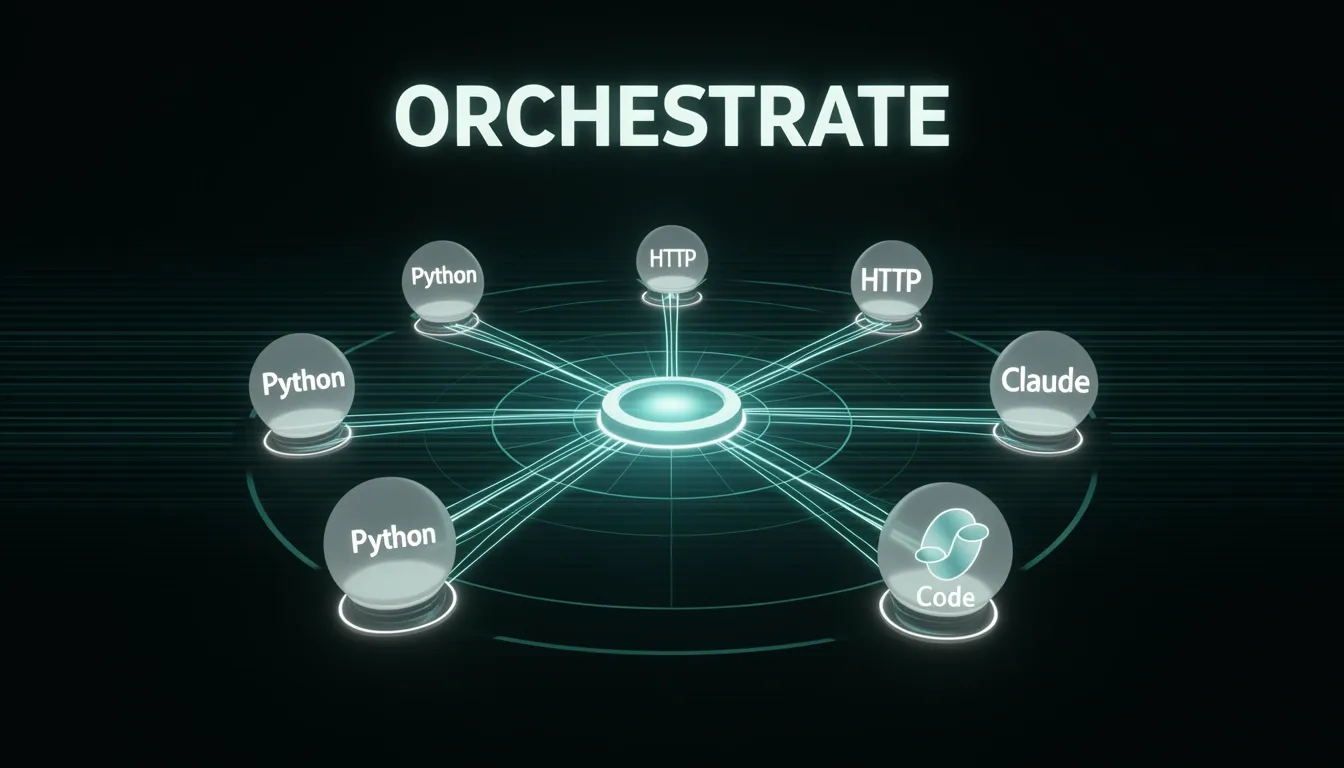
- Unopinionated about agent runtimes. I could plug in an OpenClaw bot, a Python script, a Claude Code session, or even a generic HTTP endpoint, and Paperclip wouldn't care.
- Company is the unit of organization. Not the user, not the project, but the company itself.
- Adapter config defines the agent. The integration contract is declarative rather than baked into the core.
- Hierarchical task parentage. Every task traces back to the company goal; nothing floats in space without lineage.
- Control plane, not execution plane. It orchestrates heartbeats, tasks, budgets, and governance, but agents run wherever they want and simply "phone home" via the REST API.
Tech Stack and Onboarding
Under the hood, Paperclip runs on Node.js 20+ with an Express backend and a React + Vite frontend. For persistence, it uses PostgreSQL. By default, it spins up an embedded PGlite instance at ~/.paperclip/instances/default/db, though you can override this with an external database via the DATABASE_URL environment variable. The requirements are minimal: Node.js 20+ and pnpm 9.15+. Installation is a single command—npx paperclipai onboard --yes—which launches the API server at http://localhost:3100 and automatically provisions that embedded PostgreSQL database. I appreciate that there is no manual schema migration dance just to kick the tires.
One API, Two Auth Levels
The server exposes a single unified REST API under /api. There is no fragmented "agent API" versus "board API." Instead, access is scoped by credentials: board authentication carries full access, while agent API keys receive scoped permissions. As of the V1 implementation spec dated 2026-04-28, the baseline already shipped REST CRUD endpoints for agents, projects, goals, issues, and activity. The V1 contract extends this into a governance-aware control plane, which means the API isn't just CRUD anymore—it's enforcing policy and lineage.
What It Refuses to Be
I think the most important thing to understand about Paperclip is what it deliberately leaves out. It does not run your agents. It does not provision GPUs, manage Python environments, or sandbox your code. It tracks the work, governs the boundaries, and maintains the audit trail, but the execution happens in the agent's native runtime. That separation is what makes the architecture clean, and it's also why calling it an "agent framework" would be misleading. It's infrastructure for autonomous companies, not a replacement for the agents themselves.
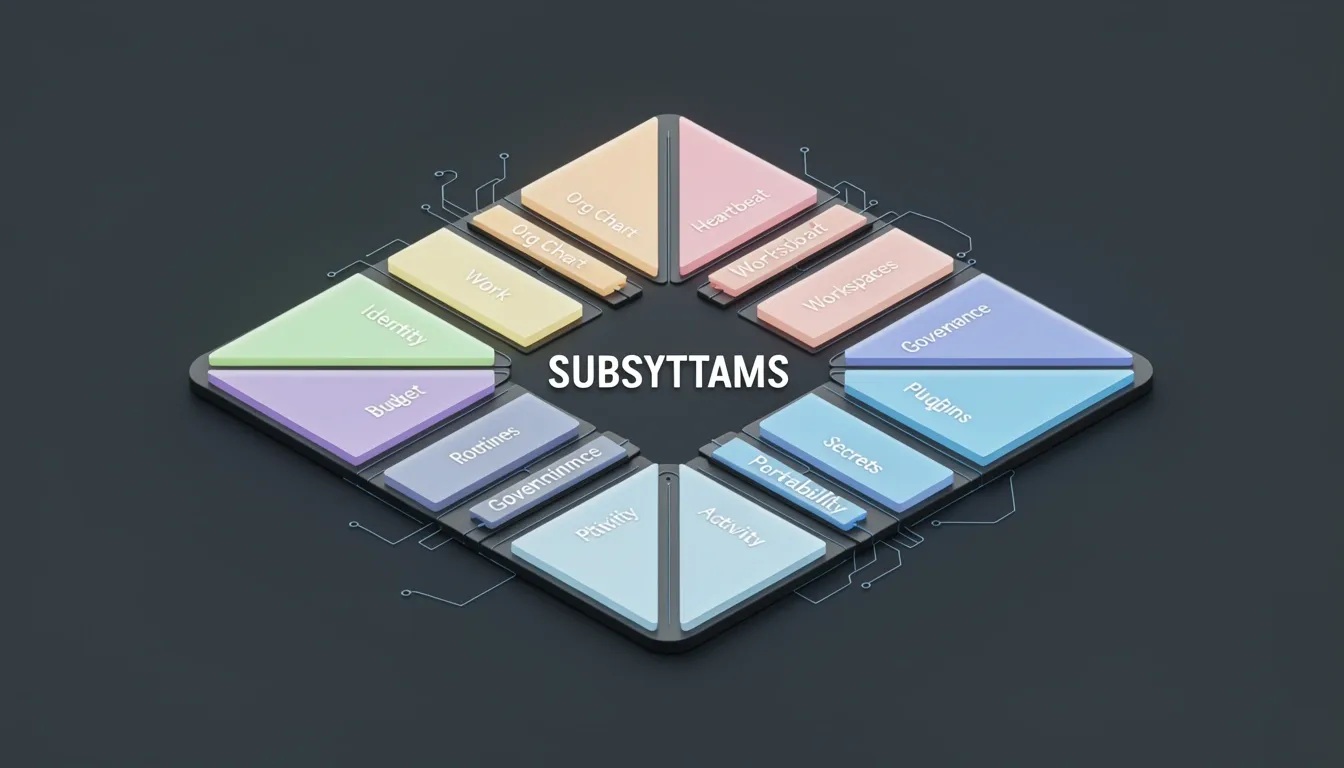
The 12-Subsystem Architecture Deep Dive
When I look at Paperclip's server architecture, I see a control plane built for production failures, not just prototypes. The platform breaks down into 12 core subsystems, and each one addresses a specific operational risk that usually destroys autonomous agent deployments.
Identity, Org Chart, and Agent Roles
The first two layers establish that agents are employees, not endpoints. Identity & Access manages session-based authentication alongside scoped API keys. Then Org Chart & Agents assigns each agent a concrete role—CEO, CTO, or engineer—a title, reporting lines, permissions, and budgets. What stands out to me is that delegation flows up and down this org chart automatically. An engineer agent can escalate a blocked task to its manager without a human looping in, which avoids the flat-swarm chaos you get when every agent has the same priority.
Task Hierarchy and Execution Safety
Work & Tasks enforces a strict parentage chain: every task must trace back to the company goal. The data model is surprisingly rigorous:
- Stable identifiers with parent and sub-issues, plus blockers and single assignee rules.
- Collaboration artifacts: comments, issue documents, attachments, work products, and labels.
- Review/approval handoffs between agents.
- Atomic checkout with execution locks, which prevents double-work by ensuring only one run can claim a task at a time.
I find that last point particularly smart because race conditions on shared tasks are one of the first things that break multi-agent systems.
The Heartbeat and Runtime Stack
Heartbeat Execution drives actual work through a DB-backed wakeup queue that supports coalescing. Before any adapter fires, the pipeline runs:
- Budget checks and workspace resolution.
- Secret injection and skill loading.
- Adapter invocation with structured output.
Each run generates structured logs, cost events, session state, and audit trails. If a run gets orphaned, recovery handles it automatically. Supporting this, Workspaces & Runtime manages execution environments and adapter configurations. Routines & Schedules overlays routine-scoped environment variables after project env but before Paperclip's runtime-owned keys. Plugins keep the stack extensible by supporting external adapter plugins.
Governance, Budgets, and Cost Controls
Governance & Approvals implements a board-of-directors model where humans approve critical decisions by default. Agent hiring, strategy changes, and org structure modifications all require board sign-off. Execution policies include review/approval stages, decision tracking, and full audit logging. This connects tightly to Budget & Costs, which assigns each agent a monthly budget in cents. For example, budgetMonthlyCents: 5000 triggers a soft warning at 80% utilization and auto-pauses the agent while blocking new tasks at 100%. The board can override limits, but cost tracking surfaces token budgets and throttles agents automatically. To me, this is the difference between a demo and production-grade infrastructure.
Security, Observability, and Multi-Tenancy
Secrets & Storage manages company-scoped secrets with runtime injection. Sensitive values stay out of prompts unless a scoped run explicitly needs them, which reduces leakage risk. Activity & Events provides structured logging and event tracking across all operations. Finally, Company Portability allows a single deployment to run unlimited companies with complete data isolation, so the architecture scales horizontally without rewrites.

Goal-Aware Execution: Why Context Ancestry Matters
I see the Alignment Problem as the single biggest reason autonomous agents fail in production. When an agent only receives a task title like "Write WebSocket handler for document updates," it has no anchor. It can produce technically correct code that never moves the business forward, optimizing locally while missing global objectives entirely. Paperclip's Goal-Aware Execution fixes this by attaching full goal ancestry to every task, so the agent sees the why behind the request, not just the instruction.
How Goal Ancestry Flows Through the System
The mechanism is architecturally rigorous. During each heartbeat invocation, context travels upward from the specific task through the project layer and finally to company-level goals. The Paperclip SKILL.md trains agents to query this chain explicitly using GET /api/goals/:goalId?includeAncestors=true during their execution cycles.
When I look at the example chain, the value becomes obvious:
- Task-level: Write WebSocket handler for document updates
- Project-level: Implement real-time sync
- Product-level: Ship collaboration features
- Company-level: Make $2mm ARR with the #1 AI note-taking app
This persistent hierarchy lives in the execution context. It does not disappear after the first prompt. The agent can reference it across multiple heartbeats, which directly reduces decision-making variance over time and prevents agents from completing tasks without knowing their real importance.
What Changes in Agent Behavior
With the full chain visible, agents stop optimizing in isolation. I notice four specific behavioral shifts that directly address the failure modes documented in the framework:
- Prioritization by strategic weight. Instead of relying on arbitrary urgency flags, agents compare competing tasks by their relative contribution to higher-level goals. A bug fix that threatens the ARR target naturally outranks a cosmetic refactor that sits at the bottom of the ancestry chain.
- Smarter execution tradeoffs. Because the agent understands tactical intent, it can choose a faster implementation that satisfies the immediate goal rather than over-engineering a perfect solution that misses the shipping window. It knows when to stop.
- Active misalignment rejection. Agents can reject or escalate work that does not serve the visible goal chain. This prevents the classic drift where locally optimal work—like a beautifully abstracted module nobody asked for—wastes resources on misaligned activities.
- Auditable reasoning. Task comments and audit logs gain substance because agents cite strategic value. You do not just see what happened; you see the explicit goal ancestry that justified the approach.
The Manual Context Problem
The GitHub README draws a sharp contrast that matches my own observations about agent orchestration. Without Paperclip, you manually gather context from several places just to remind your bot what you are actually doing. With Paperclip, context flows automatically from the task up through project and company goals. The agent always knows what to do and why.
That difference is structural. Persistent hierarchical context prevents agents from drifting into locally optimal but globally useless work. Each heartbeat reinforces the strategic thread, keeping execution aligned with business outcomes rather than isolated ticket descriptions. When agents fail to prioritize competing work, it is usually because they lack this exact lineage. Paperclip surfaces it by design.

Heartbeat-Driven Execution Model Explained
Paperclip treats the heartbeat as a control protocol rather than a continuous runtime. I see this as a deliberate architectural choice: the platform decides when an agent wakes up, but the agent retains full autonomy over what it does during that cycle. Agents surface on scheduled intervals, task assignments, on-demand pings, or automation triggers, then return to dormancy. This pull-based rhythm prevents the resource drain of persistent processes while keeping the system responsive.
Adapter Interface and Built-in Runtimes
Every adapter must implement a strict three-method contract. The invoke(agentConfig, context?) method kicks off the cycle, status(agentConfig) polls for liveness, and cancel(agentConfig) issues a graceful stop signal. This interface keeps Paperclip agnostic about the underlying runtime. The built-in roster covers most deployment scenarios: process for child-process spawning, http for outbound webhooks, and a suite of local AI IDE adapters including claude_local, codex_local, gemini_local, opencode_local, pi_local, and cursor, plus the openclaw_gateway bridge.
The process adapter exposes granular operational controls. Its configuration accepts command, args, cwd, env, timeoutSec, and graceSec. I notice the defaults are practical: 900 seconds for execution timeout and 15 seconds for graceful shutdown. When cancellation fires, Paperclip sends SIGTERM first, then escalates to SIGKILL once the grace period expires. The http adapter follows a similar philosophy but speaks REST. It expects url, method, headers, timeoutMs (defaulting to 15000 ms), and a payloadTemplate that supports Mustache-style variable substitution such as {{agent.id}}. This lets external webhooks receive templated context without hardcoding agent state into URLs.
Scheduling Logic and Context Delivery
Context delivery is not one-size-fits-all. Paperclip offers two configurable modes per agent. A thin ping transmits only IDs and pointers, forcing sophisticated stateful agents to pull their own context via API. A fat payload bundles the current assignments, goal summary, budget snapshot, and recent comments, which suits simple or stateless agents that lack caching infrastructure. I find this flexibility important because it prevents over-the-wire bloat when the agent already maintains its own state machine.
The scheduler enforces guardrails through fields nested inside adapter_config: enabled (boolean), intervalSec (integer with a 30-second floor), and maxConcurrentRuns (default 20, clamped to a 1–50 range). Before waking an agent, the scheduler checks three hard stop conditions: the agent is paused or terminated, a run is already active, or the hard budget limit has been exhausted. If the agent is already executing when a new heartbeat arrives, Paperclip coalesces the wakeup rather than spawning duplicate runs.
Session continuity is where the model gets interesting. For resumable adapters, Paperclip persists session IDs across heartbeats. The next scheduled wake-up automatically reuses the saved session, so the agent picks up mid-stream instead of cold-starting. Agents retain the ability to reset sessions when their context grows stale, which acts as a manual circuit breaker against drift.
There is also an optional modelProfiles.cheap lane, but it comes with heavy restrictions. It is limited to status-only recovery coordination, and guard context explicitly blocks deliverable work: allowDeliverableWork: false, allowDocumentUpdates: false, and resumeRequiresNormalModel: true. If a source-work retry, process-loss retry, or continuation is needed, Paperclip forces the task back onto the normal or original model lane. To me, this creates a clear economic boundary: cheap models can check pulse, but they cannot perform surgery.
Governance, Budgets, and Approval Gates
When I look at how Paperclip handles autonomous agents at scale, the board-of-directors governance model stands out as the central nervous system. Rather than letting agents run unchecked, the platform forces human oversight into critical paths while automating the guardrails that prevent runaway costs.
Budget Control and Cost Throttling
The budget mechanism operates with surgical precision. Each agent carries a per-agent monthly budget defined in cents—for example, budgetMonthlyCents: 5000—which might look pedantic until you realize it prevents the rounding errors and oversights that dollar-level budgets hide. I noticed that the system triggers a soft warning at 80% utilization, giving operators a heads-up before the hard stop. At 100% utilization, the agent auto-pauses and blocks new tasks entirely. The board retains override authority, but the default behavior is automatic throttling based on surfaced token budgets. This isn't just a billing alarm; cost tracking is wired directly into execution logic, so agents throttle themselves without waiting for human intervention.
Approval Gates and Audit Trails
Paperclip treats certain decisions as board-level by default. Agent hiring, strategy changes, and org structure modifications all require explicit human sign-off. The platform enforces this through execution policies built with review and approval stages, decision tracking, and full audit logging. When I trace a decision through the system, every approval or rejection leaves a forensic trail. This means compliance isn't an afterthought bolted onto logs; it's the structural backbone of how work moves forward.
Hierarchical Task Management
Every task must justify its existence by tracing back to the company goal through a strict parentage chain. The issue model is dense with structural safeguards: stable identifiers, parent/sub-issues, blockers, single assignee enforcement, comments, issue documents, attachments, work products, labels, and review/approval handoffs. I find the atomic checkout with execution locks particularly important—this prevents two agents from picking up the same work item simultaneously, eliminating double-work in a distributed system where race conditions are inevitable.
Org Chart and Delegation Flows
Agents don't just execute; they occupy roles. Paperclip assigns them titles like CEO, CTO, or engineer, complete with reporting lines, permissions, and budgets. Delegation isn't manual. Instead, work flows up and down the org chart automatically based on role definitions and availability. This mirrors how real companies function, but without the Slack messages and status meetings.
Heartbeats and Run Recovery
Under the hood, a DB-backed wakeup queue drives agent activity with coalescing logic to prevent stampede effects. Before an agent wakes, the system runs budget checks, workspace resolution, secret injection, skill loading, and adapter invocation. Each run generates structured logs, cost events, session state, and audit trails. I appreciate that orphaned runs recover automatically—if a process dies mid-execution, the platform cleans it up rather than leaving zombie tasks burning cycles.
Multi-Company Isolation and Environment Precedence
One deployment can host unlimited companies with complete data isolation, which makes parallel venture testing or strict environment separation practical. Environment resolution follows a rigid hierarchy: Project env merges into the run environment for issues in that project, overriding conflicting agent env keys before Paperclip injects its own runtime-owned keys. For routine execution, a routine-scoped env overlay applies after project env but before runtime keys. Routine env values use the same secret-aware binding format, stored on routines.env and snapshotted in routine revisions. Secrets resolve against the routine binding target, so routine-owned secrets don't need direct bindings on the executing agent. Sensitive values inject at runtime and stay out of prompts unless a scoped run explicitly requests them.

Cost Tracking and Cross-Team Attribution
Granular Attribution from Agent to Organization
When I examine Paperclip's cost architecture, the first thing that impresses me is the granularity. Fully-instrumented agents report both token and API usage back to the control plane, which then organizes spending into four distinct attribution levels:
- Per Agent: Individual employee accountability for personal agent spend.
- Per Task: Specific units of work that can be traced to a single request.
- Per Project: Collections of related tasks rolled up into team initiatives.
- Per Company: Total organizational burn rate across all agents and projects.
This tiered structure prevents the "black box" billing problem that plagues many autonomous systems, where you know the total bill but cannot trace which specific agent, task, or project drove the spend.
The platform tracks costs in dual units simultaneously—raw tokens and their monetary equivalents in dollars. I find this approach practical because it gives technical teams the token-level visibility they need for prompt optimization while finance sees actual budget impact in currency. All of this data flows through the standard REST API via agent reporting endpoints, and the control plane aggregates everything for dashboard visualization. The instrumentation is designed to be lightweight, yet it captures not just LLM token consumption but also associated API costs, providing a complete picture of resource usage without becoming a performance bottleneck. This dual visibility is essential for spotting unexpected cost spikes before they escalate into budget crises.
Cross-Team Cost Causality and Hard Budget Stops
Where the architecture gets particularly clever is the billing code mechanism attached to every task. When Agent A requests work from Agent B, the tokens that Agent B consumes during execution are automatically billed against Agent A's original request rather than isolating them to Agent B's ledger. This establishes a strict cost causality chain that eliminates untracked cross-team requests—a common source of budget overruns in multi-agent environments. Because the billing code travels with the task across the request boundary, there is no ambiguity about which budget should absorb the downstream charges, and teams cannot hide spend by pushing work to other agents.
This granular tracking feeds directly into enforcement. The governance model supports per-agent monthly budgets defined in cents, such as budgetMonthlyCents: 5000. The system manages utilization through clear thresholds:
- Soft warning at 80% utilization to alert the agent owner.
- Auto-pause at 100% utilization that blocks new task creation.
- Board override privileges remain available for genuine emergencies.
The default behavior is a hard financial stop that prevents incremental overages. For operators managing autonomous AI companies at scale, having both the technical token data and the financial dollar impact in one unified view provides the exact visibility required to prevent runaway spend and maintain tight budget discipline across distributed agent teams.

Pros and Cons: The Honest Assessment
When I look at Paperclip’s value proposition, the immediate standout is its refusal to act as a gatekeeper. The runtime support is genuinely unopinionated: I can wire in OpenClaw bots, Python scripts, Claude Code sessions, Codex, Gemini, HTTP endpoints, or custom shell scripts without rewriting my agents for a proprietary SDK. That flexibility matters because it removes framework lock-in at a time when most orchestration layers force you to pick their ecosystem.
Where Paperclip Earns Its Keep
- Runtime agnosticism: The platform treats agents as external executables rather than internal citizens. I see this as a deliberate architectural bet that keeps my existing toolchains intact.
- Goal-aware execution: Every task carries hierarchical ancestry from individual work items up through projects to company-level goals. This directly tackles the alignment problem I worry about with autonomous systems, making it much harder for an agent to drift into misaligned work without the context flagging it.
- Governance guardrails: Per-agent monthly budgets come with soft warnings at 80% and automatic pause at 100%. Add board approval gates for hiring and strategy changes, plus full audit logging, and I get a control plane that actually feels safe to hand to non-technical stakeholders.
- Heartbeat-driven safety: Bounded execution windows, atomic checkout with execution locks, coalesced wakeups, and budget checks create multiple layers of protection. When I examine this model, it is clear the designers prioritized preventing runaway resource consumption over raw throughput.
- Multi-level cost attribution: Tracking spend at per-agent, per-task, per-project, and per-company levels, complete with cross-team billing codes, solves the hidden cost problem of untracked inter-agent requests.
- Multi-company isolation: One deployment hosts unlimited companies with complete data isolation. I find this useful for running separate ventures or A/B testing strategies in parallel without spinning up new infrastructure.
- Open-source stack: The codebase is 97.6% TypeScript, runs on Node.js 20+, and serves the frontend via React and Vite. PostgreSQL handles persistence, with embedded PGlite for local development. The onboarding command
npx paperclipai onboard --yeslowers the barrier to a first local build.
The Friction You Should Expect
That same depth creates overhead. The 12-subsystem architecture spans Identity & Access, Org Chart & Agents, Work & Tasks, Heartbeat Execution, Workspaces & Runtime, Governance & Approvals, Budget & Costs, Routines & Schedules, Plugins, Secrets & Storage, Activity & Events, and Company Portability. For teams unfamiliar with control plane concepts, I expect this to present a real learning curve during initial setup.
- Self-hosted operational burden: There is no documented managed cloud offering. I am responsible for my own PostgreSQL instance (or PGlite), Node.js runtime, and underlying infrastructure. This is not a criticism of the architecture, but it is a hard requirement for operational capacity.
- Runtime dependency: Paperclip orchestrates execution but never performs it. I still need to provision, monitor, and manage the actual agent runtimes—whether Claude Code, Codex, OpenClaw, or custom shells—entirely separately.
- Early-stage contract: The V1 implementation spec carries a 2026-04-28 date, which signals to me that the governance-aware control plane contract is still evolving. I would plan for API shifts and schema migrations as the project matures.
- Control-plane-focused UI: The React interface handles operations, budgets, and audit trails well, but it offers no built-in visualization for agent outputs. I get structured logs, cost events, session state, and audit trails, yet if I want rich output inspection, I will need external tooling.
- Adapter documentation gaps: Built-in adapters cover process, http, claudelocal, codexlocal, geminilocal, opencodelocal, pilocal, cursor, openclawgateway, and hermes_local. However, the adapter contract itself—implementing invoke, status, and cancel—requires custom work for any non-standard runtime, and I find the advanced configuration docs thinner than I would like.
My bottom-line assessment is that Paperclip trades convenience for control. If my team already runs its own infrastructure and needs a governance layer that understands budgets, ancestry, and multi-tenancy, these pros are exactly what I am looking for. If I need a fully managed, plug-and-play agent platform with rich output dashboards and zero operational lift, the cons here are deal-breakers.