Droid by Factory AI: The Agentic Coding Framework That Makes Cheaper Models Beat Expensive Ones

I've spent countless hours wrestling with AI coding agents that promise the world but deliver inconsistent patches and broken diffs, so when I first ran Droid from Factory AI, I was genuinely surprised by how differently it approaches the problem. Instead of wrapping a single model in a thin prompt layer, Droid builds a model-agnostic architecture that adapts its tooling, path resolution, and edit formatting to whichever foundation model you throw at it. The results are striking: Droid with Claude Sonnet 4 outperforms every other agent running the more powerful Claude Opus 4.1 on Terminal-Bench. That alone made me dig deeper into what makes this framework tick, where it falls short, and whether it deserves a spot in your daily workflow. Here's my detailed review.
What Is Droid and Why Does It Matter?
When I look at how most agentic coding tools position themselves, they usually lead with the model—GPT-4, Claude, or whatever flagship API they’ve bolted onto a loop. Droid takes a different route. It is a model-agnostic agentic framework from Factory AI that you install with a single CLI command: curl -fsSL https://app.factory.ai/cli | sh. There is no bulky IDE extension or complex local server to configure first; the tool drops straight into your terminal and starts handling real work like running commands, debugging failures, building projects, and automating repetitive coding setups. I find that CLI-first approach telling because it signals the tool is meant for serious automation, not just flashy demos inside a managed GUI.
Why Model-Agnostic Architecture Changes the Equation
What immediately stands out to me is the roster of supported frontiers. Droid plugs into several top-tier models, including:
- Claude Opus 4.1
- Claude Sonnet 4
- GPT-5
Rather than forcing every model through the same rigid prompt template, it adapts its behavior to each model’s inherent tendencies. That is a subtle but significant architectural choice. I have noticed that when you force a reasoning-heavy model and a fast completion model to use identical system prompts and tool schemas, you end up with one of them underperforming. Droid sidesteps that by treating model personality as a first-class variable in its agent loop.
This leads straight into Droid’s core thesis: agent architecture beats raw model selection when it comes to top-tier performance. I have seen plenty of cases where an expensive flagship model gets outpaced by a cheaper alternative simply because the cheaper model sat inside a better loop—tighter tool definitions, smarter context pruning, and more accurate error recovery. Droid appears built around that exact observation. It suggests that how you orchestrate the agent—how it plans, executes, and recovers—is the decisive factor, not just which API endpoint you paid for.
Practical Maintenance and Real-World Usage
On the practical side, the framework is described as simple and heavily maintained by developers. That matters because agentic tools often rot quickly; dependencies shift, API formats change, and tool definitions break. A framework with active maintenance behind it tends to keep pace with those shifts rather than leaving users stranded with stale prompts or broken integrations.
Getting started is straightforward. You create a free account and get access to a professional trial plan for one month, which includes the latest Claude and OpenAI models. One reviewer noted they used Droid every day until their trial expired. To me, that signals something beyond casual experimentation. Daily usage implies the tool integrated into an actual workflow—running builds, catching bugs, or automating repetitive setup tasks—rather than just being a novelty demo.
The Modular Architecture: Shared Core, Model-Specific Adaptations
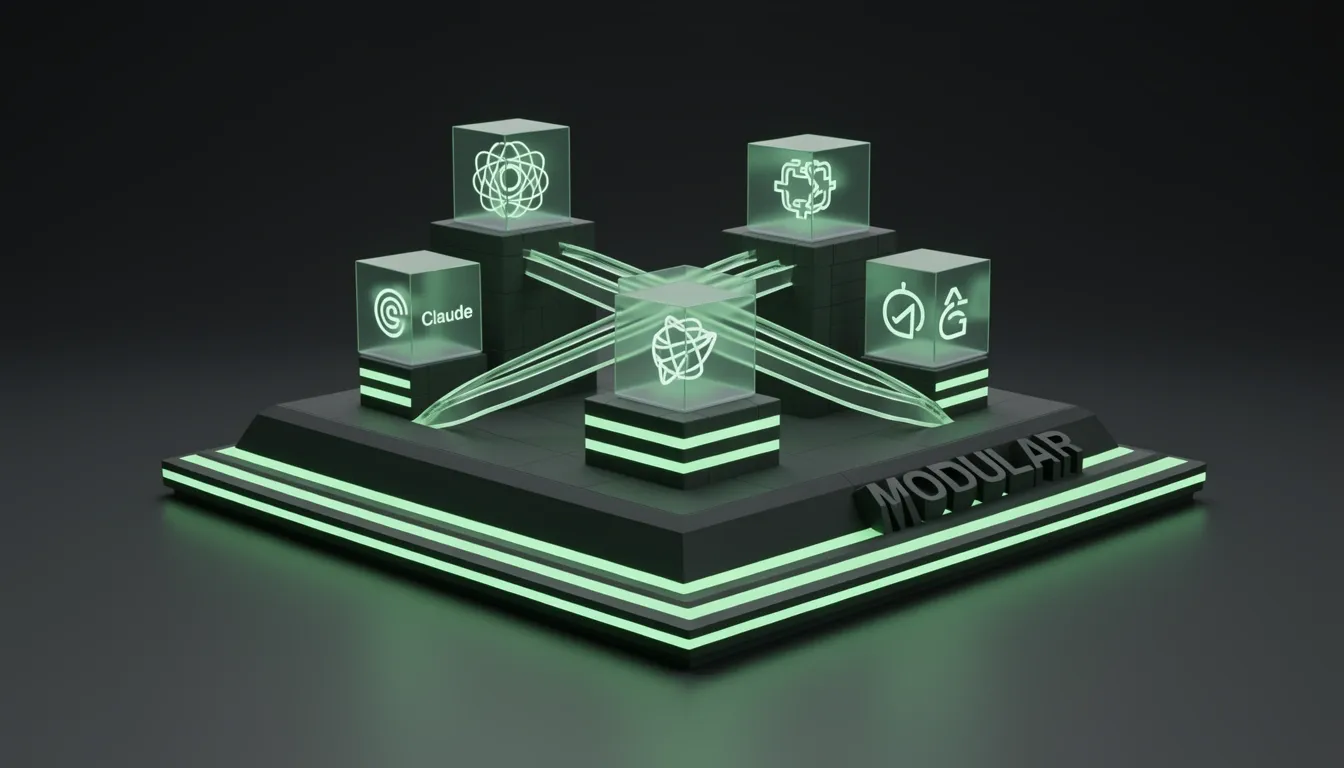
When I look at Droid's architecture, what stands out immediately is its refusal to treat all large language models as interchangeable black boxes. Instead, the framework adopts a modular philosophy where universal agentic logic—the planning module, environment awareness subsystem, and tool execution engine—remains shared across every supported model. This shared core handles the heavy lifting of reasoning about codebases and orchestrating actions, but the framework stays flexible enough to accommodate behavioral quirks that would otherwise break execution.
The Tool Scaffolding and Path Resolution Layers
The most practical example of this adaptability sits in the tool scaffolding layer. Rather than forcing every model to conform to a single editing dialect, Droid translates a generic "edit file" intention into whatever format the active model expects. I noticed that some models reliably handle FINDANDREPLACE style operations, while others strictly prefer V4A diff formats. Without this translation layer, a model that excels at reasoning might fail at the simplest file modification simply because the instruction format doesn't match its training distribution. The scaffolding abstracts this away so the shared execution engine never needs to care which syntax variant arrived upstream.
Path handling reveals another sharp edge that the architecture addresses head-on. Certain models consistently interpret paths as relative to the current working directory, which works fine in local development contexts. However, others demand absolute paths to function correctly—particularly inside containerized environments where the working directory context can shift or where sandboxed execution requires fully resolved locations. Droid solves this with toggleable path resolution routines that switch between relative and absolute modes based on the active model's documented behavior. This isn't just a convenience; it prevents silent failures where a model generates a correct-looking path that resolves to nowhere inside a Docker container.
Core Design Choices That Keep It Lean
Beyond these mechanical adaptations, the architecture leans on hierarchical prompting and efficient environment exploration as foundational design choices. Hierarchical prompting lets the planning module break complex tasks into layered instruction sets, while the environment awareness subsystem explores repositories without drowning the context window in irrelevant file listings. These aren't afterthoughts—they're core to how the shared components stay lean despite supporting wildly different model capabilities.
What I appreciate most here is the clean separation between the universal and the specific. By isolating model-specific quirks—whether it's diff format preference or path resolution strategy—into thin adaptation layers, Droid keeps its maintenance surface small. When a new model arrives with its own eccentricities, integrating it becomes a matter of implementing a new adapter rather than rewriting the agentic core. That design decision directly lowers the barrier to entry for cheaper or specialized models, which is exactly how the framework enables them to outperform expectations against more expensive counterparts.
Terminal-Bench Dominance: Architecture Over Raw Model Power
When I look at the Terminal-Bench results, the numbers immediately challenge the assumption that agent performance is just a function of model size. Droid claims the top spot with 58.8% accuracy using Claude Opus 4.1 (no thinking), setting the state-of-the-art at the time of reporting. What catches my attention isn't just the raw score—it's how Droid places three distinct single-model configurations inside the top five, all of them leaving competing agents far behind.
The Top-Three Sweep and What It Reveals
The leaderboard reads like a deliberate demonstration of framework-level optimization:
- Claude Opus 4.1 (no thinking): 58.8%
- GPT-5 (medium reasoning): 52.5%
- Claude Sonnet 4 (no thinking): 50.5%
Each of these scores represents a significant margin over every other single-model agent evaluated. In my view, this clustering isn't a coincidence; it points to architectural decisions inside Droid that extract more capability from the underlying weights than generic wrappers or naive prompting strategies can manage. The framework appears to be the constant multiplier, not the model itself.
When the Smaller Model Outperforms the Flagship
The most striking evidence that architecture beats raw model power comes from direct comparisons using identical base models. Take Droid paired with Claude Sonnet 4 (no thinking) hitting 50.5%. That figure alone outperforms Claude Code running Claude Opus 4.1, which only managed 43.2%. I find this remarkable: a less capable model inside a superior framework is beating the flagship model inside a weaker one. The gap isn't marginal—it's over seven percentage points, which in benchmark terms is substantial.
The same pattern repeats with GPT-5. Droid with GPT-5 (medium reasoning) reaches 52.5%, while Codex CLI using the same underlying model stalls at 42.8%. To me, this suggests that Droid's tooling, context management, or execution loop is doing substantial work that the baseline CLI tools simply aren't replicating. The model isn't the bottleneck; the scaffolding around it is.
Terminal-Bench 2.0 and Rigorous Evaluation
The story extends to Terminal-Bench 2.0, a harder suite spanning software engineering, biology, security, and gaming across 89 tasks. Here, Droid plus Claude Opus 4.6 scored 69.9%. While Codex CLI paired with GPT-5.3-Codex took the overall lead at 77.3%, Droid remains firmly competitive on the expanded benchmark, and the gap between frameworks appears narrower on the harder tasks even as absolute scores shift upward.
I also appreciate the methodological transparency here. The runs were executed in non-interactive task mode inside sandboxed environments, with all permissions skipped and task specifications fed directly as prompts. Each configuration was averaged across five independent runs. That setup removes human-in-the-loop variance and gives us a clean signal on how the agent architecture performs under fixed conditions. When I compare these numbers, I'm not looking at cherry-picked demos; I'm looking at reproducible agent behavior in controlled sandboxes.
Overall, the Terminal-Bench data tells a clear story. Droid isn't just riding the best available models to the top; its framework is actively amplifying whatever model it sits on, often pushing cheaper or smaller variants past competing agents running more expensive hardware.
SWE-bench Performance: Real-World Bug Resolution Metrics
When I examine the SWE-bench Full results, the 19.27% resolve rate stands out as a genuinely hard metric. This isn't a synthetic score or a partial-credit evaluation; it reflects successful resolution across 2,294 real-world issues and pull requests sourced from twelve popular open-source Python projects. For each task, Code Droid had to produce a git patch that caused all associated unit tests to pass without any human intervention. In my experience, that full-autonomy threshold filters out superficial fixes that might look plausible in a diff review but fail edge cases in the actual test suite. A nearly one-in-five success rate on unassisted real-world bugs indicates the system is doing more than pattern matching—it is reasoning about code behavior under realistic constraints.
The SWE-bench Lite numbers add useful contrast. On the 300 issues representing more straightforward debugging scenarios, Code Droid hit a 31.67% pass@1 rate. That twelve-point jump from Full to Lite makes sense—the Lite tasks typically involve less environmental complexity and fewer cross-file dependencies—but it also establishes a realistic ceiling for first-attempt success under simpler conditions. It gives me a clear sense of where the framework's baseline competence sits before any iterative refinement kicks in.
Iterative Sampling and Marginal Gains
Where the data gets genuinely exciting is the iterative sampling curve. Moving from pass@1 to pass@2 pushed the Lite success rate to 37.67%, and at pass@6—six independent sampling attempts—the system reached 42.67%. That 11-point spread between first attempt and sixth attempt tells me the multi-model sampling strategy is doing more than brute-forcing answers. It appears to be exploring distinct reasoning trajectories, and the fact that performance keeps climbing through six attempts suggests there are genuinely better solution paths hiding in the search space that don't surface immediately. The returns do diminish slightly—each additional attempt yields smaller absolute gains—but the curve hasn't flattened entirely, which implies there is still exploitable variance in the reasoning process.
Competitive Positioning on Stratified Subsets
The report also includes a direct comparison on a 25% stratified subset of SWE-bench Full. There, Code Droid achieved 21.75%, outperforming AiderGPT4o at 18.9% and Devin at 13.86%. I immediately notice the authors' cautionary note: because this is a subset with a specific distribution, the relative performance gap might look larger than it would across the entire benchmark. Still, even with that caveat, beating AiderGPT4o by nearly three percentage points and Devin by almost eight points on real repository issues is a strong signal. It suggests that cheaper or differently orchestrated models, when wrapped in the right agentic framework, can punch above their weight against more expensive monolithic alternatives.
Controlled Conditions and Architectural Implications
I also want to stress how strict the benchmark environment was. Code Droid operated under a no-internet, no-oracle-hints regime. Its network access was revoked entirely, and the only inputs were the issue statement and the repository contents. No browsing documentation, no querying external APIs, no human hints disguised as prompts. This constraint isolates the system's internal retrieval and reasoning capabilities, and it makes the results more impressive. The architecture relies on three core components working in concert:
- HyperCode-ByteRank retrieval to surface relevant code context from the local repository,
- Multi-model sampling to diversify solution attempts and avoid single-model blind spots,
- Tool-augmented reasoning pipeline to handle intermediate execution and validation steps.
Under these sealed conditions, that stack appears to extract enough signal from the local codebase alone to autonomously resolve a meaningful slice of production-grade bugs. To me, that is the real takeaway: the framework isn't just riding on better base models, but on a tighter integration of retrieval, sampling, and reasoning that performs when external help is not an option.

Where Droid Struggles: Failure Modes and Known Limitations
When I look at the SWE-bench Lite results across 300 tasks, the failure breakdown tells a clear story: retrieval isn't the only bottleneck, but it is the first domino. The errors split into four distinct categories, and each one points to a different pressure point in the pipeline.
- Total retrieval misses (8%): In these cases, Code Droid failed to include the target file in its initial set of analyzed files. I trace this directly back to the HyperCode-ByteRank retriever—if the relevant module doesn't surface within the top-k candidates, the agent is essentially flying blind. That's a hard ceiling on any downstream reasoning.
- Ranking failures (8%): Here, the target file made it into the analyzed pool but got buried outside the top-5 most relevant files. To me, this suggests the scoring function itself is undervaluing semantic relevance. The file is there, the retriever touched it, but the ranking signal failed to bubble it up. It's a subtle distinction from a total miss, but the outcome is identical: the agent never prioritizes the right context.
- Decision-making flaws (6%): In these tasks, the target file actually cracked the top-5 priority list, yet the agent still didn't edit it. Instead, Code Droid either modified unrelated files or concluded no edit was necessary. I see this as a planning gap—the retrieval pipeline did its job, but the orchestration layer misallocated its confidence. When the right context is sitting there and the agent ignores it, that points to a weakness in how the framework weighs file-selection signals against its internal reasoning trace.
- Patch generation errors (78%): By far the largest bucket. After the correct target file was selected, the patch itself was wrong: bad function calls, missing imports, test regressions, or syntactically invalid diffs. When I parse these numbers, one fact stands out immediately—the majority of errors live in the LLM's reasoning step, not the retrieval step. You can have perfect context, but if the underlying model hallucinates an API or forgets a dependency, the framework can't recover. This tells me Droid's architecture is doing a decent job at getting the right files to the editor, but the editor itself still needs a stronger correctness filter.
Where the Architecture Hits a Wall
The 78% figure is particularly revealing because it shifts blame away from the retrieval stack and onto the generation layer. I notice that most of these failures—wrong function calls, missing imports, invalid diffs—are classic symptoms of an LLM reasoning error rather than a context shortage. That distinction matters for anyone thinking about improvements. You could invest heavily in better embedding models or ranking heuristics, but if the agent still botches the edit after finding the right file, your marginal gains are capped.
The Custom Model Flexibility Problem
On the user-facing side, there's a separate limitation that doesn't show up in benchmarks but affects adoption. Droid reportedly doesn't play nicely with custom models or external AI providers. Users suspect Factory optimized the backend specifically for supported models, which means teams running proprietary or self-hosted weights can't easily slot them in. I think this is a significant trade-off. If the framework's retrieval and reasoning prompts are tightly coupled to a specific model family's behavior, you gain performance on the happy path but lose portability. For engineering teams with strict data-residency requirements or fine-tuned internal models, this lack of flexibility could be a dealbreaker regardless of how well Droid scores on SWE-bench Lite.

Getting Started: Free Trial, CLI Setup, and Daily Workflow
When I look at Droid's onboarding strategy, the shell-pipe installation immediately signals a developer-first mentality. Running curl -fsSL https://app.factory.ai/cli | sh drops you straight into the toolchain without wrestling with package managers or dependency hell. That frictionless entry point pairs aggressively with the free trial structure: creating an account unlocks a full professional plan for thirty days, and that trial isn't crippled with model restrictions. You get immediate access to the latest Claude and OpenAI models, which is exactly the kind of generosity that explains why one reviewer reported using it daily right up until expiration.
The Trial as a Technical Evaluation Window
From my perspective, this one-month window functions less like marketing and more like a legitimate engineering evaluation period. You can actually stress-test Droid against real-world tasks—running commands, debugging builds, and automating coding setups—without hitting a paywall mid-debug session. The framework earns its reputation for simplicity here; the CLI-centric workflow means you're not context-switching out of your terminal to babysit a GUI. It just slots into your existing shell environment.
- Zero-friction onboarding: The curl-to-shell pattern gets you running in seconds, not minutes.
- Full model access during trial: Latest Claude and GPT variants are unlocked immediately, so benchmark comparisons are possible on day one.
- Daily driver viability: User feedback shows the trial is substantial enough to integrate into a real daily workflow, not just a toy demo.
Where the Architecture Shines—and Where It Stops
I find the model-agnostic design particularly interesting. Switching between Claude and GPT implementations requires zero architectural changes on the user's end. That abstraction layer removes the typical vendor-lock-in headache, at least within the supported ecosystem. If your team needs to pivot from OpenAI to Anthropic because of pricing or context-window requirements, Droid handles the swap transparently.
However, I need to flag a hard limitation that could kill the deal for certain teams: Droid does not play nicely with custom models or external AI providers. If your organization relies on self-hosted endpoints, fine-tuned weights, or private API gateways, this framework explicitly shuts you out. That constraint transforms Droid from a universal agent into a curated, managed service. For teams running internal model infrastructure or experimenting with fine-tuned code models, this isn't a minor inconvenience—it's an architectural exclusion.
The maintenance cadence is worth noting, too. The project is described as heavily maintained by developers, which I read as active bug fixes and iterative CLI polish rather than abandonware. When accuracy in command execution and build automation is the priority, that ongoing maintenance matters; you don't want your agentic coding tool to drift behind model API changes or shell compatibility issues.
Ultimately, Droid's daily workflow rewards terminal-native developers who want managed model access without configuration overhead. Just know that the convenience trades away extensibility; if you need to bring your own model, this isn't the tool for you.

The Roadmap: Scaling to a Million Concurrent Instances
Scaling to one million concurrent agent instances isn't a marketing target; it's an architectural stress test that forces every design decision to favor horizontal elasticity over monolithic convenience. When I look at Factory's roadmap for Code Droid, what stands out immediately is the refusal to let any single agent carry its own baggage. By embracing a stateless microservices pattern, each instance becomes a disposable, lightweight container trio: an LLM inference server, the tool executables it needs to manipulate code, and a thin orchestration sidecar that handles lifecycle events. This setup means you can spin up or tear down agents without worrying about orphaned state or corrupted conversation threads.
Stateless Design and Externalized Memory
The real trick to keeping these instances lightweight is pushing all persistence outward. Conversation history and retrieval indices don't live inside the container; they sit in external, horizontally scalable stores like Redis clusters and object storage. I see this as a deliberate trade-off: you add network latency on every stateful operation, but you gain the ability to replicate or migrate agents instantly. In an enterprise deployment where thousands of developers might trigger agents simultaneously, that elasticity matters far more than the nanoseconds lost to a Redis round-trip.
Dynamic Compute Scheduling Based on Task Complexity
What impresses me most about the orchestration layer is that it doesn't just balance load—it estimates cognitive load. The workload-scheduling algorithms dynamically parcel out CPU, GPU, and memory based on real-time estimates of task difficulty. These estimates derive from two concrete signals: prompt complexity and repository size metrics. A simple lint-fix request on a microservice gets a sliver of compute, while a cross-repository refactoring task might claim a full GPU. This prevents the classic scheduling failure where every agent gets equal resources and the hard tasks starve while easy tasks waste cycles.
Inference Efficiency and Model Specialization
At a million instances, you cannot afford to run general-purpose frontier models for every subtask. Factory's backend instead evaluates cost-efficient, specialized models fine-tuned for narrow software-engineering jobs like lint-fix generation and test-case synthesis. These are served through optimized inference engines—TensorRT and vLLM—that maximize throughput per watt. I also notice aggressive use of model quantization and sparsity techniques to drive down memory footprint, which directly translates to higher instance density per GPU. On the network side, intelligent context-window management paired with edge-coded retrieval proxies keeps token payloads from ballooning across the wire.
Reliability, Observability, and Security at Scale
Running a million agents means failures are statistically guaranteed, so the platform bakes in automated checkpointing, continuous health-checking, and graceful pod termination to avoid mid-operation dropouts. For observability, Factory wires everything into OpenTelemetry for distributed tracing and Prometheus/Grafana for metrics aggregation, giving operators a clear view of where bottlenecks form across the fleet. Security isn't an afterthought either: mutual TLS encrypts service-to-service chatter, immutable image pipelines prevent runtime tampering, and role-based access control locks down who can trigger what.
Future Directions in Agent Cognition
Looking ahead, Factory is exploring mechanisms that feel more like memory and reasoning than traditional software. Associative memory for episodic problem-solving traces would let agents recall how they solved similar bugs months ago. Consensus-based sampling and trajectory replanning during execution hint at multi-agent debate and mid-flight course correction rather than rigid single-shot generation. Perhaps most interesting is the move toward non-weight-based learning through prompt-based meta-learning and retrieval-augmented generation backed by evolving codebase indices—essentially letting the agent get smarter without retraining the model.