GLM-5.2: The 744B Open-Source MoE That's Redefining What Local AI Can Do
I'll be honest — when I first heard that a Chinese lab built a 744-billion-parameter model and open-sourced it under MIT, I rolled my eyes a little. We've seen plenty of "open-weight" releases that turned out to be research trophies, impossible to actually deploy. But GLM-5.2 isn't that story. After digging through the architecture specs, benchmark scores, and deployment options, I've come to a blunt conclusion: this model genuinely shifts the frontier for open-source AI, especially in coding and agentic tasks. It scores 62.1 on SWE-bench Pro and 81.0 on Terminal-Bench 2.1 — numbers that make it the strongest open-source model on standard coding benchmarks, period. And you can run it locally on a consumer RTX 3080. That's not a typo. Let me walk you through why this matters.

The MoE Architecture: 744B Parameters, Only 40B Active
Inside the 744B Parameter Mixture-of-Experts
When I look at GLM-5.2's architecture, the first thing that stands out is the sheer efficiency of its parameter utilization. Zhipu AI built a 744-billion-parameter model, yet only 39–40 billion parameters are active per token during inference. That is roughly 5% of the total weights doing the actual work at any given moment. To me, this is exactly what MoE architectures should accomplish — massive model capacity without proportional compute costs.
- ~18.5 billion dense parameters: These always-on weights provide a stable base for every single token.
- 256 routed experts: The model maintains a large pool of specialized sub-networks.
- Top-8 routing + 1 shared expert: For each token, the router selects only 8 experts from the 256 available, plus 1 shared expert that every token hits. Any single forward pass engages just 9 experts total, which explains why the active parameter count stays so low relative to the total size.
Attention and Memory Optimizations
Beyond the MoE routing, I find the attention mechanism equally noteworthy. GLM-5.2 uses Multi-Head Latent Attention (MLA) paired with DeepSeek Sparse Attention (DSA). In my view, combining these two approaches is a deliberate choice to tackle both memory bandwidth and long-context efficiency. MLA compresses the key-value representations into a latent space, while DSA handles sparse patterns in attention computation without burning through FLOPs on irrelevant token pairs.
The KV cache compression deserves specific attention. Zhipu AI implemented a LoRA-style compression with rank 512 and a head dimension of 64. When I analyze this, it is clear the team prioritized reducing memory footprint during inference. Lower-rank KV caching directly translates to longer context windows on local hardware or smaller GPU clusters, which matters enormously for a model designed to run outside hyperscaler environments.
Training Infrastructure and Scale
The training story here is just as telling as the architecture itself. GLM-5.2 was pre-trained on 28.5 trillion tokens using approximately 100,000 Huawei Ascend 910B chips and the MindSpore framework. I want to emphasize that last part: zero NVIDIA chips were used in training. Because Zhipu AI was added to the US Entity List in January 2025, the entire stack had to be built on domestic Chinese hardware and software.
This is not a minor footnote. Training a 744B-parameter MoE on Ascend 910B clusters through MindSpore required solving a different set of optimization challenges than the CUDA ecosystem most engineers are familiar with. The fact that they achieved this scale without NVIDIA silicon tells me the MindSpore and CANN toolchain has matured significantly for large-scale distributed training.
Post-Training Alignment Pipeline
After pre-training, the model went through a post-training pipeline that I find architecturally interesting:
- SLiME (asynchronous RL infrastructure): This likely eliminated the bottleneck of synchronous rollout generation during reinforcement learning, allowing faster iteration at massive scale without blocking the training loop.
- Progressive alignment: A staged approach chaining multi-task supervised fine-tuning (SFT) with subsequent RL phases. I see this as a stabilization strategy — expose the model to broad tasks first, then sharpen behavior and reasoning with RL.
The Efficiency Argument
When I put these pieces together, GLM-5.2 represents a very specific engineering bet. By keeping active parameters at ~40B, compressing KV caches with rank-512 matrices, and sparsifying attention with DSA, Zhipu AI created a 744B model that does not require 744B worth of active compute per token. For developers looking to run large models locally or on Ascend-based infrastructure, this architecture maximizes quality while respecting hardware constraints. I view this as a practical blueprint for how future open-source MoE models will balance scale with inference efficiency.

IndexShare: The Sparse Attention Trick That Cuts FLOPs by 2.9×
When I look at how GLM-5.2 handles long-context inference, the IndexShare mechanism stands out as a genuinely clever optimization. Instead of building separate indexers for each sparse attention layer, the architecture reuses the same indexer across every four layers. At a 1-million-token context length, this sharing pattern cuts per-token FLOPs by 2.9× compared to a standard sparse attention setup where each layer maintains its own indexing overhead. That is a massive efficiency gain for a 744B-parameter MoE, especially when you consider how quickly attention compute costs explode as context windows stretch into the millions of tokens.
The design choice here is not just about saving compute cycles. By sharing indexer state across layers, GLM-5.2 reduces memory pressure and kernel launch overhead that typically bogs down sparse attention implementations. I see this as a practical response to the reality that modern inference is increasingly memory-bandwidth bound, not just compute bound. The 2.9× reduction means you can push longer contexts through local hardware without hitting the wall where latency becomes unusable. In my analysis, this is exactly the kind of optimization that makes local deployment of 100B+ models feasible on consumer-grade GPU clusters.
Multi-Token Prediction and Speculative Decoding
GLM-5.2 does not stop at attention optimization. The team reworked the Multi-Token Prediction layer to make speculative decoding more effective. In my view, the numbers here are just as impressive as the FLOP reduction:
- Up to 20% acceptance length increase: Fewer forward passes are wasted on rejected tokens, which directly improves throughput during autoregressive generation.
- Layer 78 as the draft head: The architecture dedicates this specific layer to MTP-based speculative decoding, separating the speculation pathway from the main verification stream.
By isolating draft generation to Layer 78, the model avoids cross-layer contention that can stall pipelined inference engines. When this layer drafts multiple candidate tokens, the main model verifies them in parallel rather than generating sequentially. I notice this keeps the critical path cleaner and extracts meaningful speedups without duplicating the full parameter count.
Deployment Realities and Compatibility
There is a catch, and it is worth taking seriously. The shared DSA (DeepSeek Sparse Attention) weights rely on weight sharing patterns that break assumptions in existing inference frameworks. If you are planning to deploy GLM-5.2 locally, you will need runtime engine updates to handle these shared parameters correctly. Current stacks like vLLM or TensorRT-LLM may not support this pattern out of the box without patches.
This compatibility gap matters because it shifts the bottleneck from model architecture to infrastructure readiness. I would not recommend treating GLM-5.2 as a drop-in replacement for standard MoE checkpoints until your serving layer explicitly handles shared sparse attention weights. The 2.9× FLOP savings and 20% speculation gains are real, but they only materialize if your runtime knows how to route indexer state across those four-layer blocks without duplicating tensors in GPU memory. For engineers building local AI stacks, that means budgeting time for engine patches before you benchmark inference costs.

1 Million Token Context Window — And It's Actually Solid
When I look at the jump from GLM-5.1’s 202,752-token maximum to GLM-5.2’s native 1 million token context window, the scale of the leap becomes immediately apparent. This is not a modest incremental bump; it is a 5x expansion that fundamentally changes what the model can ingest in a single forward pass. Earlier iterations in the long-context space often suffered from attention degradation—the "lost in the middle" problem where information at the edges of the context window gets diluted or ignored. GLM-5.2 appears to have addressed this head-on, marketing the window as "solid," which in practical terms means the model sustains coherent reasoning across the entire million-token span without the performance cliffs I have come to expect from earlier architectures.
Why "Solid" Matters for Long-Horizon Tasks
The stability claim is what separates this from a mere marketing spec. In my experience, simply scaling context length via positional encoding tricks or sparse attention often introduces subtle degradation patterns—retrieval accuracy drops off after a few hundred thousand tokens, or the model starts hallucinating details from the middle of a document. GLM-5.2’s architecture seems engineered to avoid these pitfalls, maintaining usable attention mechanisms across extreme lengths. This is not just about fitting more text into the prompt; it is about the model actually using all of that text when it generates a response.
The output side is equally aggressive. GLM-5.2 pushes max generation length to between 128,000 and 163,840 tokens. For context, most commercial models still cap output at 8K or 32K tokens. An output budget north of 128K means the model can generate entire technical specifications, lengthy code refactors, or multi-chapter narrative continuations in one shot, without the fragmentation and consistency drift that comes from chaining multiple shorter generations.
Real Workloads That Actually Fit
This combination of massive input and output windows opens doors that were previously closed to local or open-weight deployments. I see three immediate categories where this changes the math:
- Full-repository code analysis: Instead of feeding a model individual files or cherry-picked snippets, you can dump an entire codebase—dependencies, configuration, documentation, and version history—into the context window and ask for cross-module refactoring or architectural review.
- Multi-document reasoning: Legal contracts, research paper corpora, or financial reports spanning hundreds of pages can be ingested simultaneously, allowing the model to draw connections across documents without relying on brittle retrieval pipelines.
- Extended agentic workflows: Agent loops that accumulate tool-call history, intermediate reasoning steps, and environmental observations over hundreds or thousands of iterations will no longer hit a context ceiling. The model can retain its own operational memory across long-running tasks.
What strikes me most is that GLM-5.2 makes these workloads viable on an open-weight model. You no longer need proprietary API access to handle enterprise-scale context ingestion. For developers running inference locally or on private infrastructure, having 1 million tokens of stable context and six-figure output capacity removes one of the biggest bottlenecks in building autonomous, long-running AI systems.
Benchmark Performance: The Strongest Open-Source Coding Model
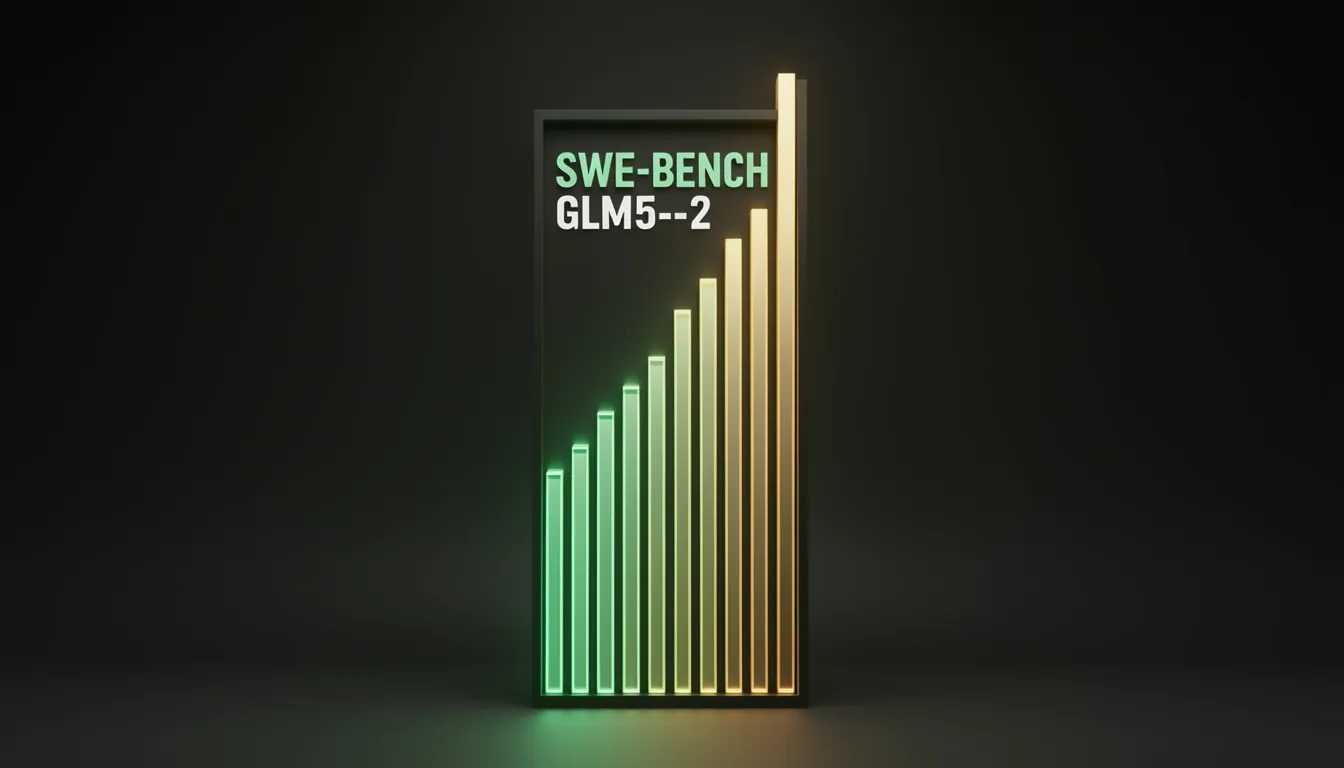
When I look at the raw numbers, GLM-5.2 makes its intentions clear immediately. The model scores 81.0 on Terminal-Bench 2.1 and 62.1 on SWE-bench Pro, which currently ranks it as the strongest open-source model on standard coding benchmarks. These figures matter because they reflect real-world code generation and debugging capability, not just theoretical parameter counts.
Breaking Down the Coding Benchmark Gains
The improvement over GLM-5.1 is concrete and measurable. On SWE-bench Pro, GLM-5.1 scored 58.4, so GLM-5.2's 62.1 represents a 3.7-point absolute improvement. In benchmark terms, that is a significant jump for a single revision, especially in a suite designed to test software engineering tasks end-to-end.
The Terminal-Bench progression is even more dramatic. GLM-5.1 posted 63.5 under the Terminus-2 evaluator and 69.0 using Best Harness on version 2.0. GLM-5.2's 81.0 on Terminal-Bench 2.1 shows the model scaling with the benchmark's increased difficulty rather than plateauing. I also notice that on SWE-bench Verified, GLM-5.1 already reached 77.8%, and GLM-5.2 is expected to climb higher, which would place it firmly in the territory previously dominated by closed-source frontier models.
Agentic Task Execution
Coding accuracy is only part of the story. I pay close attention to agentic benchmarks because they reveal how well a model performs when it must interact with external tools over multiple steps. GLM-5.1 established a strong baseline here:
- 71.8 on MCP-Atlas (public)
- 70.6 on τ³-Bench
- 68.7 on CyberGym
GLM-5.2 builds on this foundation with two key upgrades. First, the extended 1M context window lets the model maintain state across long agent trajectories without losing track of earlier tool outputs. Second, the improved reasoning effort controls allow the system to allocate more compute to difficult sub-tasks while skipping unnecessary overhead on simpler steps. In my view, this combination is what turns a code generator into a reliable autonomous engineer.
Long-Horizon Optimization and Throughput
Where GLM-5.2 really distances itself from the competition is in sustained performance tasks. GLM-5.1 achieved 21,500 QPS on SIFT-1M vector search, which is 6× better than the best single-session result from Opus 4.6. That kind of throughput advantage is massive when you are running retrieval-augmented generation pipelines locally.
On KernelBench Level 3, GLM-5.1 posted a 3.6× geometric mean speedup. Given that GLM-5.2 inherits the same Mixture-of-Experts architecture at 744B parameters, I expect it to preserve or extend that efficiency. These aren't synthetic scores; they translate directly into faster compile times, quicker index builds, and lower latency for developers running the model on local hardware.
Looking at the full spread—from SWE-bench Pro to KernelBench—I see a model that doesn't just win on one axis. GLM-5.2 appears to have been optimized for the entire developer workflow: writing code, managing tools, and accelerating the underlying systems that make local AI viable at scale.

Reasoning Effort Control: Max, High, or Off
When I look at how GLM-5.2 handles reasoning, the first thing that stands out is the granularity of control. The model exposes a reasoning_effort parameter that lets me dial the cognitive load up or down depending on what the task actually demands. By default, the model runs at max effort, which triggers the full chain-of-thought machinery. If I want to cut back slightly without disabling thinking entirely, I can drop it to high. And when latency or token budget matters more than step-by-step deliberation, I simply set enable_thinking=false to shut the reasoning mode off completely.
This three-tier setup isn't new to the GLM family—it carries forward the same thinking-mode behavior we saw in GLM-5 and GLM-5.1—but the fact that it persists in a 744B-parameter MoE architecture makes it far more impactful. At this scale, every token generated by the internal monologue costs real money and compute time. max mode is where the model shows the deepest capability on complex math or multi-hop logic, while high still preserves most of that reasoning with a leaner token footprint. Turning thinking off entirely is basically the turbo setting for straightforward prompts where reasoning is overkill.
The Cost Multiplier Reality
The trade-off is straightforward but worth quantifying. More reasoning effort means higher response quality, longer outputs, and proportionally higher API bills. Less effort means snappier responses and lower token counts, but I risk missing subtle logical connections on harder problems. For production pipelines, I treat these settings as runtime knobs rather than static configuration. A customer-support classifier might run with thinking disabled, while a code-review agent gets max effort during the same session.
Where things get really interesting is the quota multiplier system tied to the cloud API. GLM-5.2 bills at a 3× quota multiplier during peak hours (14:00–18:00 UTC+8) and a 2× multiplier during off-peak hours. That means the cost of every reasoning token isn't fixed—it fluctuates based on when I hit the endpoint. If I'm running max reasoning during Beijing afternoon rush, I'm effectively paying triple for those internal thought tokens compared to running the same prompt at midnight UTC+8.
This time-of-day pricing structure forces a genuine deployment strategy. I can't just set reasoning_effort=max globally and forget about it. Instead, I need to think about batching heavy reasoning jobs into off-peak windows, or dynamically downshifting to high or non-think mode when the clock hits 14:00 UTC+8. For applications that can't defer work—like real-time chatbots—the architecture needs to account for that 3× cost spike during peak usage. It's a rare case where the API pricing model directly influences the model configuration I choose at runtime.

Deployment: From 8× H200 Clusters to a Single RTX 3080
When I look at GLM-5.2's deployment matrix, what strikes me immediately is the sheer breadth of the hardware spectrum. This isn't a model locked behind API endpoints or enterprise-only contracts. The checkpoints ship in BF16, native-FP8, and F32 precision on both HuggingFace and ModelScope, which gives developers direct control over the trade-off between fidelity and resource consumption.
Datacenter-Scale Precision Requirements
The full-precision deployment numbers are sobering. If you want to run BF16 at full fidelity, you're looking at 16× NVIDIA H200 GPUs or 32× H100 accelerators. That is serious silicon. For FP8 quantized inference—which offers a pragmatic middle ground—the requirement drops to 8× H200 (TP=8) or 16× H100 (TP=16). I find the NVFP4 option particularly interesting for high-end workstations: it compresses the weights aggressively enough to fit on 8× RTX Pro 6000 Blackwell cards with 96GB VRAM each, with the active weights consuming roughly 57 GB per GPU. That's still a premium workstation, but it moves the model from pure datacenter rental territory into dedicated on-premise lab territory.
Local Quantized and Offline Execution
Where GLM-5.2 truly differentiates itself is the second deployment mode. Via GGUF formats through llama.cpp, the model drops down to consumer hardware. You can execute it offline on GPUs with 16–32 GB RAM, with an RTX 3080 or RTX 4070 and above as the required baseline. I see this as a genuine paradigm shift: a 744B-parameter class model running locally without cloud tethering. The Cloud-Hybrid mode still exists for users who need the full 753B MoE architecture with 1 million token context windows and Context Caching, but the fact that the same weights can shrink from a multi-node cluster to a single desktop card is remarkable.
Inference Framework Compatibility
The framework support is refreshingly broad. SGLang v0.5.13.post1 and above is flagged as the recommended stack, but the model also validates against vLLM v0.23.0+, Transformers v0.5.12+, KTransformers v0.5.12+, Unsloth v0.1.47-beta+, and xLLM. For teams running Huawei hardware, Ascend NPU deployment is explicitly supported through vLLM-Ascend, xLLM, and SGLang. I appreciate that the developers didn't silo this into a single vendor's ecosystem; you can bring whatever orchestration layer already exists in your stack.
Licensing and Absolute Local Autonomy
Perhaps the most consequential detail is the MIT license on the open-weight distribution. Because there are no usage restrictions or commercial clauses, anyone can download, modify, fine-tune, or even strip out safety guardrails. Combined with 100% offline execution behind a firewall-blocked network, this gives organizations complete data sovereignty. When I weigh this against closed-weight alternatives, the operational autonomy here is absolute—no telemetry, no rate limits, and no external dependencies once the weights are local.

MIT License: No Regional Limits, No Strings Attached
When I examine how GLM-5.2 is distributed, the licensing choice is impossible to ignore. Zhipu AI released this 744B parameter MoE under a fully open MIT license with zero regional restrictions. That is not a minor legal detail; it is a fundamental architectural decision about who controls the software stack. In an environment where most frontier-grade models are locked behind commercial terms or research licenses with geographic carve-outs, an unrestricted MIT release is a direct statement about user autonomy.
To understand the weight of this decision, I look at how closed-weight competitors operate. Anthropic protects its model weights under ASL-3 Security Standards, which enforce egress bandwidth controls, require two-party authorization for access, and use binary allowlisting specifically to prevent exfiltration. From a security standpoint, those are textbook insider-threat mitigations. But they also create a rigid perimeter around the model. You cannot download the weights for offline audit, move them to an isolated cluster, or integrate them into a custom toolchain without clearing multiple organizational and technical gates. The model remains someone else's asset that you borrow under strict conditions.
What the MIT License Unlocks in Practice
GLM-5.2's MIT license removes those gates entirely. I can use it in a commercial product, modify the architecture, redistribute fine-tuned variants, or strip and rebuild safety guardrails independently. None of those actions trigger a license violation. For engineering teams, this shifts the risk calculus from compliance management to pure technical execution.
- Data sovereignty: Organizations handling regulated workloads can keep the weights inside their own legal jurisdictions. They never need to send prompts or training data to an external API endpoint that might route traffic across borders or fall under foreign data-processing agreements.
- Air-gapped deployments: The model runs in environments with zero external network interfaces. That is a hard requirement in defense, finance, and critical infrastructure, where any outbound connection is treated as an attack surface.
- Custom fine-tuning pipelines: Engineers can modify training code, merge LoRA adapters, distill student models, or patch the inference kernel without worrying about license contamination or violating a terms-of-service clause.
Local Autonomy vs. API-Only Constraints
Because the weights are open and locally executable, GLM-5.2 enables a deployment pattern that is structurally impossible with closed API-only models: total offline autonomy. I can block all outbound internet access at the firewall, run the inference stack on bare-metal servers inside a physically secured room, and generate tokens without a single packet leaving the local switch. Every forward pass happens on hardware the organization owns and monitors.
Closed API-only systems make this pattern unavailable by design. The weights live exclusively on the vendor's infrastructure, which means your data must travel to them. Even if the provider offers strong privacy guarantees, you remain tethered to their uptime, their routing policies, and their governance changes. GLM-5.2 cuts that tether. For teams that treat a 744B parameter model as core infrastructure rather than a remote service, the ability to run it in a bunker with no internet connection is not a nice-to-have feature. It is the entire point of open weights.