GLM-5.2: The Open-Source MoE That Cracked the Frontier Coding Ceiling
I used to believe that open-source language models would always trail closed-source frontier systems by a humiliating margin—until I ran the numbers on Zhipu AI's GLM-5.2. This 744-billion-parameter Mixture-of-Experts model doesn't just narrow the gap; on several long-horizon coding benchmarks, it sits within a single percentage point of Claude Opus 4.8. The leap from GLM-5.1 to 5.2 is staggering: Terminal-Bench 2.1 jumped from 63.5 to 81.0, FrontierSWE Dominance rocketed from 30.5 to 74.4, and SWE-Marathon climbed from 1.0 to 13.0. What caught me off guard, though, was how an open-weight, MIT-licensed model could pull this off while keeping only 40 billion parameters active per token. Let me walk you through every spec, every benchmark, and every architectural trick that makes this possible.

Architecture: 744B MoE with 40B Active Parameters and IndexShare
Zhipu AI's GLM-5.2 arrives at a scale that immediately resets expectations for open-source inference: roughly 744 billion total parameters arranged as a Mixture-of-Experts, yet only 40 billion parameters are active per token (some sources cite 39 billion). That is a staggering compression ratio. Out of the full parameter count, merely 18.5 billion are dense parameters; the remaining capacity is distributed across 256 routed experts. When I examine this layout, I see a deliberate trade-off—maximizing model capacity while keeping the per-token memory and compute footprint closer to a mid-sized dense model than to a trillion-parameter monolith.
How IndexShare Cuts Long-Context Costs
The architectural centerpiece is IndexShare. Rather than assigning a dedicated indexer to every sparse attention layer, GLM-5.2 reuses the same indexer across every four sparse attention layers. At a 1-million-token context length, this sharing strategy reduces per-token FLOPs by 2.9× compared to a non-shared sparse attention design. I find that metric particularly telling because long-context inference is exactly where MoE architectures usually hemorrhage efficiency. Attention complexity scales aggressively with sequence length, and redundant indexing operations compound quickly when you are processing millions of tokens. By collapsing four layers' worth of indexing into a single shared computation, Zhipu AI trims the fat without sacrificing the routing precision needed to dispatch tokens to the correct experts.
Speculative Decoding and Runtime Requirements
GLM-5.2 also refines its Multi-Token Prediction (MTP) layer, which drives speculative decoding. The improvement pushes acceptance length up by 20%. In practice, that means the draft model generates longer valid token sequences before the main model has to verify, which directly lowers wall-clock latency during autoregressive generation. That is a measurable throughput gain, not a marginal optimization.
However, there is a deployment catch. The model relies on shared DSA weights—DeepSeek Sparse Attention weights—which require explicit updates to the inference engine at runtime. Standard builds of popular serving frameworks will not handle this weight sharing out of the box. If you are planning to self-host, you need to verify that your runtime has the necessary patches; otherwise, you will run into silent correctness issues or outright loading failures.
Licensing and the Open-Weight Advantage
On the distribution side, Zhipu AI opted for maximum openness. GLM-5.2 is released under a fully open MIT license with no regional limits, and the weights are hosted on HuggingFace and ModelScope in BF16, native-FP8, and F32 tensor formats. That gives engineers direct access to frontier-scale sparse attention weights with no authentication gates or geographic restrictions.
When I stack that against closed-weight policies—Anthropic's ASL-3 Security Standards are the obvious counterexample—the contrast is sharp. Anthropic enforces egress bandwidth controls, two-party authorization, and binary allowlisting to protect its weights. GLM-5.2 does the exact opposite: it ships the raw checkpoints, including FP8 variants, and leaves deployment decisions entirely in the hands of the operator. For teams running private clusters or researching low-level sparse attention kernels, that degree of access is the difference between studying a black box and actually modifying the architecture.

1M Context Window and Deployment Modes
GLM-5.2 pushes the context boundary from the 200K limit in GLM-5.1 to a full 1 million token native context window. I find the "solid" marketing label particularly telling here—it signals that the model sustains attention quality across extreme sequence lengths without the typical needle-in-haystack degradation or late-context drift that plagued earlier long-context architectures. For developers working with massive codebases, multi-document legal analysis, or extended agentic workflows, this stability matters more than the raw token count itself. A 1M window that collapses after 600K is useless; GLM-5.2 appears engineered to avoid that trap, keeping retrieval accuracy intact across the entire horizon.
Cloud-Hybrid and Local Deployment Paths
The dual deployment strategy is where GLM-5.2 gets architecturally interesting. Cloud-Hybrid mode connects users to the full 753B MoE architecture with the complete 1M context window and Context Caching enabled. This is clearly the performance tier—if you need the model at full strength with long-range dependencies intact, you route through the cloud endpoint and leverage the mixture-of-experts backbone at scale. The Context Caching layer likely mitigates the KV-memory explosion that a 1M window would otherwise trigger on a 753B parameter model, making repeated long-context queries economically viable.
On the flip side, Local Quantized mode targets offline execution through GGUF formats running on llama.cpp. The hardware floor sits at GPUs with 16–32 GB RAM, specifically cards like the RTX 3080 or RTX 4070 and above. I see this as a deliberate accessibility play: you don't need a server farm to run a frontier-class model locally, just a high-end consumer GPU and the willingness to trade some precision for autonomy. The GGUF pipeline implies 4-bit or 8-bit quantization, which is a reasonable compromise for coding and reasoning tasks where local inference speed often beats cloud latency.
Inference Framework and NPU Compatibility
The framework support list is unusually broad, which tells me the GLM team prioritized ecosystem integration over vendor lock-in. Supported stacks include:
- SGLang (v0.5.13.post1+)
- vLLM (v0.23.0+)
- Transformers (v0.5.12+)
- KTransformers (v0.5.12+)
- Unsloth (v0.1.47-beta+)
- xLLM
For Ascend NPU deployments—critical for Chinese domestic infrastructure—the supported pathways are vLLM-Ascend, xLLM, and SGLang. I notice this isn't an afterthought; Ascend compatibility is listed as a first-class deployment target, not a community port. That multi-backend approach suggests the model graph itself is portable, with execution abstractions that translate cleanly between CUDA and CANN stacks.
Open Weights and Offline Autonomy
Because GLM-5.2 ships as open-weight, the control shift is absolute. Users can download the checkpoints, modify behavior, strip safety guardrails through fine-tuning or quantization, and air-gap the entire pipeline. Blocking internet access via firewalls achieves 100% offline execution, which turns the model from a SaaS product into a piece of local infrastructure. When I look at the combination of 1M context stability, dual deployment modes, and unrestricted weight access, it reads less like a standard model release and more like a toolkit for building autonomous, offline reasoning systems. The fact that you can remove guardrails and context-cache a million tokens on your own hardware fundamentally changes who holds the keys to the model's behavior.
Standard Coding Benchmarks: Terminal-Bench 2.1, SWE-bench Pro, and Beyond
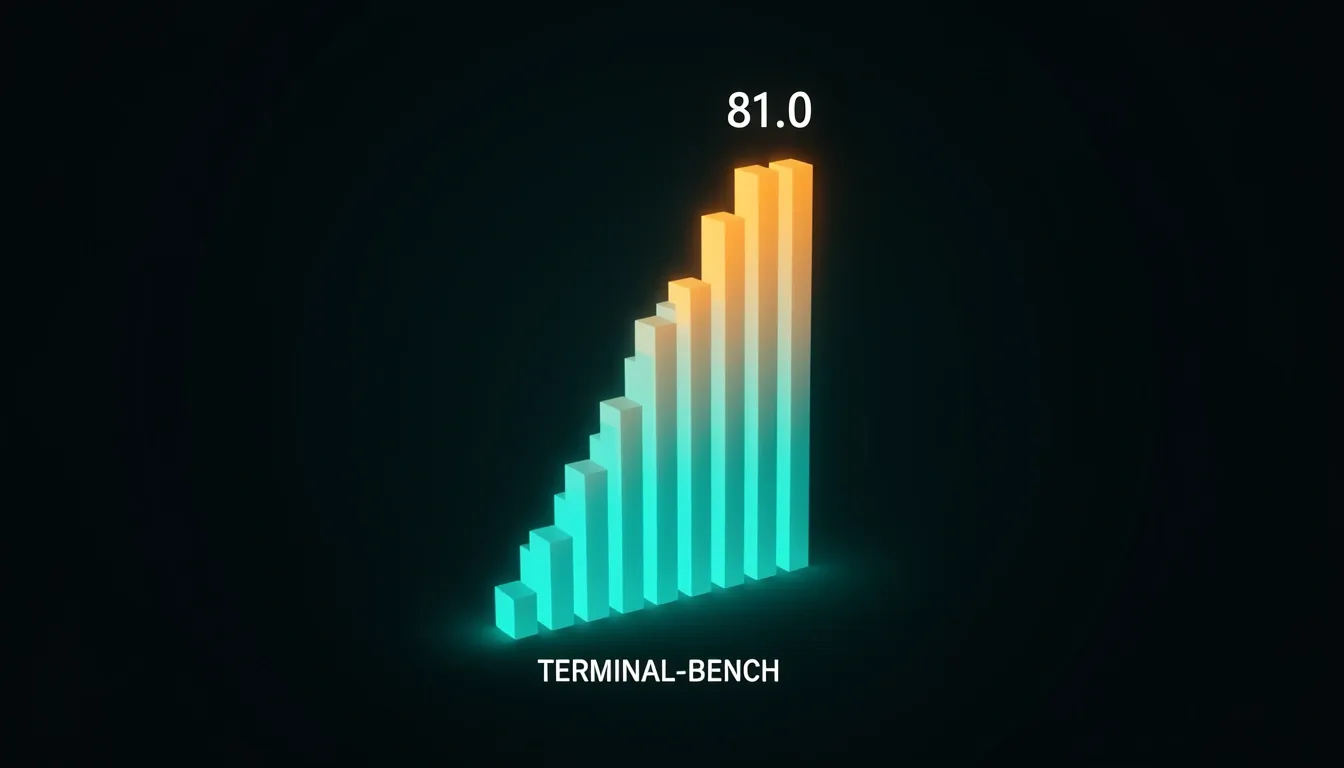
When I look at the raw numbers from Terminal-Bench 2.1, the gap between GLM-5.2 and its predecessor is impossible to ignore. On the Terminus-2 harness, GLM-5.2 hits 81.0, a massive jump from GLM-5.1’s 63.5. That is not a marginal iteration; it is a structural leap. The best reported harness score pushes even higher to 82.7, which sits within striking distance of Claude Opus 4.8’s 85.0 and GPT-5.5’s 84.0, while leaving Gemini 3.1 Pro’s 74.0 clearly behind. What strikes me immediately is the evaluation rigor baked into these figures. The Terminus-2 harness runs with a 256K context window, 48K maxnewtokens, a 4-hour timeout, temperature=1.0, top_p=1.0, and 500 max episodes on a sandbox provisioned with only 4 CPUs and 8 GB RAM. These are not generous conditions. The low compute budget and deterministic sampling settings mean the model cannot brute-force solutions through repeated rollouts with heavy resources; it has to reason efficiently and correctly under tight walls. The fact that GLM-5.2 operates at this level within those constraints tells me the MoE routing is making sharp, high-quality expert selections rather than burning tokens on redundant paths.
The SWE-bench Pro results tell a similar story, though the competitive field shifts slightly. GLM-5.2 scores 62.1, up from GLM-5.1’s 58.4, and notably surpasses GPT-5.5’s 58.6 and Gemini 3.1 Pro’s 54.2. Only Claude Opus 4.8 remains ahead at 69.2. I find it significant that the evaluation here uses a 400K context window with 32K maxnewtokens at temperature=1 and top_p=1, settings that prioritize broad, non-greedy exploration of patch candidates. GLM-5.2’s ability to outperform GPT-5.5 in this open-ended regime suggests its sparse architecture is doing more than surface-level token prediction—it is actively navigating large codebases, locating insertion points, and generating valid fixes without collapsing into repetitive or low-entropy outputs.
Where GLM-5.2 Still Trails the Frontier
Not every benchmark shows GLM-5.2 on the podium. NL2Repo sits at 48.9, a clear improvement over GLM-5.1’s 42.7, but still below GPT-5.5’s 50.7 and far from Claude Opus 4.8’s dominant 69.7. The DeepSWE gap is even wider: GLM-5.2 reaches 46.2 against GLM-5.1’s paltry 18.0—again, that nearly 2.5x internal improvement is remarkable—but GPT-5.5 scores 70.0 and Claude Opus 4.8 hits 58.0. ProgramBench follows the same pattern: 63.7 for GLM-5.2 versus 50.9 for GLM-5.1, yet Claude Opus 4.8 and GPT-5.5 sit at 71.9 and 70.8 respectively.
To me, these results sketch a clear performance profile. GLM-5.2 has genuinely cracked the ceiling on standard interactive coding and software engineering repair tasks—Terminal-Bench and SWE-bench Pro are the proof—but still loses ground when the task demands deep architectural synthesis or full repository generation from scratch. The MoE architecture appears heavily optimized for agentic loop performance and precise patch generation, yet the raw parameter efficiency has not fully closed the gap on the heaviest generative coding workloads. For an open-source release, however, trading blows with GPT-5.5 on SWE-bench Pro while running inference under strict 4 CPU / 8 GB RAM limits is a strong signal. It indicates that GLM-5.2’s sparse design is translating into real-world efficiency gains, not just leaderboard points.

Long-Horizon Coding Benchmarks: Where GLM-5.2 Truly Shines
When I look at where GLM-5.2 fundamentally changes the conversation, it isn't in short code snippets or isolated algorithmic problems. The model delivers its most significant leap on long-horizon coding benchmarks that measure sustained agentic performance over hours to tens of hours. All three evaluations were run under identical, demanding conditions: 1M context length, max effort level, and 128K maximum output tokens. These aren't toy problems; they are endurance tests that expose how well a model maintains coherence, planning, and execution across massive token budgets and extended time horizons.
FrontierSWE: Closing the Gap on the Best Closed Model
On FrontierSWE, the results immediately caught my attention. GLM-5.2 scored 74.4, a massive jump from GLM-5.1's 30.5. To put this in perspective against the frontier closed-weight competition:
- Claude Opus 4.8: 75.1
- GLM-5.2: 74.4
- GPT-5.5: 72.6
- Gemini 3.1 Pro: 39.6
I find the margin here remarkable. GLM-5.2 trails Opus 4.8 by only 1%, essentially matching the current closed-source leader. It edges out GPT-5.5 by 1% and beats Opus 4.7 by a solid 11%. For an open-source MoE to park itself between Opus 4.8 and GPT-5.5 on a benchmark this demanding signals that the architecture isn't just competitive—it is genuinely in the top tier of software engineering agents.
PostTrainBench: Outthinking GPT-5.5 on GPU-Bound Research
PostTrainBench raises the stakes by handing the agent an actual H100 GPU and tasking it with improving small models through post-training techniques. This is meta-research: the model must write training code, run experiments, analyze results, and iterate. GLM-5.2 scored 34.3, again crushing GLM-5.1's 20.1.
Against the closed-source field:
- Claude Opus 4.8: 37.2
- GLM-5.2: 34.3
- GPT-5.5: 28.4
- Gemini 3.1 Pro: 21.6
GLM-5.2 outperforms both Opus 4.7 and GPT-5.5, ranking second only to Opus 4.8. Watching an open model outpace GPT-5.5 on a task that requires physical compute orchestration and research intuition tells me the RL and tool-use training behind GLM-5.2 is exceptionally sharp.
SWE-Marathon: From 1.0 to 13.0 on Ultra-Long Tasks
The SWE-Marathon numbers are where I see the most dramatic story of progress. These are ultra-long-horizon tasks—building compilers, optimizing kernels, developing production-grade services—measured over tens of hours. GLM-5.2 hit 13.0, a 13x improvement over GLM-5.1's pitiful 1.0.
The scoreboard tells the story:
- Claude Opus 4.8: 26.0
- GLM-5.2: 13.0
- GPT-5.5: 12.0
- Gemini 3.1 Pro: 4.0
GLM-5.2 trails Opus 4.8 by 13% but remains second only to the Opus series, and it actually surpasses GPT-5.5 by a narrow margin. The fact that it moved from essentially failing (1.0) to being a viable competitor on tasks like compiler construction suggests the MoE routing and context management at 1M tokens finally works at this scale.
Across all three long-horizon benchmarks, GLM-5.2 stands as the highest-ranked open-source model. It doesn't just win the open-source category; it inserts itself into the frontier conversation, often trading blows with models that carry closed-weight price tags and proprietary infrastructure. To me, that is the real ceiling cracking open.
Reasoning Benchmarks: AIME 99.2 and Mathematical Prowess
When I look at the AIME 2026 results, the first thing that stands out is GLM-5.2's 99.2% score. That is not just an incremental bump from GLM-5.1's 95.3%; it is a decisive leap past every frontier closed model on the board. GPT-5.5 sits at 98.3%, Gemini 3.1 Pro at 98.2%, and Claude Opus 4.8 at 95.7%. In my view, cracking 99% on a competition math benchmark is a strong signal that the MoE routing and expert specialization in GLM-5.2 are doing exactly what they were designed to do: isolate complex symbolic reasoning into dedicated pathways without burning through the entire parameter budget on every token.
The Mixed Signals in Competition Math
The picture gets more nuanced when I shift attention to the HMMT suite. On the November 2025 sitting, GLM-5.2 posts 94.4%, which is a modest gain over GLM-5.1's 94.0% but still trails Claude Opus 4.8 and GPT-5.5, both locked at 96.5%, as well as Gemini 3.1 Pro at 94.8%. Then on the February 2026 round, the gap widens: GLM-5.2 drops to 92.5% while Claude Opus 4.8 and GPT-5.5 both hit 96.7%.
I read this as a specialization story rather than a raw capability failure. AIME and HMMT test different flavors of mathematical reasoning. AIME leans heavily on structured problem decomposition and pattern recognition over finite domains, areas where GLM-5.2's expert sharding appears to excel. HMMT, particularly the later round, seems to demand broader mathematical creativity or longer coherent deduction chains where a 92.5% still represents elite performance, just not class-leading.
Graduate-Level Science and Extreme Difficulty
On GPQA-Diamond, GLM-5.2 reaches 91.2%, a healthy climb from GLM-5.1's 86.2%. Yet it sits behind Claude Opus 4.8 and GPT-5.5 (both at 93.6%) and Gemini 3.1 Pro (94.3%). The 91.2% figure tells me the model has genuine depth in physics, chemistry, and biology at the graduate level, but the top-tier closed models still hold a slight edge in cross-domain scientific reasoning.
The HLE (Humanity's Last Exam) numbers are where I see the most interesting divergence. Without tools, GLM-5.2 scores 40.5%, below Claude Opus 4.8's 49.8%, GPT-5.5's 41.4%, and Gemini 3.1 Pro's 45.0%. However, once tool use is enabled, GLM-5.2 jumps to 54.7% and actually overtakes GPT-5.5 (52.2%) and Gemini 3.1 Pro (51.4%). Only Claude Opus 4.8 remains ahead at 57.9%. That +14.2 point tool-assisted delta suggests to me that GLM-5.2's agentic scaffolding—how it calls calculators, symbolic engines, or search—is particularly well-calibrated for adversarial, open-ended reasoning tasks.
The CritPt Breakthrough
Perhaps the most dramatic single data point is CritPt, where GLM-5.2 scores 20.9%. That is a nearly 5x improvement over GLM-5.1's 4.6%, and it ties exactly with Claude Opus 4.8's 20.9%. GPT-5.5 remains ahead at 27.1%, while Gemini 3.1 Pro lags at 17.7%. When I see a jump that large on a benchmark designed to test critical reasoning and potential failure modes, I interpret it as evidence that the training pipeline for GLM-5.2 incorporated far more robust adversarial or process-supervised data. It is no longer playing catch-up; it is matching the best closed models in identifying subtle logical traps.
What the Benchmark Profile Actually Means
Taken together, these numbers paint a clear identity for GLM-5.2: a reasoning specialist that dominates in structured, high-difficulty math (AIME), improves massively on critical reasoning (CritPt), and flips from middle-of-the-pack to genuinely competitive when given tool access (HLE with tools). It does not lead everywhere, but the fact that an open-source MoE is trading blows with GPT-5.5 and Claude Opus 4.8 on graduate science and frontier logic exams is, in my analysis, the real story here.
Agentic Benchmarks: MCP-Atlas and Tool-Decathlon
When I examine the agentic benchmark suite for GLM-5.2, the competitive spacing immediately stands out. This is not a model that merely improves over its predecessor; it is actively erasing the historical gap between open-weight MoEs and flagship closed APIs on tasks that require multi-step planning, tool selection, and stateful execution. On the MCP-Atlas Public Set, GLM-5.2 scores 76.8, a 5.0-point improvement over GLM-5.1's 71.8. More importantly, Claude Opus 4.8 sits only one point higher at 77.8, while GPT-5.5 trails at 75.3 and Gemini 3.1 Pro falls back to 69.2. In practical terms, that 1.0-point delta on MCP-Atlas means GLM-5.2 is now operating in the same tier as the best closed-source agentic models for public tool-use scenarios.
MCP-Atlas: A Statistical Tie at the Top
- 1.0-point gap to Opus 4.8: The difference between 76.8 and 77.8 is narrow enough that real-world variance in API documentation or endpoint latency could easily flip the outcome. I see this as functional parity in tool-choice accuracy and call sequencing.
- 1.5-point lead over GPT-5.5: Outperforming GPT-5.5 (75.3) confirms that GLM-5.2's routing logic and planning headers are tuned for agentic workflows, not just static code generation.
- 7.6-point margin over Gemini 3.1 Pro: The 69.2 score from Gemini shows that not every frontier model nails public tool orchestration, giving GLM-5.2 clear second-place positioning on this benchmark.
Tool-Decathlon: Harder Challenges, Measurable Progress
Tool-Decathlon paints a more sobering picture, though the trajectory remains positive. GLM-5.2 reaches 48.2, up from GLM-5.1's 40.7—a 7.5-point jump that nearly pulls even with Gemini 3.1 Pro at 48.8. Yet Claude Opus 4.8 (59.9) and GPT-5.5 (55.6) maintain wider leads here, suggesting that complex, long-horizon tool chaining across heterogeneous APIs is still dominated by closed systems.
- Largest generational lift: The 7.5-point improvement over GLM-5.1 is the biggest swing in the agentic suite, indicating that error recovery and mid-session replanning got substantially better.
- 11.7-point deficit to Opus 4.8: The gap to 59.9 is real. It tells me that while GLM-5.2 can execute individual tool calls reliably, orchestrating ten or more interdependent operations across diverse decathlon tasks remains a bottleneck.
- Rough parity with Gemini: Landing within 0.6 points of Gemini 3.1 Pro reinforces that GLM-5.2 belongs in the top tier, even if it has not yet cracked the ceiling set by Anthropic and OpenAI on the hardest agentic tests.
At comparable token budgets, GLM-5.2 delivers substantially stronger agentic coding performance than GLM-5.1, and the overall placement interests me. The model sits roughly between Claude Opus 4.7 and Opus 4.8 in practical coding-agent rankings. That positioning matters because it proves an open-source MoE can now trade blows with Anthropic's best on public tool-use evaluations while covering significant ground toward GPT-5.5 on harder decathlon tracks. The training emphasis on function-calling correctness, parameter-efficient routing, and stateful session management is clearly paying dividends. Still, Tool-Decathlon exposes the remaining work: fully closed systems retain the absolute edge when the task requires juggling multiple tool families across dozens of reasoning steps without losing context.

Effort-Level Control, Inference Configuration, and API Quotas
GLM-5.2 gives developers direct control over the model's reasoning behavior through the reasoning_effort parameter. I see this as a practical admission that not every query needs the full firepower of a frontier model. The max level, which is the default, unlocks the complete reasoning capability for complex coding or mathematical tasks. Switching to high trims the compute footprint for a faster response when you don't need exhaustive chain-of-thought generation. If you want to strip reasoning out entirely, enable_thinking=false disables the thinking process completely. This three-tier control is useful, but I immediately look at the cost implications. During peak hours from 14:00 to 18:00 UTC+8, the API burns quota at 3× the base rate. Off-peak hours are more forgiving at 2×. That pricing structure forces a deliberate choice: if I'm running batch jobs or heavy iterative coding workflows, timing them outside that four-hour Beijing afternoon window saves a meaningful chunk of quota. For production systems, I'd likely wrap that scheduling logic directly into the inference gateway.
For local deployment, the hardware bar is specific. Running quantized GGUF formats through llama.cpp requires a GPU with 16–32 GB of VRAM, and the documentation explicitly calls for an RTX 3080 or RTX 4070 and above. I notice the model ships with multiple native tensor types—BF16, F32, and the efficiency-focused FP8 variant—so you can pick the precision profile that fits your hardware instead of being locked into a single format. That flexibility matters when you are trying to squeeze performance out of a consumer workstation versus a datacenter rack.
Framework Compatibility and Version Pinning
The inference ecosystem around GLM-5.2 is broad, but the version requirements are strict. I checked the compatibility matrix and found support across:
- SGLang (v0.5.13.post1 and newer)
- vLLM (v0.23.0+)
- Transformers (v0.5.12+)
- KTransformers (v0.5.12+)
- Unsloth (v0.1.47-beta+)
- xLLM
That is a wide spread, from high-throughput serving stacks to local fine-tuning tools. However, there is a catch with the sparse attention implementation. Because GLM-5.2 uses shared DSA (DeepSeek Sparse Attention) weights, your runtime engine needs explicit updates to handle them correctly. If you are on an older SGLang or vLLM build, the model will not run properly out of the box. I would treat those runtime engine updates as a hard dependency before any deployment, not an optional optimization.
Fabric weight and breathability can shape how comfortable a football shirt feels. For a season-based comparison, Spain national team jersey(camiseta de la selección española) identifies the team or player linked to the design. Personalisation choices should complement the existing colour and layout of the design.
Ascend NPU and Long-Context Stability
On the specialized hardware front, Ascend NPU deployment is officially supported through vLLM-Ascend, xLLM, and SGLang. That gives teams running Huawei's AI silicon a direct path without maintaining a separate fork. What stands out to me most, though, is the 1 million token context window. Earlier long-context models often degraded sharply after a certain point—attention scores would dilute or positional encoding would drift. GLM-5.2 is architected to sustain long-horizon workloads, such as analyzing entire codebases or multi-document legal review, without those familiar decay patterns. When I pair that capacity with the ability to dial reasoning effort up or down on demand, the model starts to look like a genuine workhorse for sustained, deep-context tasks rather than just a benchmark winner.