MCP Explained: The USB-C Port for AI That Changes Everything About How Models Connect to the Real World
I've been watching the AI ecosystem scramble to connect language models to real systems for over a year now, and the chaos was palpable—every team reinventing bespoke glue code for every model and every tool. Then Anthropic dropped the Model Context Protocol in November 2024, and suddenly there was a real standard where there had been only fragmentation. I remember my first reaction being skeptical—another protocol?—but the more I dug into the architecture, the more I realized this isn't just another API spec. MCP is to AI agents what USB-C was to hardware: a universal interface that makes plug-and-play interoperability possible across an entire ecosystem. In this article, I'll walk you through what MCP actually is, why it's become the backbone of the agentic AI revolution, and the honest trade-offs you need to weigh before adopting it.
What Is the Model Context Protocol (MCP)?
When Anthropic open-sourced the Model Context Protocol in November 2024, I immediately recognized it as a fundamental shift in how we architect AI integrations. Rather than shipping another Python package or JavaScript wrapper, Anthropic released a specification—a contract that defines how large language models should talk to the outside world. I see this distinction as vital. MCP is not a library you import, nor is it an SDK you vendor into your codebase. It operates at the same conceptual layer as REST or GraphQL, but instead of serving human developers querying APIs, it serves AI agents that need to discover and invoke capabilities dynamically.
The analogy to a USB-C port is not just marketing fluff; it captures the essence of what MCP attempts to solve. Right now, every AI tool vendor builds bespoke adapters for LLMs to reach databases, IDEs, browsers, or internal microservices. I have watched teams burn engineering hours writing one-off connectors that break the moment a model updates its tool-calling schema or a vendor changes an authentication flow. MCP replaces that chaos with a universal interface. If a system exposes an MCP server, any model-compatible client can plug into it without the client knowing the implementation details upfront. That plug-and-play interoperability is what makes the standard genuinely useful across the ecosystem.
Why a Specification Matters
I think the decision to make MCP a protocol rather than a framework is its smartest architectural move. Specifications create shared integration surfaces that outlive individual implementations. When a company builds an MCP server around its internal CRM, analytics pipeline, or proprietary hardware controller, that server does not belong to Anthropic, OpenAI, or Google. It belongs to the ecosystem. I have noticed that this approach insulates integrations from the constant churn we see in model releases. Because MCP is model-agnostic, swapping from Claude to GPT-4 to a local Llama instance does not require rewriting your connector layer. The protocol abstracts the model away from the machinery it controls.
The adoption curve already validates this design. Major clients now speak MCP natively:
- Cursor and Windsurf for AI-native code editing
- Claude Desktop and Claude Code for conversational and agentic workflows
- Cline for autonomous coding tasks
I find that list significant because it spans code editors, desktop assistants, and autonomous agents. These clients do not share a common tech stack beyond the fact that they all need to pull context from files, terminals, and third-party APIs. MCP gives them a single, structured way to do that.
The Server as a Shared Surface
What excites me most is how enterprises are starting to treat MCP servers as internal integration surfaces. Instead of building a Slack bot, a separate CLI tool, and a dashboard widget for the same backend service, teams can build one MCP server. That server then becomes available to any AI client that enters the environment. I see this collapsing the traditional N×M integration problem—where N models need custom code to reach M tools—into a much simpler N+M problem. You write the server once, and every compliant client gains access.
The protocol also enforces structured, transparent communication between agents and the components they orchestrate. Every tool invocation, context fetch, and capability negotiation happens through a defined schema. When I look at how opaque some agent frameworks are about what data they pulled or which function they called, I appreciate that MCP forces visibility by design. That transparency is not a side effect; it is a core requirement for debugging multi-step agent workflows in production.
The Three-Layer Architecture: Host, Client, and Server
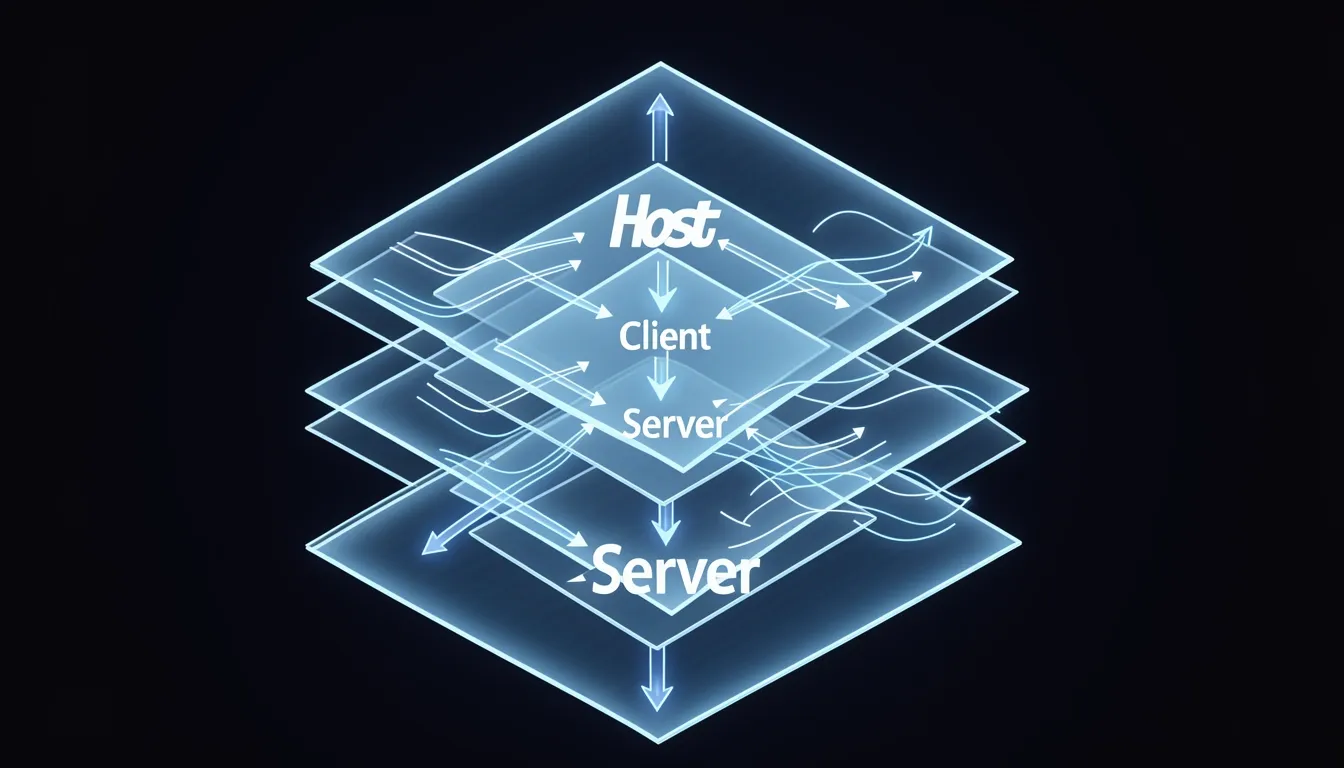
When I look at how MCP avoids the chaos of one-off API integrations, the answer is its strict three-layer separation. At the top sits the Host—the LLM application itself, such as Claude Desktop or VS Code. The host does not talk to servers directly; instead, it initiates connections, instantiates client objects, enforces security policies, and coordinates context aggregation from multiple external sources. This keeps the core application logic clean while delegating protocol-level grunt work downward.
Beneath the host is the Client, a 1:1 stateful connection manager created on demand by the host. I see this as the diplomatic middle layer: each client handles protocol negotiation, capability exchange, and bidirectional message routing with exactly one server. Because the relationship is strictly one-to-one, state never leaks between connections, and the host can run dozens of clients in parallel without crosstalk or concurrency headaches.
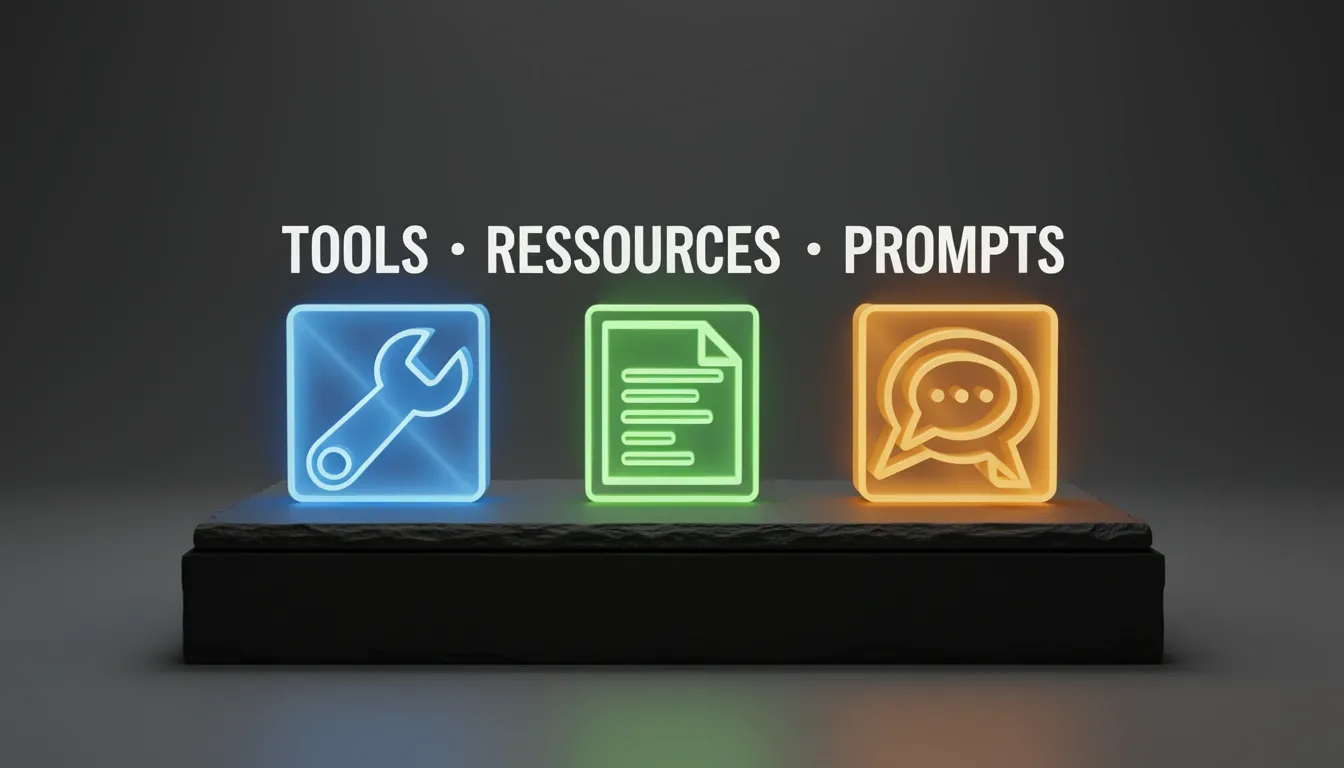
The final layer is the Server—a lightweight, specialized adapter that exposes three primitives through MCP:
- Resources for read-only data
- Tools for executable functions
- Prompts for reusable templates
Rather than building monolithic plugins, developers write focused servers that do one job well. The host then aggregates these capabilities, giving the LLM a unified view of the outside world without letting any single server monopolize the session.
Transport Mechanisms and Message Flow
All communication rides on JSON-RPC 2.0, which keeps the wire format predictable and easy to debug. MCP currently supports three transport mechanisms:
- stdio — Local process-to-process communication via stdin and stdout. It is simple, fast, and perfect for desktop tools that live on the same machine.
- HTTP with SSE — Remote communication using Server-Sent Events for server-to-client streams and standard HTTP POST for client-to-server requests, giving you real-time push without polling overhead.
- Streamable HTTP — The 2026 roadmap transport that will enable stateless operations, load balancing, and horizontal scaling for cloud deployments.
The lifecycle is equally rigid, which I appreciate because it removes ambiguity. It starts with Initialization: the client sends an initialize request carrying its protocol version and capabilities, and the server replies with its own. Next comes Operation, where messages flow strictly according to those negotiated capabilities. Finally, Shutdown closes the loop via a graceful close() call. There are no surprise disconnections or hidden handshake steps.
Core Design Principles
Three principles hold this architecture together:
- Server composability: Each server provides focused functionality, and multiple servers combine without friction.
- Security isolation: A server cannot read the full conversation history or see other servers, which limits blast radius if one adapter misbehaves.
- Progressive enhancement: Capabilities are negotiated during initialization, so the protocol remains backward compatible as new features roll out.
Three Core Primitives: Tools, Resources, and Prompts
I see MCP's architecture as a deliberate separation of concerns that keeps agentic systems flexible without drowning the LLM in unstructured data. Rather than dumping raw API documentation into a context window, the protocol exposes three distinct primitives—Tools, Resources, and Prompts—each with a specific owner and lifecycle. This design immediately struck me as the difference between handing someone a library card and handing them a curated toolkit where every instrument has a defined purpose and a clear owner.
Tools: The Model's Action Layer
- Task-oriented abstraction: A single MCP tool can wrap multiple underlying APIs, database drivers, and business logic layers. The LLM does not need to understand the internal choreography of a microservice fleet; it calls a high-level tool, and the server handles the orchestration. This makes MCP conceptually closer to a task-oriented tool layer than a conventional resource-oriented API.
- Discovery and execution contract: Tools expose
tools/listfor discovery andtools/callfor execution. I noticed this creates a strict but simple contract: the model queries what capabilities exist, judges relevance based on its current reasoning chain, and invokes the exact function it needs. - Agentic decision flow: Because the model controls when and how to use tools, MCP functions as an active action layer rather than a passive data pipe. The LLM can issue a database query, perform a file operation, or trigger an external API call, then fold the returned output back into its reasoning and continue the task.
Resources: Read-Only Context Anchors
- URI-addressable grounding data: Resources are identified by URI and remain strictly read-only. They cover files, git history, database schemas, and any other contextual data that keeps the model's responses tethered to real, up-to-date information.
- Application-controlled boundaries: Unlike tools, resources are managed by the application, not the model. This prevents the LLM from accidentally mutating the source of truth while still letting it consume live context. I see this boundary as a critical safety rail that keeps the agent honest and the data intact.
Prompts: User-Controlled Interaction Templates
- Reusable structured entry points: Prompts function as interactive templates triggered by menu choices or slash commands. They give users a repeatable way to kick off complex workflows without retyping elaborate instructions every time.
- Separation of intent and execution: By letting the user invoke a prompt while the model independently manages tool calls, MCP cleanly separates who starts the conversation from who performs the actions. This avoids conflating user input with model reasoning.
What ties these primitives together is the idea of upskilling an LLM the same way you install an app on a smartphone. Tool access is not hard-coded into every model interaction; instead, the LLM gains structured affordances through whatever MCP servers are attached. That makes the protocol a reusable integration layer for agentic behavior—one where capabilities are modular, discoverable, and scoped to the right controller.

Why MCP Matters: Hallucination Prevention and Real Data Access
When I look at why agentic AI actually works now rather than just promising to work, the difference is rarely the base model itself. To me, the shift happened because MCP introduced a rigid, standardized protocol that lets models talk to external systems without improvising. It is essentially a universal translator between a model's reasoning loop and the messy reality of APIs, databases, and desktop environments. Instead of every integration being a custom hack, MCP provides structured communication, transparent tool contracts, and developer-defined guardrails that keep the model inside safe boundaries while it acts.
The architectural pattern here is what stands out to me. The model does not abandon its own reasoning to rely on external tools; it stays anchored in its internal logic and reaches out only when its training data is clearly insufficient. That boundary matters. When a model needs current stock levels, it does not hallucinate availability based on patterns it saw during pre-training. It calls a live inventory API and gets the real number. When it pulls documentation, it reads the version that was merged into production 15 minutes ago, not the snapshot from the last crawler run. This distinction between live state and stale crawled content is the core mechanism that drives down hallucination risk.
How Real-Time Tool Calling Replaces Guessing
- Live inventory queries: The model asks the warehouse system directly rather than assuming an item is in stock.
- Fresh documentation: It fetches the latest commit from the codebase instead of relying on months-old crawl data.
- Guardrail enforcement: Every function call happens inside boundaries the developer controls, so the model cannot wander into unauthorized operations.
I also notice that MCP turns these models from passive chatbots into active participants in software systems. Claude and GPT-4 can now connect to application APIs, product databases, codebases, and even desktop environments. The user does not see the protocol handshakes or JSON schemas; they simply experience more precise answers and, more importantly, real outcomes.
From Static Answers to Executable Outcomes
- Calendar operations: An assistant does not suggest you reschedule; it actually moves the meeting, updates the event, and fires off attendee notifications through the calendar API.
- E-commerce fulfillment: When you ask for a blue dress, the agent checks real inventory, calculates shipping times, and places the order rather than linking to a category page.
- Travel booking: It books the flight through the airline's system instead of dumping a list of URLs for you to click.
To me, this invisible infrastructure is what makes MCP matter. End users experience it as accuracy and agency, but under the hood it is a strict contract: the model must use real functions, retrieve real data, and respect the guardrails. That contract is what separates an agent that hallucinates from one that actually operates in the real world.
MCP vs. REST APIs: Why the Distinction Matters
When I look at how traditional REST APIs are constructed, I see interfaces built for deterministic callers: a developer hard-codes a request to a known endpoint, sends a precisely shaped payload, and expects a predictable response. These systems assume the caller already knows exactly what it is doing and when to do it. That assumption works perfectly for human developers or rigid application logic, but it collapses the moment I hand control to a language model operating from natural-language context.
MCP servers flip this premise entirely. Instead of forcing the model to guess which endpoint to hit, an MCP server exposes metadata and structured descriptions that tell the model which tools exist, what each tool actually does, and under what circumstances it should invoke them. The model does not need prior knowledge of the API surface; it discovers capabilities dynamically through the protocol. This shift from hard-coded request patterns to intent-driven discovery is the fundamental architectural difference between the two approaches.
Why Wrapping APIs Falls Short
Simply wrapping existing REST APIs inside MCP servers provides standardized tool discovery, but I notice that it leaves the underlying interaction model untouched. Traditional APIs still expose massive endpoint surfaces, dozens of parameter combinations, and schemas that describe raw data shapes rather than operational intent. When something breaks, they return raw HTTP errors that mean nothing to a model without additional interpretation layers.
For an agent parsing vague user instructions, this friction creates real problems. I notice that large endpoint surfaces increase the chance of hallucinated parameters because the model must navigate an ocean of irrelevant options. Poor tool selection becomes common when endpoints describe data structures instead of actions. Wasted tokens pile up as the model traverses options that were never meant for its use case. The wrapper standardizes the handshake, but it does not fix the mismatch between how APIs express capability and how models understand intent.
Designing for the Agent, Not the Developer
The fix is agent-native tool design. When I build MCP tools specifically for model consumption, I narrow each tool to exactly what the agent needs—nothing more. Descriptions are written for how a language model selects and invokes functions, not for how a human developer reads Swagger docs. I enforce consistent structural patterns so the model builds reliable mental models of the toolset.
This approach changes the unit of abstraction. In a traditional API, the client must understand internal composition: which microservice owns which endpoint, how to chain three separate calls to complete one logical task, and how to interpret status codes across different services. With MCP, the client model sees only the logical capability it needs. I can compose one exposed function from several backend calls, and the agent remains unaware of the internal orchestration. This makes MCP particularly powerful for multi-system automation, where a single user request might require coordinated actions across databases, SaaS platforms, and internal services.
Breaking Vendor Lock-In
Another advantage I see is portability. I write the MCP integration once, and any MCP-compatible agent can consume it without custom logic for each model provider. The protocol abstracts away vendor-specific implementation details, so I am not rewriting authentication flows, request serializers, or error parsers every time I switch models or upgrade to a new LLM release. The tool description lives in the server, and every client reads the same contract.
This architecture treats the model as a first-class consumer rather than an afterthought. By designing tools that speak the model's language—intent, context, and structured discovery—I eliminate the impedance mismatch that plagues API-wrapping strategies and build automations that actually scale.
When Should You Use MCP? (And When Not To)
When I look at Harrison Chase's core argument for MCP, the signal is unambiguous: this protocol earns its keep when you need to bring tools to an agent you do not control. I see the value proposition crystallize around fixed-agent surfaces like Claude Desktop, Cursor, and Windsurf. In these environments, the underlying agent loop, planner, and model-routing logic are locked down from the user's perspective. I cannot rewrite the orchestration code, swap the base model, or tweak the reasoning pipeline. What I can do is expose an external capability the default product never shipped with, and MCP fills that gap precisely as the protocol layer that lets the agent discover and invoke an external tool.
This pattern extends far beyond developers. I notice that non-developers and subject-matter experts face the exact same constraint: they lack access to modify agent internals, yet they still need to decide which tools an assistant should reach. MCP gives them a protocol-level hook to grant that access without touching a single line of the agent's core logic.
Where MCP Actually Shows Up
The concrete domains where this dynamic plays out are broader than they first appear. I see MCP slotting into several verticals where the host agent is fixed:
- E-commerce: Product search, cart updates, order history retrieval, and checkout flows—all exposed to an agent that remains vendor-controlled.
- Finance: Account balance lookups, transaction categorization, and report generation, often gated behind permission controls that MCP servers can advertise during the discovery phase.
- Marketing: Audience queries, outbound messaging triggers, and campaign scheduling through structured workflows where the agent orchestrates timing but the business logic lives in external services.
- Operations and support: Customer support bots, logistics tracking systems, and clinical assistant tools that need to pull patient records, appointment schedules, or shipment data without the host agent knowing those schemas ahead of time.
- Meta-coordination: One AI agent coordinating with another, using MCP as the lingua franca to negotiate capabilities rather than hard-coding API contracts between systems.
When Standardization Becomes Dead Weight
But I would be doing a disservice if I treated MCP as a silver bullet. There are clear conditions where I skip the protocol entirely:
- Minimal API surface: If my agent only needs one or two simple APIs, a direct integration is usually more efficient than introducing a full protocol stack. The server management, capability negotiation, and schema discovery add latency and operational surface area that a basic HTTP client simply does not have.
- Small, well-scoped tasks: When the overhead of standing up a server, maintaining discovery endpoints, and handling protocol-level negotiation outweighs the benefits of standardization, MCP becomes overkill. In those cases, the flexibility the protocol offers turns into dead weight, and a tightly coupled integration is the more honest engineering choice.

Limitations, Trade-offs, and Production Readiness
When I look at the operational reality of running MCP in production, the first thing that stands out is the context tax. Community benchmarks show that five active MCP servers can eat up 55,000+ tokens before the user even types a message. That is a massive chunk of the context window gone immediately, leaving far less room for conversation history and task execution. The obvious fix is to keep MCP servers project-scoped and strictly limit how many are active per session, but that adds friction to the developer experience.
Cache Partitioning and Token Dedup
The token problem does not stop at the initial connection. I noticed that MCP tools are deliberately appended after built-in tools to protect the built-in tool prefix cache. This design makes tool registration order-dependent. If you add, remove, or reorder an MCP server, you invalidate the MCP tool cache, while the built-in prefix cache remains intact. It is a fragile balance.
To claw back some tokens, implementations use a lightweight LLM side-query for tool documentation deduplication. It checks whether a tool's description was already shown in the last N turns and strips it if so. This saves tokens, but I see two clear costs: it adds latency on every check, and if the tool's behavior has changed since the last turn, the model might operate on stale or incomplete information.
Authentication and Infrastructure Overhead
Then there is the auth story. The MCP auth module at src/services/mcp/auth.ts weighs in at 88KB and implements both JWT and OAuth flows. That file size alone tells me that securely managing credentials across diverse external servers is not a solved problem; it is a significant codebase to maintain and audit.
Beyond auth, there is genuine server sprawl. Each tool server is another deployable unit requiring monitoring, uptime guarantees, and versioning. The protocol's local-first origin also becomes visible here. It was clearly designed for desktop and local use, which raises hard questions about cloud deployment, multi-user access patterns, and distributed reliability. Running MCP at scale is not just a configuration change; it is an architectural shift.
Model Behavior and Ecosystem Gaps
I also need to point out that simply adding more tools does not guarantee better results. The model's success depends heavily on the quality of tool descriptions, specifications, and its own ability to interpret them correctly. More surface area can mean more confusion.
MCP is still a young standard, so breaking changes and shifting best practices are a real possibility. Compatibility is another concern: right now, MCP enjoys first-class support inside Anthropic's ecosystem and Claude, but native support across other providers remains uncertain. Betting on MCP as a universal standard today requires accepting that risk.
Security and Production Strategy
On the security front, I am glad to see that governance is being treated as a first-class concern. MCP Guardian is an open-source effort that logs requests and enforces policies, which gives operators some guardrails.
Given all of this, my practical advice is to treat MCP as experimental for now. Start with non-critical deployments, measure the operational complexity, and validate whether the token overhead, cache behavior, and auth burden fit your stack before rolling it into mission-critical workflows.