Zero-Shot vs Few-Shot Prompting: The Complete Decision Framework
I remember the first time I tried to get an LLM to output dates in a specific format and it kept giving me something totally different every single time. That frustration sent me down a rabbit hole of prompt engineering techniques, and I quickly realized the choice between zero-shot and few-shot prompting isn't just academic—it's the single most impactful decision you'll make for format-critical workflows. Zero-shot prompting means asking the model to perform a task with zero examples, relying entirely on instruction clarity and format constraints. Few-shot prompting, also called in-context learning, supplies a small number of input/output pairs so the model can infer the desired pattern. In this article, I'm focusing strictly on these two techniques—their definitions, comparative trade-offs, format control mechanics, domain-knowledge decision logic, and output consistency strategies—because this is part one of a larger series on prompt engineering.
Zero-Shot Prompting: The No-Examples Baseline
When I strip away all examples and rely purely on the model's pre-trained weights, I'm working with zero-shot prompting. The model has nothing to go on except the instruction text I feed it and the statistical patterns it learned during training. At its core, the LLM is simply predicting the next token based on the context window I provide. Without exemplars, the model cannot reliably infer non-standard labeling conventions or idiosyncratic output formats. This means the burden of clarity falls entirely on how I structure the prompt itself.
The Mechanics of an Effective Zero-Shot Prompt
I have found that zero-shot performance depends on four specific mechanical elements. If any of these are vague, the model will hallucinate structure rather than follow it.
- Task specification: I always open with an explicit verb and object, such as "Classify the following text…" or "Summarize the paragraph below." Ambiguous phrasing like "What do you think about this?" invites inconsistent behavior because the model has no examples to disambiguate my intent.
- Discrete label set: When I need classification, I enumerate the exact options—either positive, negative, or neutral—rather than assuming the model knows my taxonomy. Without this guardrail, the LLM might invent labels that feel plausible but do not match my downstream parser.
- Exact output formatting constraints: I add hard constraints like "Provide your classification as a single word" or "Return valid JSON." This directly shapes the token prediction path by restricting the vocabulary of acceptable next tokens.
- Stable delimiters for inline input: I separate the instruction from the payload using consistent markers, for example: Text: "The new feature works great, but the documentation could be better." This delimiter acts as a structural cue that helps the model recognize where the instruction ends and the data begins.
Where Zero-Shot Shines—and Where It Breaks
In my experience, zero-shot works best when the task is straightforward and the desired output format is already well-represented in the model's training data. If I need a quick sentiment label on a common English sentence, zero-shot is usually the fastest path because I skip the overhead of crafting demonstrations. It is also my default choice when I need immediate results and the task is universally understood—translation, basic summarization, or standard entity recognition.
However, I have noticed that zero-shot prompting collapses when the complexity of the question is high or when the criteria for the answer differ from the norm. If I ask for a nuanced legal analysis using a non-standard scoring rubric, the model has no demonstrations to anchor its reasoning. The same applies to rare labeling conventions; without exemplars, the LLM will default to the most statistically common pattern rather than the specific one I need.
The concrete example—"Classify the following text as either positive, negative, or neutral. Provide your classification as a single word. Text: 'The new feature works great, but the documentation could be better.'"—illustrates exactly why instruction clarity and format constraints matter more than demonstrations here. The model must resolve the mixed sentiment using only the discrete label set and the single-word constraint. There are no examples showing how to handle hedged language, so the prompt's precision becomes the entire control surface. When I need that level of speed and the task is simple enough that pre-trained priors align with my goals, zero-shot is the right baseline. But the moment the task drifts from the ordinary, I know I will need to start adding shots.

Few-Shot Prompting: Teaching by Example
Few-shot prompting works by appending a handful of input-output pairs to the task description, a technique more formally known as in-context learning. When I look at the setup, I see two distinct phases: first, I gather representative examples that mirror the exact output I want, and second, I write explicit instructions that tell the model how to generalize from those examples. This isn't just about giving the model more text to process; it's about anchoring the model to a specific pattern that its pre-training might not have reinforced strongly enough.
When Few-Shot Outperforms Zero-Shot
I reach for few-shot prompting when zero-shot leaves too much room for interpretation. The technique shines in several concrete scenarios:
- Strict output formatting: When I need JSON schemas, specific markdown structures, or rigid report templates, examples act as a schema validator that instructions alone rarely provide.
- Consistency at scale: If I'm generating fifty product descriptions and need the same tonal register every time, demonstrations lock the style in place.
- Zero-shot failure recovery: When a direct instruction produces vague or incorrect results, adding two or three examples usually corrects the trajectory without rewriting the entire prompt.
- Domain-specific reasoning: Niche fields like medical coding or legal clause extraction often require implicit conventions that aren't common in general training data.
- Context augmentation: Extra background embedded as example pairs can ground the model in situational details that would otherwise require lengthy exposition.
The Inference Mechanism Behind Demonstrations
The underlying mechanism fascinates me: the model isn't memorizing the examples verbatim. Instead, it appears to infer a latent mapping rule from a statistically tiny sample—sometimes just two or three pairs. I see this clearly in simple translation analogies. If I provide "cheese" → "fromage" and then "apple" → "pomme," the model grasps that the task is English-to-French noun translation. It doesn't need a grammar book; it extrapolates the pattern from the demonstrations. This is especially powerful when the desired pattern sits outside the high-probability outputs of the model's base training distribution.
Controlling Tone and Structure with Implicit Specification
One of my favorite applications is style control through dialogue demonstrations. Consider a prompt where I embed this exchange:
: Teach me about resilience.: Resilience is like a tree that bends with the wind but never breaks. It is the ability to bounce back from adversity and keep moving forward.
By inserting this turn alongside a final open-ended user query, I am implicitly specifying the output distribution—both the tone (metaphorical, encouraging) and the structure (short paragraph, definitional arc). The model reads these demonstration turns as a soft constraint. The final task remains open-ended, but the ambiguity around how to sound and how to format collapses dramatically. The examples function as an implicit contract: "Produce something that belongs to the same family as these outputs."
When I analyze the trade-offs, few-shot prompting demands more tokens and more curation than zero-shot, but the return is precise: I get a calibrated response that instructions alone often fail to guarantee.

Comparative Analysis: Trade-Offs Between Zero-Shot and Few-Shot
When I evaluate the zero-shot versus few-shot trade-off, the core tension is immediately measurable. Few-shot prompting generally outperforms zero-shot on format-sensitive and domain-specific tasks, but that accuracy gain comes at a direct cost in token consumption and context-window pressure. Every demonstration I embed consumes tokens, and when inputs or outputs are long, I hit the model's context-length limits fast. The risk is especially acute with large input documents or verbose code generation, where a handful of examples can eat up twenty to thirty percent of the available context window before the actual task even begins. That overhead isn't theoretical—it translates into higher API bills, increased latency, and heavier computational load.
I also have to account for the hidden engineering tax. Designing a strong few-shot prompt means curating examples, ordering them correctly, and tuning the format. Small changes in example selection or sequence can swing performance from near-random to near state-of-the-art, which tells me that prompt engineering is highly empirical and tightly coupled to the specific model I'm querying. The variance is model-dependent; what works on one large model might flop on a smaller open-weight variant, so I treat prompt templates as hypotheses to be validated rather than recipes to be copied.
When Few-Shot Pulls Ahead—and When It Backfires
In my testing, few-shot demonstrations shine when I need to inject nuanced domain behavior or handle context-dependent complexity that the base model didn't absorb from pretraining. If the task demands strict output formatting—like extracting structured JSON from messy text or following an obscure industry convention—zero-shot often guesses wrong, while a handful of well-chosen examples anchor the model's behavior.
That said, I can't treat few-shot as a universal win. Recent research has documented cases where zero-shot actually beats few-shot, which breaks the intuitive assumption that more examples always help. Zero-shot is fundamentally opportunistic; it relies entirely on the correlations baked into the original training corpus. When the task aligns cleanly with those pretrained patterns, adding demonstrations can introduce noise or bias rather than clarity.
The Cost-Benefit Equation
I frame the spectrum as a direct resource decision: trading prompt brevity for reduced ambiguity. Zero-shot keeps the prompt lean and lets the model lean on its pretraining. Few-shot is a deliberate investment that must justify its own cost. Because every demonstration increases token usage and raises computational, API, and latency costs, I treat few-shot prompting as a tool whose return on investment needs empirical validation on the target workflow. I don't assume it will pay off; I measure it against the actual task.
A Practical Escalation Rule
My decision rule is straightforward. I start with zero-shot for simple or clear formats where the instruction itself carries enough signal. I only escalate to few-shot when formatting consistency fails or when the task becomes mission-critical and the model keeps missing subtle domain rules. This keeps my prompts lean and my costs predictable, while reserving the heavier few-shot approach for the edge cases where pretrained generalization truly falls short.

Format Control in Practice: CSV and Date Conversion Examples
When I look at where few-shot prompting genuinely pulls ahead of zero-shot, format control tasks stand out immediately. There is something about the precision of pattern matching—watching an input morph into an exact output—that demonstrations handle far better than raw instruction. The classic example that proves this is date conversion into DD-MM-YYYY format.
Deconstructing the Few-Shot Date Template
The few-shot structure is elegant in its rigidity: Convert these dates to DD-MM-YYYY format: Input: March 15, 2024 / Output: 15-03-2024 | Input: December 1, 2023 / Output: 01-12-2023 | Input: April 7, 2024 / Output: [Your turn to convert this one].
What strikes me here is the density of control packed into a short string. First, there is a transformation goal statement that anchors the task. Then the explicit target format—DD-MM-YYYY—is embedded directly in the task description, leaving no room for the model to guess whether day or month comes first. The consistent Input: and Output: labels create a rigid framing that the model can latch onto, and the final placeholder—[Your turn to convert this one]—functions as a completion trigger rather than a vague question. I notice that the third example is deliberately left open; this is not an oversight but a structural choice that invites the model to continue the established pattern.
Zero-Shot Constraints for Simple Formats
Zero-shot is not useless here, but its success depends heavily on how unambiguous the format is. Consider the classification prompt: Classify the following text as either positive, negative, or neutral. Provide your classification as a single word. Text: "The new feature works great, but the documentation could be better."
Here, the prompt relies on four specific components to compensate for the lack of examples:
- Task specification that defines the operation
- A discrete label set (positive, negative, neutral) that bounds the output vocabulary
- An exact output formatting constraint—the phrase single word—which prevents rambling explanations
- Inline input payloads with stable delimiters that separate instructions from data
In my experience, this works for simple, well-defined formats where the instruction alone removes ambiguity. The model does not need to see an example of "positive" to know what positive means, provided the label set is closed and familiar.
The Ambiguity Trap and Operational Reality
The operational takeaway is straightforward: when a task is format-sensitive, reliability improves measurably when demonstrations are included. However, zero-shot remains viable for trivial formats where the constraints are self-evident.
The danger lies in ambiguity. Take the value 03/05/2019. Without explicit regional context, this string is a landmine—it could mean March 5 or May 3 depending on whether the user assumes US or European conventions. This is exactly why the few-shot date prompt works so hard to specify DD-MM-YYYY explicitly. When I see a zero-shot prompt attempt date conversion without that level of specificity, I expect inconsistent outputs because the model has no demonstration to disambiguate the positional meaning of each number.
For production systems, my rule of thumb is simple: if the output format has a strict grammar—dates, CSV schemas, JSON keys—few-shot examples act as compile-time type checking. Zero-shot is fine for loose classification or boolean flags, but the moment positional syntax matters, I reach for labeled input/output pairs every time.
The Domain-Specific Knowledge Decision Tree
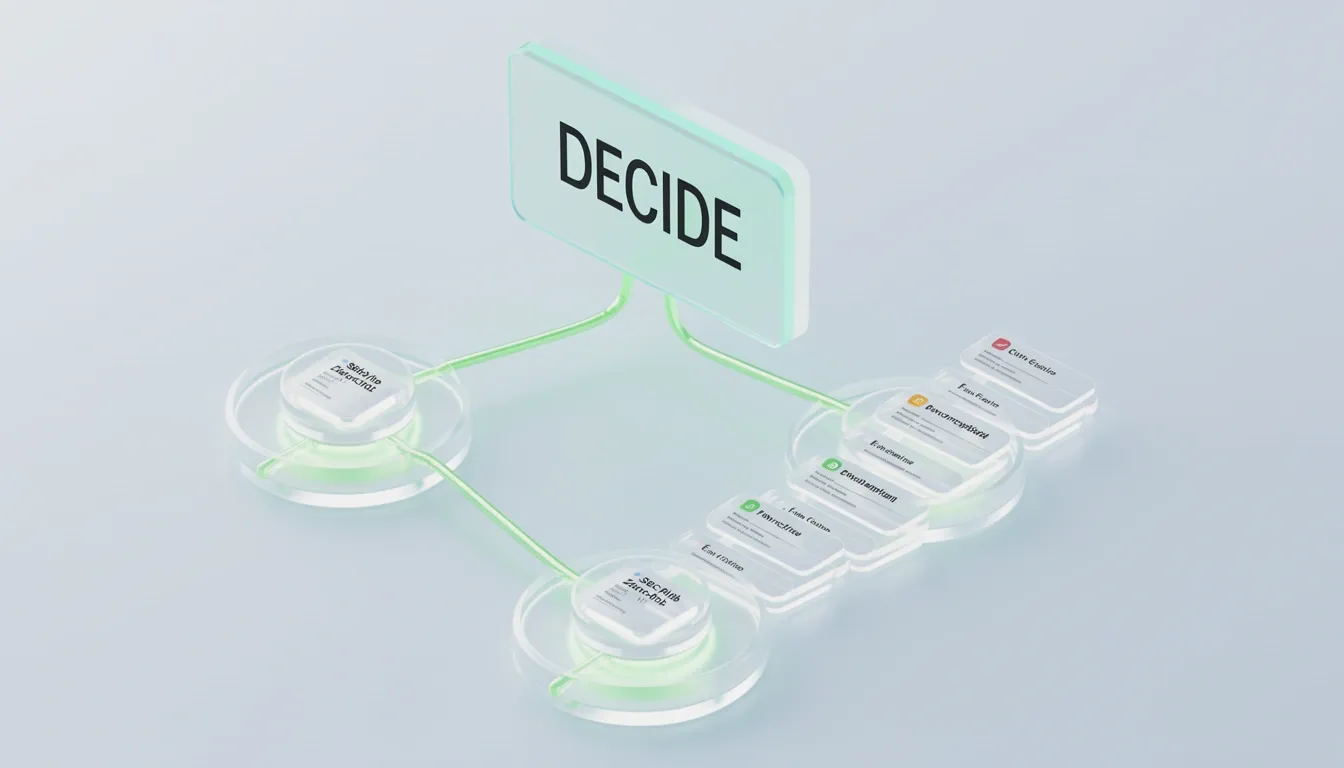
When I look at the choice between zero-shot and few-shot prompting, I see a decision tree that hinges on one primary question: is the task straightforward enough that the model already understands it from pre-training alone? If the answer is yes, zero-shot is the obvious path. The model can lean on its pretrained generalization and produce a reasonable output without hand-holding. But once I move past simple, well-understood tasks, the logic branches quickly.
Mapping the Decision Logic
The next question I ask is whether the task demands domain-specific knowledge or additional context that pre-training likely missed. If it does, I reach for few-shot demonstrations. This is where I see teams make their first major mistake—they assume a large parameter count equals broad expertise, but models routinely fail on specialized verticals without explicit guidance. If the task is still ambiguous after that check, I look at whether the success criteria deviate from standard conventions.
- Custom scoring rubrics: If the evaluation logic differs from typical patterns, zero-shot usually guesses wrong.
- Non-standard labeling: Unusual categorization schemes or priority rankings force me to provide anchors.
- Context-dependent complexity: When the answer criteria shift based on the input domain, few-shot becomes necessary.
When the complexity spikes or the answer criteria differ from the norm, zero-shot prompting collapses.
Why Zero-Shot Breaks Down on Subjective Scoring
I noticed this pattern clearly in ranking tasks. Ask a model to score an answer on a 1-to-5 scale in zero-shot, and two failure modes appear immediately:
- No objective mapping: The model lacks a reliable bridge from numeric values to semantic meanings. What does a "3" actually represent in your specific context?
- Rubric misalignment: The model's internal notion of quality often clashes with the user's intent. It might prioritize fluency and structure while the user cares about factuality and precision.
Without a few-shot example that anchors the numeric scale to concrete, domain-relevant behavior, the output becomes unreliable.
The Cost of Specialized Knowledge
For tasks like medical diagnosis from patient history, the stakes get higher. Even when I use few-shot reasoning steps, those examples need articulation by a domain expert. A generic demonstration written by a generalist won't capture the nuanced heuristics that define clinical accuracy. I treat few-shot here not as a formatting tool, but as a knowledge-transfer mechanism.
The General Knowledge Prompting Hybrid
There is a middle path I find useful when I want to bolster commonsense reasoning without bulking up the training dataset. General Knowledge Prompting lets me augment the query with external knowledge before the final API call, or I can have the LLM generate its own factual context and feed it back into the prompt. This hybrid approach injects relevant grounding without requiring multiple labeled demonstrations.
The Practical Rule
My working rule is simple: if I can trust the model's pretrained generalization to handle the task, I stay with zero-shot. The moment I need to inject nuanced domain behavior, custom evaluation logic, or context-dependent complexity, I add few-shot demonstrations. The cost of a few extra tokens in the prompt is almost always lower than the cost of parsing an incorrect zero-shot result.
Output Consistency and Demonstration-Driven Formatting
I see output consistency as the clearest justification for the extra token cost that few-shot prompting demands. Rather than relying on the model to infer the desired format from an abstract instruction, I treat each demonstration as an implicit specification of the output distribution, covering both tone and structure. When I need a chatbot to maintain a specific voice, I prepend example interactions that show the exact conversational manner, tone, and stylistic phrasing I want, then present the new user input. This approach anchors the model far more reliably than zero-shot instructions alone, because the examples act as living templates rather than loose guidelines.
Bias Risks in Classification Tasks
However, I have to watch for specific consistency risks that Zhao et al. (2021) identified in GPT-3 classification settings. The first is majority label bias: if my demonstrations contain unbalanced label frequencies, the model skews toward the overrepresented class regardless of the actual input content. The second is recency bias, where the model tends to repeat whatever label appeared at the end of the prompt. Finally, common token bias pushes the model to favor frequent tokens over rare ones, even when the rare label is correct. To mitigate these issues, I calibrate label probabilities so that an empty input such as N/A yields a uniform label prior. This calibration step helps neutralize skewed priors before they distort predictions, and I view it as essential when I move from open-ended generation into classification or extraction tasks.
Sample Selection and Ordering Strategies
Beyond bias correction, the way I select and arrange examples matters significantly. I rely on several practical heuristics to build high-quality demonstration sets:
- Semantic similarity: I select examples that sit close to the test case via nearest-neighbor clustering in embedding space.
- Diverse subsets: I construct representative batches using a graph built over embedding cosine similarity to avoid redundant demonstrations that add noise without information.
- Learned embeddings: I use contrastive learning to train selection-specific embeddings that surface better matches than generic sentence encoders.
- Adaptive selection: I apply Q-learning to optimize which samples maximize downstream task performance.
- Active learning: I pick examples with high disagreement or entropy, letting model uncertainty guide the selection toward the most informative demonstrations.
For ordering, I keep demonstrations diverse, relevant, and often randomized. I have noticed that better models and larger demonstration pools do not eliminate permutation sensitivity, so fixed or naive orderings can quietly degrade output quality even when the individual examples are strong.
LangSmith Evaluator Formatting Constraints
When I work inside the LangSmith evaluator framework, the formatting rules become strict and unforgiving. Each few-shot example must follow the exact variable mapping used by the main evaluator prompt, plus a dedicated fewshotexplanation variable, and a score variable. The score variable name must match the feedback key used by the evaluator's scoring output exactly. This tight coupling between the evaluator's output score field and the variable name reserved inside each few-shot example ensures consistent rendering across the pipeline. I find that ignoring this mapping breaks the evaluation logic silently, so I treat it as a hard schema requirement rather than a formatting suggestion.
By combining careful bias calibration, deliberate sample curation, and rigid formatting discipline, few-shot prompting moves from a simple "add examples" tactic into a precise output-control mechanism that justifies every additional token.

Bias Pitfalls: Majority Label, Recency, and Common Token Effects
When I look at the empirical work from Zhao et al. (2021) on GPT-3, the fragility of few-shot prompting becomes obvious. The researchers isolated three distinct failure modes that turn a carefully crafted prompt into a lottery. First, majority label bias kicks in when the demonstration set contains an uneven distribution of labels; the model quietly latches onto the overrepresented class and starts echoing it regardless of the actual input. Second, recency bias means the final example in the prompt exerts disproportionate influence, so the model often parrots the last label it saw. Third, common token bias pushes the model toward high-frequency tokens, which warps predictions in tasks where rare classes carry equal semantic weight. Together, these effects explain why swapping a single example or reordering the same six shots can swing accuracy from near-random to near state of the art.
Breaking Down the Three Distortions
- Majority label bias: If four out of five demonstrations predict "Positive," the model treats that ratio as prior evidence. I see this as a form of implicit frequency learning that overrides semantic reasoning, especially when the true test distribution is balanced.
- Recency bias: The last demonstration acts like an anchor. When I test different permutations of the same examples, the output distribution shifts measurably based on which label appears in the final position, making order a first-class hyperparameter.
- Common token bias: In tasks with skewed vocabularies, frequent tokens receive inflated probability mass. This is especially damaging in classification tasks where the minority class uses rare but valid labels, because the model effectively learns to play it safe by guessing the common answer.
The practical fallout is severe. A prompt engineer might assume that adding more examples or upgrading to a stronger model will stabilize behavior, but the data shows that permutation sensitivity persists regardless of scale or model quality. Better weights and larger context windows do not automatically fix structural sampling biases; they just give the biases more room to operate.
Mitigation and Sample Selection
Zhao et al. propose a calibration fix: adjust the output label probabilities so that an empty input such as N/A returns a uniform prior. This strips away the skew introduced by the prompt format itself and forces the model to justify its prediction from the actual content rather than the demonstration statistics. Beyond calibration, the choice of demonstrations matters heavily.
Practical selection heuristics include:
- Nearest-neighbor clustering: Retrieve examples semantically close to the test input in embedding space to maximize relevance.
- Graph-based diversity: Build subsets that maximize coverage using cosine similarity graphs over embeddings, ensuring the selected shots span the task distribution.
- Learned selectors: Train embedding spaces with contrastive learning specifically for sample selection, or apply Q-learning to treat example picking as a sequential decision problem where the reward is final task accuracy.
- Active-learning sampling: Prioritize examples with high disagreement or entropy to surface informative edge cases rather than redundant confirmations.
I always remind myself that diversity and relevance beat sheer volume. Randomizing order across multiple inference calls can also dilute recency effects, though it burns more tokens and complicates deterministic pipelines.
That token cost is the final variable few-shot teams cannot ignore. Every demonstration adds latency, API spend, and context-window pressure. When inputs or outputs are long, a 12-shot prompt can slam into the model’s context limit and force expensive truncation or chunking. I weigh those compute costs against the consistency gains on every project, because a biased but cheap zero-shot call sometimes outperforms a bloated, unstable few-shot prompt that drifts with every permutation.