Pi Agent Deep Dive: Why a Four-Tool Coding Agent Outperforms the Feature-Heavy Competition

I've spent enough time wrestling with bloated coding agents that choke on their own complexity, so when I first encountered Pi's radical minimalism—just four built-in tools and a ~600-line TUI—I was genuinely skeptical. Then I saw it claim second place on the TerminalBench leaderboard with only read, write, edit, and bash, and I realized the industry's obsession with feature-stuffed agents might be exactly backwards. Pi's architecture challenges a core assumption in the agentic AI space: that more built-in capabilities automatically mean better outcomes. In this review, I'll walk you through Pi's four-package core architecture, its TypeScript extension system with hot reloading, its benchmark validation, and the very real tradeoffs you'll face if you adopt it. By the end, you'll understand exactly where Pi shines and where its deliberate omissions might leave you wanting.
Pi's Four-Package Core Architecture
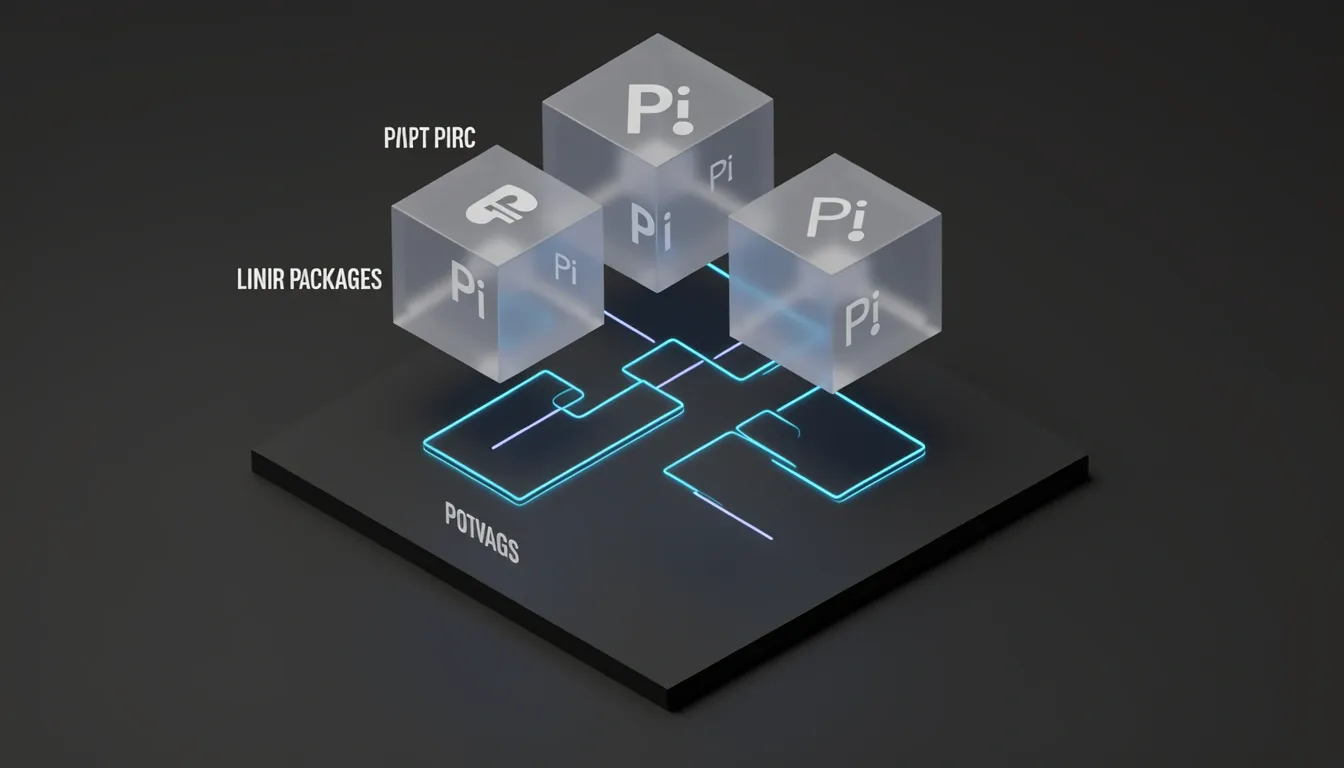
When I look at Pi's codebase, what strikes me immediately is the intentional discipline behind its four-package architecture. Instead of sprawling across dozens of modules, the entire system collapses into four specialized pillars: an AI provider abstraction, a deterministic agent core, a razor-thin terminal UI, and the coding agent itself. This isn't minimalism for its own sake; it's a structural bet that extensibility comes from clear boundaries, not feature accumulation.
The AI Abstraction Layer
The AI package functions as a universal adapter for language model providers. I noticed it handles transport protocol diversity—HTTP, WebSocket, and others—while normalizing authentication mechanisms ranging from simple API keys to OAuth flows. The provider roster is extensive: Anthropic, OpenAI, Google, Azure, Bedrock, Mistral, Groq, Cerebras, xAI, Hugging Face, Kimi For Coding, MiniMax, OpenRouter, and Ollama all plug into the same interface. What impressed me is the mid-session model switching. You can bounce between providers without touching framework internals, which suggests the abstraction is deep enough to mask implementation details but thin enough to avoid overhead.
The Deterministic Agent Loop
At the heart of the system sits the agent core, which implements a generalized interaction loop. The cycle is straightforward but rigorously defined: capture user input, evaluate context and available extensions to select tools, execute those tools, verify the results, and then decide the next action. I find the determinism here noteworthy. The loop exposes clear entry and exit points specifically designed for extension interception, meaning middleware can hook into the cycle without corrupting the core state. This observability is rare in agent frameworks, where black-box execution is often the default.
A 600-Line Terminal Interface
The TUI package is where Pi's philosophy becomes visceral. It weighs in at roughly 600 lines of code, a deliberate counterweight to the bloat I see elsewhere. The creator explicitly rejects the idea that a terminal interface should be treated as a "game engine"—a direct jab at approaches like Claude Code, which leans on React and pays a 12+ millisecond re-layout penalty on every update. That delay manifests as visible flicker and sluggish feedback. Pi's stripped-down renderer, by contrast, pushes hundreds of frames per second without dropping a frame. When responsiveness directly impacts developer flow, those milliseconds matter.
Dual-Mode Operation: TUI and SDK
Finally, the coding agent refuses to choose between interactive and programmatic use. It operates simultaneously as a full TUI coding agent and as a software development kit for headless deployment. The same core logic drives both paths. For automation, Pi exposes an RPC mode that streams JSON over stdin/stdout, or you can embed it directly via the SDK. The OpenClaw integration demonstrates this in production: the exact logic that powers the terminal session also runs silently inside an external application. That symmetry eliminates the drift I often see when a project's "API version" lags behind its interactive interface.
This four-package structure reveals a consistent pattern: every layer is designed to do one job completely, then get out of the way. The AI package hides provider complexity. The agent core enforces predictable execution. The TUI sacrifices visual weight for raw speed. And the coding agent collapses the boundary between tool and library. For me, that's the blueprint of a system built by someone who has debugged the alternatives.

The Four Built-In Tools and TerminalBench Validation
When I look at Pi's architecture, the first thing that stands out is its ruthless simplicity. The agent ships with exactly four built-in tools: read file, write file, edit file, and bash. At first glance, this looks like a severe limitation compared to competitors that bundle sub-agents, plan loaders, background bash processors, and Model Context Protocol support. But this isn't an oversight—it's a deliberate design choice backed by hard numbers.
The TerminalBench Reality Check
The validation comes from TerminalBench, a benchmark that throws approximately 82 diverse tasks at agents, ranging from basic system configuration to complex Monte Carlo simulations. In October 2024, Pi powered by Claude Opus 4.5 claimed second place on the leaderboard. It sat immediately behind Terminus, which takes minimalism even further by transmitting only raw keystrokes to a tmux session and reading back VT code sequences.
What strikes me about these results is that Pi reached this tier without the feature bloat that defines most coding agents. The benchmark results suggest that an extensive built-in toolkit isn't a prerequisite for solving real programming tasks. If an agent with four tools can outperform—or at least compete with—feature-heavy alternatives, then the industry assumption that more built-ins equal better performance starts to crumble.
Why These Four Tools Matter
The selection isn't random. Each tool maps to a non-negotiable primitive for software development:
- Read file: Essential for inspecting existing code, configuration files, and logs.
- Write file: Handles initial file creation and bulk writes without needing interactive editors.
- Edit file: Enables precise in-place modifications using Unix diff/patch algorithms under the hood, avoiding the fragility of full-file overwrites when changing specific lines.
- Bash: Provides arbitrary command execution, effectively unlocking the entire system environment—compilers, package managers, test runners, and custom scripts.
This quartet covers the full lifecycle of file system interaction and process execution. Nothing more, nothing less.
What Pi Intentionally Leaves Out
Where this gets interesting is the omissions. Pi explicitly avoids baking in capabilities that other frameworks treat as table stakes:
- Sub-agents and delegation primitives
- Plan loaders and structured workflow managers
- Background bash processors
- Model Context Protocol (MCP) support
- Built-in to-do managers
The philosophy here is clear: these aren't discarded, but deferred. If a user needs MCP integration or hierarchical task management, they implement it as an extension rather than inheriting it as core bloat. I see this as a direct response to the industry's current "messing around and finding out stage," where no stable consensus exists on what constitutes an essential agent feature.
Shifting the Burden of Proof
By proving competitive performance with only four primitives, Pi shifts an important burden. Instead of minimalists having to justify why they stripped features away, advocates for additional built-in capabilities now need to demonstrate that their extra complexity delivers measurable, benchmark-backed improvements. The TerminalBench results provide empirical evidence that simpler architectures can match—or exceed—alternatives weighed down by speculative feature expansion. When I evaluate agent frameworks, this kind of evidence-backed restraint is far more convincing than a bloated feature matrix.
TypeScript Extension System and Hot Reloading
I see Pi's extension architecture as a fundamental departure from static plugin models. By implementing the entire system in TypeScript, the developers exposed the agent's internal nervous system rather than bolting on a sandboxed scripting layer. This gives users direct access to Pi's reasoning loop, event lifecycle, and terminal UI, transforming it from a fixed-feature utility into a runtime-programmable platform.
The Four API Surface Points
The extension API is narrow but powerful. I break it down into four interaction surfaces that collectively redefine what an agent framework can do:
- registerTool(): By supplying a name, description, JSONSchema parameters, and an execute function, I can inject new capabilities directly into the agent's reasoning loop. The agent doesn't merely "know about" the tool—it autonomously plans with it, requests execution, and folds the results into subsequent thought steps.
- registerCommand(): These surface in the command palette as user-invocable actions. Unlike tools, which the agent selects during reasoning, commands give me explicit manual triggers that sit alongside Pi's native interface.
- on() event subscription: Hooking into lifecycle events like toolcall, toolresult, and model_response makes building observability and middleware layers straightforward. I can intercept and react to the agent's internal decision stream in real time.
- TUI system access: Full access to custom UI components, themes, and prompt templates means I'm not limited to text-in-text-out interactions. I can build visual interfaces that live directly inside the agent's terminal environment.
Hot Reloading as a Development Force Multiplier
What impresses me most is the hot reloading mechanism. In traditional agent frameworks, changing a tool definition typically means killing the process, rebuilding context, and waiting through model initialization—a multi-minute cycle that obliterates flow state. Pi collapses that iteration loop into seconds.
When I modify an extension file inside a project directory, Pi detects the change and reloads the extension without terminating the session. The manual path uses the /reload command, which emits a sessionshutdown event, reloads resources, then fires sessionstart with reason: "reload" alongside resources_discover carrying the same reload reason. Alternatively, I can launch with the --watch flag to automate this across all extension locations.
There are strict behavioral constraints I have to respect. Reload is terminal for handlers—I must execute await ctx.reload() and immediately return. Tools running inside an ExtensionContext cannot trigger reloads themselves, which prevents mid-execution chaos. Most importantly, Pi wipes in-memory extension state after reload, so I design my extensions to be stateless or to persist data externally.
Self-Modification and the Transparency Loop
Perhaps the most architecturally interesting consequence is that Pi can rewrite its own capabilities. Because extensions hold full API access, I can task the agent with generating or modifying its own tools, commands, and event hooks. This creates a feedback loop where Pi improves its own transparency and debuggability features at runtime. Rather than waiting for upstream releases, I can patch behavior, add instrumentation, or reshape the UI while the session is live.
On-Demand Capabilities: /skill:name and Package Installation
Pi ships with exactly four built-in primitives: read, write, edit, and bash. That’s the entire default toolkit. Everything else is treated as an external extension, which immediately signals a design philosophy I find refreshing: the core agent stays minimal, and complexity is opt-in rather than baked into the default footprint. When I compare this to agents that preload dozens of tool definitions into the system prompt, Pi’s decision to start lean and expand only on request looks like a deliberate architectural move to protect reasoning quality.
The mechanism for this expansion is the /skill:name command, which the documentation describes as invoking "capability packages" at runtime. Instead of loading every possible tool description into the context window when the session starts, Pi pulls in additional functionality only when the user or the task explicitly asks for it. I see this as a significant departure from the monolithic agent pattern, where every tool is always present whether you need it or not.
Installing these extensions is handled through the pi install CLI, and the URI format reveals exactly how modular the system is. You can point to an npm package using scoped resolution, or pull directly from a git repository:
npm:@foo/some-tools— resolves through the npm registry, including scoped packages.git:github.com/user/repo@v1— pulls directly from a git repository, with the@v1suffix enabling version pinning right in the URI.
This dual-source support tells me Pi is treating its tool ecosystem as a genuine package manager layer, not just a hardcoded plugin directory. The fact that version pinning is native to the git syntax suggests the authors expect real dependency management at the agent level, which is something I rarely see in coding agents.
How the Modular Agent Toolchain Works
This architecture creates what I’d call a modular agent toolchain pattern. The breakdown is straightforward:
- Base primitives — The four core tools handle filesystem operations and script execution.
- External expansion — Capabilities install from npm or git as separate, versioned packages.
- Runtime activation — New tools only enter the conversation when triggered by
/skill:name.
Context Window Impact
The practical effect on model behavior is where this gets interesting. Every tool definition the LLM can access consumes tokens and attention. When an agent preloads twenty or thirty tool schemas into the system prompt, the model has to reason across all of them simultaneously, even if the current task only requires file editing. By keeping the active toolset restricted to the four primitives plus whatever /skill:name loads on demand, Pi removes that noise from the context window. In my view, that directly translates to better reasoning quality: the LLM sees only the tools relevant to the immediate task, so its function-calling decisions are made against a smaller, sharper signal rather than a cluttered inventory of rarely-used capabilities.
This is a clean, technically sound approach to agent design that trades the convenience of having everything available upfront for the precision of just-in-time capability loading.

Honest Pros: Where Pi Genuinely Excels
I look at Pi's TerminalBench results and see a clear rebuttal to the assumption that more tools equal better outcomes. Ranking 2nd across 82 tasks in the October 2024 benchmark, Pi proved that a lean architecture with just four built-in tools can compete directly with feature-heavy alternatives. The benchmark itself wasn't trivial—it spanned everything from basic system configuration to complex Monte Carlo simulations—so this isn't a case of winning on narrow metrics. To me, this validates the minimalist philosophy empirically rather than theoretically.
The TUI implementation reinforces that same focus on essentials. At roughly 600 lines of code, Pi's terminal interface renders at hundreds of frames per second without flicker. I find this particularly notable when comparing it to React-based agents like Claude Code, which incur 12+ milliseconds of re-layout delay per update. When you're iterating for hours inside a terminal agent, that latency compounds into real friction. Pi's approach eliminates that jank entirely, and the difference in responsiveness is immediately tangible during long sessions.
Model Agnosticism and Runtime Flexibility
One of Pi's most practical architectural wins is how it handles model diversity. I see this as a genuine operational advantage for real-world workflows:
15+ provider abstraction: The AI package unifies Anthropic, OpenAI, Google, Azure, Bedrock, Mistral, Groq, Cerebras, xAI, Hugging Face, Kimi For Coding, MiniMax, OpenRouter, and Ollama under a single interface. You can start a task with a premium model for reasoning, then switch to a cost-effective endpoint for boilerplate generation mid-session without touching the framework configuration.
Dual-mode operation: The identical core logic drives both the interactive TUI and a headless SDK integration via RPC mode using JSON over stdin/stdout. I can wire Pi into CI pipelines, automation scripts, or other programmatic workflows without maintaining separate integration paths. The boundary between human-driven and machine-driven usage essentially disappears.
Extensibility and Observable Behavior
Pi's extension model caught my attention because it doesn't just add features—it can alter the agent's own behavior. This creates a fundamentally different approach to system growth:
Self-modifying extensions: Extensions are capable of modifying Pi's internals, creating a feedback loop where the system improves its own transparency, debuggability, and capabilities without requiring changes to the core framework. This avoids the common trap where every new feature request risks destabilizing the foundation.
Deterministic agent loop: There are explicit entry and exit points where extensions can intercept execution, which makes the system's behavior traceable in ways that opaque agent architectures rarely achieve. When something goes wrong, I can pinpoint exactly where in the loop an extension engaged or where the logic diverged. For debugging complex agent workflows, that observability isn't just convenient—it's architecturally superior to black-box systems where intermediate states remain hidden.

Honest Cons: Where Pi's Minimalism Costs You
Missing Primitives and Orchestration Gaps
Pi's minimalism cuts deep where competitors treat certain features as table stakes. I notice that the core engine ships without several standard abstractions:
- No built-in sub-agents or plan loaders: Multi-agent orchestration is entirely an extension concern.
- No background bash execution: Persistent shell tasks require custom extension logic.
- No MCP support: Model Context Protocol integration is absent from the base distribution.
- No to-do managers: Task-tracking primitives are missing.
These aren't luxury additions anymore; they're baseline expectations in modern agent stacks. Teams looking for out-of-the-box coordination patterns will find Pi's core insufficient, and the development overhead of rebuilding these primitives falls entirely on the user.
Extension Architecture Friction
The extension model itself hides several sharp edges that become apparent once you start building:
- Ephemeral extension state: Any in-memory state is invalidated after every reload, which means persistent state must be explicitly reconstructed by the author. I see this as a direct complexity tax: instead of the runtime handling hydration, you're manually wiring serialization logic into every stateful extension.
- Gated reload mechanisms: Tools run with an ExtensionContext and cannot call ctx.reload() directly, so a tool cannot force its own extension to refresh after a code or configuration change. The workaround—exposing a tool that queues a reload command as a follow-up user message for the LLM to trigger—works, but it feels brittle. It inserts an unnecessary conversational hop where a direct system call should exist.
- TypeScript-only ecosystem: The entire extension system is implemented in TypeScript, which creates a hard language barrier for teams working in Python, Go, or other ecosystems. I don't view this as a minor preference issue; it forces polyglot teams to maintain a separate TypeScript toolchain and context-switch across language boundaries just to customize their agent.
Ecosystem Scale and Strategic Risk
Community gravity matters, and Pi is lighter here than incumbents like Claude Code or Cursor. The result is a smaller extension ecosystem and fewer community-contributed skills, which translates to more DIY scaffolding for specialized workflows. There is also a meta-level risk acknowledged in Pi's own documentation: the industry is in a "messing around and finding out stage" with no consensus on essential agent features. By committing to minimalism now, Pi is making a contrarian bet that the market won't standardize on the very capabilities it omits. I think that's an honest stance, but it's a gamble that users inherit. If the industry converges on native multi-agent protocols or persistent state models, Pi's user base will be retrofitting standards rather than riding them.
The Security Governance Gap
Finally, the lack of built-in data governance stands out as a serious liability. Unlike platforms that ship native PII redaction middleware—such as LangChain's piiRedactionMiddleware, which supports redact, mask, hash, and block strategies for emails, credit cards, IP addresses, and other sensitive entities—Pi leaves data governance entirely to extension authors. In practice, that means every extension touching user data must reinvent its own compliance layer, and inconsistent implementations become a security liability rather than a solved problem.

Verdict: Who Should Adopt Pi and Who Should Wait
When I evaluate Pi against the current crop of coding agents, the ideal user profile emerges quickly. This tool isn't trying to win enterprise procurement cycles through checklist breadth; it's optimized for developers who prioritize architectural clarity and raw performance. If your workflow centers on interactive terminal-based coding, Pi's sub-12ms TUI rendering directly impacts whether you stay in flow state or fight the interface. I see the dual-mode architecture as the real differentiator here—the same agent that sits in your terminal can pivot into SDK/RPC mode and integrate cleanly into programmatic pipelines, CI/CD logic, or custom orchestration scripts. That versatility matters when you're treating the agent as infrastructure rather than just a conversational wrapper.
When Pi Earns Its Place
- TypeScript-native customization: Teams already comfortable with TypeScript will find the extension system immediately approachable. The hot reloading capability compresses the development cycle significantly, letting you iterate on agent behavior without restarting the runtime or losing context.
- Empirical speed validation: Pi's minimalist philosophy isn't speculative. Its performance claims are backed by TerminalBench validation, which gives concrete evidence that the architecture trades feature bloat for measurable responsiveness. For teams who want to build custom capabilities rather than accept pre-baked ones, this benchmark-backed approach reduces adoption risk.
The Hard Stops for Adoption
- Governance gaps require manual construction: If your organization depends on built-in PII detection, security governance, or compliance middleware without custom engineering, Pi presents a hard no. These aren't premium features waiting to be unlocked; they're entirely absent unless you build extensions yourself.
- Python-only toolchain friction: Organizations standardized on Python will encounter a meaningful barrier in Pi's TypeScript extension requirement. Introducing heterogeneity into your toolchain for a single agent is a trade-off many engineering leads won't accept.
- Orchestration ceilings: Pi does not natively support multi-agent orchestration or persistent background task management. If your use case requires spinning up sub-agents or managing long-running background processes, you'll hit architectural limits immediately.
The Strategic Risk of Minimalism
I think the most significant risk in adopting Pi isn't technical—it's directional. The market is currently pushing toward feature-heavy platforms with native MCP support, sub-agent hierarchies, and built-in compliance layers. Pi's bet is that extensibility will outperform built-in breadth, but if the industry converges on those advanced capabilities as baseline expectations, Pi's extension-only model could shift from "clean design" to "missing infrastructure." That's a genuine liability to weigh against the immediate gains in hackability and speed.
For solo developers and small teams who want a fast, benchmark-validated, and genuinely hackable coding agent, Pi stands out as one of the most thoughtfully architected options available right now. For larger organizations requiring comprehensive governance, built-in security features, and broad out-of-the-box capability, the safer play is to wait until the extension ecosystem matures before committing engineering resources.
Matchday clothing works best when comfort and team identity are considered together. Anyone checking fabric and breathability can place Arsenal jersey(camiseta del Arsenal) within the relevant shirt range. Choosing the correct size is especially important for children's and fitted versions.