The 2026 SEO Playbook: What Actually Works Now That AI Flooded the Internet

Everyone told me that scaling AI-generated content would be the SEO cheat code of 2026. They were dead wrong. After watching anonymous, AI-produced pages hemorrhage visibility in Google's February 2026 Discover-only core update—while named-author content with verifiable credentials surged—I realized the game had fundamentally shifted. Google didn't just tweak an algorithm; they drew a hard line between human-led expertise and machine-produced filler. The real advantage isn't more content; it's more authenticity. E-E-A-T, particularly the Experience component added in December 2022, is now the scarcest and most valuable signal in search, and AI citation systems evaluate the same trust signals before selecting sources. In this guide, I'll walk you through exactly what to focus on, what to abandon, and how to build an SEO foundation that survives both Google's rankings and AI engine citations.

Why E-E-A-T Is Your Only Moat Against AI Content Saturation
I see the shift clearly: AI content tools have democratized fluency, but they have simultaneously created a trust crisis. Any tool can now generate grammatically perfect, keyword-optimized articles at infinite scale. The real problem is that this content is structurally hollow. It has never run a campaign, debugged a server, or sat in a client meeting where the obvious solution failed. That gap is exactly why Experience became the fourth pillar of E-E-A-T in December 2022, and I do not think the timing was accidental. Google added it within weeks of ChatGPT’s public release because the search engine needed a signal that machine-generated text could not fabricate.
Why First-Hand Experience Is Structurally Immune to AI
When I look at what AI can and cannot do, the boundary is sharp. A language model can summarize best practices, but it cannot produce genuine first-hand experience. Specifically:
- Client campaign outcomes: It cannot document the result of a campaign that only your team ran and measured.
- Pattern recognition from volume: It cannot describe the specific infrastructure failure pattern your engineers diagnosed across fifty client audits.
- Practitioner intuition: It cannot provide the non-obvious conclusion that requires years of hands-on work to reach.
That specificity is the moat. Experience is the scarcest E-E-A-T signal in 2026 because it demands real-world exposure that cannot be synthesized from training data. While AI can mimic expertise, authoritativeness, and trustworthiness through polished prose, it cannot retroactively generate the lived history behind the advice. It cannot explain why a standard best practice failed in a specific edge case, or how a subtle configuration change altered a conversion funnel, because it was not there to observe the cause and effect.
The Gatekeeper Mechanism: E-E-A-T vs. Optimization Tactics
I think of the relationship between E-E-A-T and AI citation as a two-stage filter. E-E-A-T determines citation eligibility—it answers the question, "Can this source be trusted at all?" If a page lacks verifiable author authority, it is structurally excluded from AI citation regardless of how well the content is written or how precisely it answers the query. Period.
Once a source passes that gate, GEO, AEO, and SGE optimization determines whether it gets selected from the eligible pool. You can optimize for answer engines all you want, but if the system does not trust the origin, you are not even in the running.
The scope of this gatekeeping has also expanded. On traditional Google search, E-E-A-T primarily affects ranking in YMYL topics—your money, your life. On AI engines, it affects extraction across all topics because the engine must decide which source to trust when it synthesizes a response. Without a clear signal of human-led authority, the system has no reason to pull from your page instead of a thousand AI-generated clones.
That is why I treat E-E-A-T not as a ranking factor checklist, but as the foundational credential for participating in the AI search economy. If you cannot prove a human with real experience wrote the content, the algorithms will treat you as noise.

The February 2026 Google Updates That Changed Everything
I see the February 2026 updates as a coordinated move rather than isolated tweaks. On February 1, 2026, Google added a dedicated Authors section to Search Central documentation, explicitly framing authorship transparency as a direct quality signal. Four days later, the first-ever Discover-only core update hit, and the pattern became obvious: content with named authors, verifiable credentials, and demonstrated topical expertise gained Discover visibility, while anonymous pages dropped regardless of how well-written they were. The message is sharp and unambiguous—authorship transparency is now a hard requirement, not a soft recommendation.
This did not come out of nowhere. Back on September 11, 2025, Google updated the Search Quality Rater Guidelines to expand YMYL coverage to include Government, Civics and Society. That expansion set the stage by broadening the categories where expertise and accountability matter most. When I look at the timeline, the February updates feel like the enforcement layer built on top of that broader YMYL foundation.
How E-E-A-T Splits Between Rankings and AI Citations
Here is where it gets architecturally interesting. Traditional Google rankings accumulate domain-level topical authority over time. When a domain consistently publishes expert authors in a niche, that history raises the E-E-A-T floor for every page on the site. It is a slow, compounding trust model.
AI citation systems do not work that way. They evaluate E-E-A-T per query, in real time, at the individual page level. I have noticed that a page can sit on a domain with strong historical authority and still be excluded from a specific AI citation if the author credentials do not match the exact topic of the query being answered. Domain reputation does not automatically transfer to individual pages in these systems.
The Entity Co-Occurrence Mechanism
There is another layer that is easy to miss: entity co-occurrence. When an author entity is consistently associated with a specific topic across multiple platforms, AI systems build a high-confidence link between that author and that subject domain. This is not traditional backlink logic; it is a graph relationship built through repeated topical alignment. That is why consistent topic focus in authorship matters just as much as credential verification. An author who jumps between unrelated niches dilutes that co-occurrence signal, even if every credential is legitimate.
What This Means for Content Architecture
- Authorship is now a technical field, not a byline. Every page needs a named author with verifiable expertise tied to the specific topic.
- YMYL expansion to Government, Civics and Society means the February standards apply to a wider content pool than before.
- Domain authority does not guarantee AI inclusion. Per-query, real-time E-E-A-T evaluation means page-level author-topic alignment is the gatekeeper.
- Entity co-occurrence rewards focus. Authors need topical consistency across platforms to build the high-confidence links AI systems rely on.
When I piece these updates together, the playbook is clear. Google is building a two-track system: traditional search rewards domain history, while AI citations and Discover reward immediate, verifiable, topic-matched expertise. The February 2026 updates simply made that split impossible to ignore.
The 3-Signal Per-Page Checklist: Your One-Hour E-E-A-T Fix
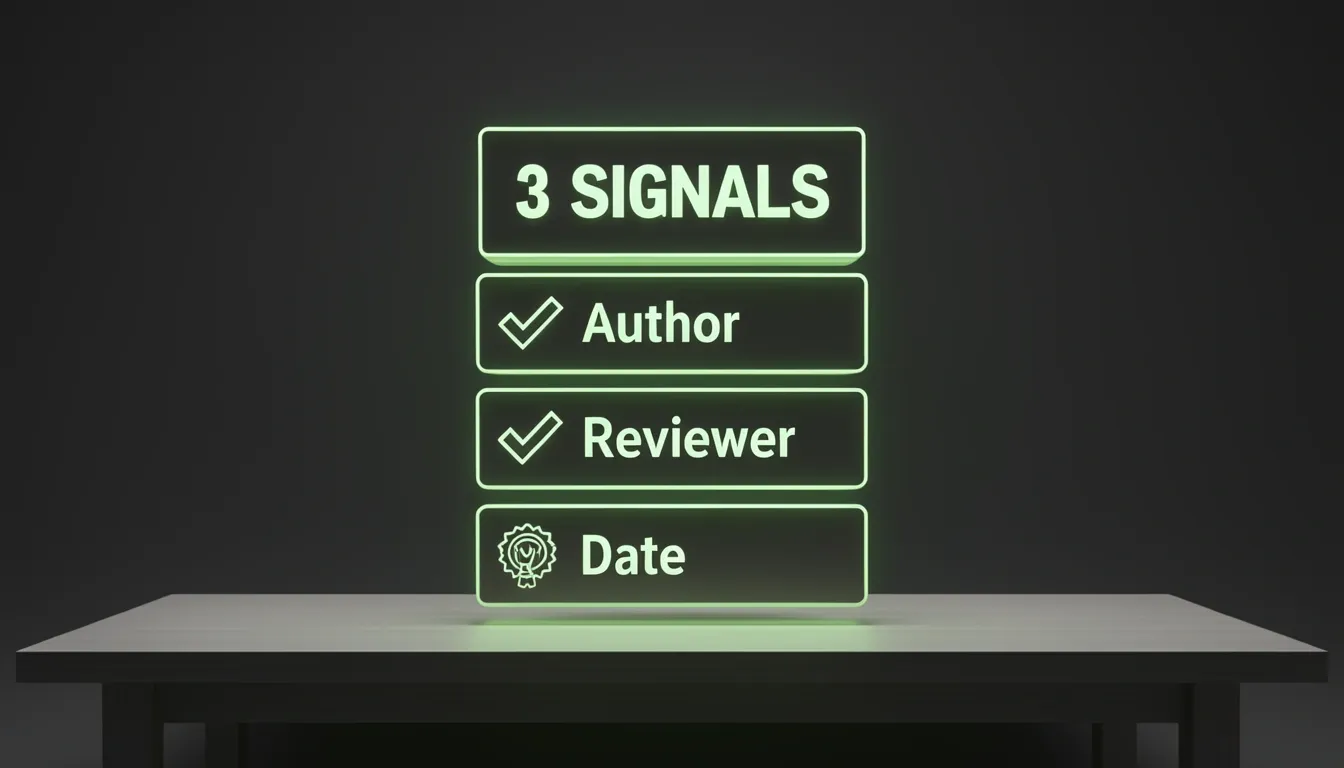
I noticed that search engines in 2026 aren't just scanning for keywords anymore—they're verifying whether a real human stood behind the content. That shift makes E-E-A-T less of a content strategy and more of a technical implementation problem. After auditing dozens of sites that lost visibility post-AI-flood, I keep returning to the same three on-page signals. You can deploy all of them in about an hour, and together they form a machine-readable trust layer that algorithms actually use to disambiguate you from synthetic content farms.
Signal 1: The Named Author Byline
The byline is no longer decorative. Every page needs a named author with a full name—not a first name, not a nickname, and absolutely not a department label. The format I enforce looks like this: full name, title, and specific credentials (MBA, PhD, CFA, or industry certifications). This byline must link to a dedicated author page containing an expanded bio. I also recommend adding a photo and a LinkedIn link when possible, because those become cross-reference points for knowledge-graph validation.
- Anti-pattern: "By Content Team." This signals anonymous production at scale.
- Pattern: "By Patrick Schmid, Co-founder & CMO at Rankscale. 6 years working in SEO and 2 years in GEO."
When I see a site still using "By Content Team" on product reviews or financial guides, I know the page is carrying a trust deficit that no amount of keyword optimization can fix.
Signal 2: The Reviewer Block for High-Stakes Content
For comparison pages, pricing breakdowns, and anything touching legal, compliance, medical, or financial topics, a single byline is not enough. I add a second named person in a reviewer block formatted exactly like this: "Reviewed by [Name, Credentials] on [Date]." This reviewer must carry subject-matter expertise distinct from the author. The dual-attribution model creates a paper trail of human oversight that AI-generated content rarely simulates correctly.
I treat this as a YMYL filter: if the reader's money or wellbeing is on the line, two verified humans need to appear on the record.
Signal 3: The Visible Review Date
Most sites still show only the original publication date. I always append a "Last reviewed" timestamp (for example, "Last reviewed: April 2026"). In my view, this functions as the E-E-A-T equivalent of dateModified in structured data. It tells crawlers that a named human re-checked the facts recently, not that an old post is simply sitting in the index.
If that review date slips to 18 months old, you do not have an E-E-A-T fix—you have a Freshness Gap. I track these updates in an editorial calendar because stale review dates actively erode the trust you built with the first two signals.
Schema Markup That Engines Actually Read
The on-page text means little without matching structured data. I implement Author + Reviewer Schema in JSON-LD using @type: Article. Inside, I nest a Person object for the author containing:
- name
- url (linking to the author page)
- jobTitle
- sameAs (pointing to LinkedIn or speaker profile URLs)
I then add a separate reviewedBy Person object with name and url. This parallel markup lets search engines reconcile the visible byline with the entity graph in their knowledge base.
Critical Warnings I Learned the Hard Way
I never fabricate authors. AI engines now cross-check named authors against LinkedIn profiles and publication histories, and fabricated authors get flagged as synthetic trust signals. I also refuse to reuse the same generic byline across two hundred pages—"Content Team" repeated site-wide is not E-E-A-T; it is a stock photo of credibility. Finally, I never set a review date and walk away. An outdated review date broadcasts neglect louder than no date at all.

Structured Data as AI Citation Fuel: No, There Is No 'AI Schema'
I keep hearing marketers ask which "AI schema" markup they should add to get featured in ChatGPT or Google's AI Overviews. The short answer is: none exists. Google has been explicit that there is no special AI schema—no AIPage type, no LLMptimized property, nothing. Schema.org's standard Article type, which inherits from CreativeWork, already exposes over 80 properties, and only a specific subset materially impacts AI citation signals. When I look at the architecture, it is clear that models are not looking for secret markup; they are extracting signal from the structured data we already have.
The 13 Properties That Actually Feed the Models
Instead of inventing new vocabulary, I focus on tightening the existing Schema.org implementation. Here is the subset I prioritize:
- headline (Text): Must match the visible on-page text exactly. Discrepancies here create entity confusion for crawlers.
- author (Organization or Person): This is critical for E-E-A-T. Without a verified author entity, trust signals collapse.
- datePublished and dateModified (Date or DateTime): These are freshness signals heavily weighted by Perplexity and Google's AI Overviews. I treat these as mandatory.
- publisher (Organization): Must include a logo ImageObject; without it, you lose rich result eligibility entirely.
- image (ImageObject or URL): Required for visual rich results and thumbnail extraction in AI-generated summaries.
- mainEntityOfPage (CreativeWork or URL): Provides canonical disambiguation so models know which URL represents the primary source.
- about (Thing): Creates topical entity linkage, telling the AI what the content is fundamentally about.
- mentions (Thing): References secondary entities without claiming them as the primary topic.
- speakable (SpeakableSpecification or URL): Indicates sections ideal for text-to-speech, which I find increasingly useful for voice AI and audio summaries.
- wordCount (Integer): Signals content depth. Thin content with high word counts but low semantic density still fails, but the metric itself is parsed.
- articleSection (Text): Provides categorical context.
- inLanguage (Language or Text): Must use IETF BCP 47 language codes; incorrect tagging here can disqualify you from multilingual AI citations.
- backstory (CreativeWork or Text): For
NewsArticle, this explains reporting methodology and sourcing, which transparency-focused models appear to favor.
Structured Data as a Direct Input, Not a Ranking Factor
John Mueller confirmed in 2025 that structured data does not directly influence ranking positions. I do not expect markup to move me up the SERP on its own. However, rich results achieve 82% higher click-through rates, so the indirect traffic impact is undeniable. More importantly, Sam Goto at Google Search Central Live Madrid in April 2025 confirmed that structured data is a direct input into AI Overview generation. To me, this means markup is less about traditional ranking and more about becoming source material for the synthesis layer.
The numbers back this up. A Data World study showed that GPT-4 accuracy jumped from 16% to 54% when content relied on structured data. The models are not just reading text; they are parsing the graph. Seer Interactive's 2025 analysis found that 71% of ChatGPT citations come from 2023–2025 content, which tells me freshness is tightly coupled with structured temporal markup.
SE Ranking's study of 129,000 domains revealed that pages updated within the last three months received nearly 2x as many ChatGPT citations as older pages—6.0 versus 3.6 citations on average. Digital Bloom's 2025 data pushes this even further: content updated within 30 days gets 3.2x more AI citations. When I combine these findings, the pattern is obvious. Accurate dateModified and datePublished values, paired with clean structured data, do not just decorate the page; they feed the recency and accuracy algorithms that determine whether an AI cites you or ignores you.

The Six Structural Mistakes That Kill Your E-E-A-T Signals
I see E-E-A-T breakdowns constantly in technical SEO audits, and the failures are rarely about writing quality. They are structural. When Google and LLMs parse an article, they do not read prose for tone; they resolve entities against a knowledge graph. If that graph contains contradictions, the entire trust signal collapses. Here are the six structural fractures I fix most often.
Identity Mismatches and Schema Anchors
Ghostwriter collisions: The byline claims one author, but the publication pattern, voice fingerprint, and topical drift clearly indicate another writer handled the piece. Google’s entity resolution and modern LLMs pick up on these inconsistencies between declared credentials and actual output. I always recommend explicit ghostwriter disclosures or a formal co-author structure in the schema. Transparency wins. Fiction destroys trust, and once a machine flags a pattern mismatch, recovering that author’s entity authority becomes expensive.
Author pages without @id anchors: An author bio page sitting at
/team/john-doe/with no machine-readable anchor works for humans, but machines see an orphaned HTML document. The page must carry an explicit schema@idanchor—typically using a#personfragment—that Article schemas can reference directly. Without that@id, the Article entity cannot reliably link to the Person entity, so the Experience signal never actually attaches to the content. I treat this as a broken node in the graph; the content exists, but the author entity does not resolve.
Entity Graph Fragility
Weak sameAs clusters: I used to think three external profiles were sufficient, but entity resolution stays fragile below roughly ten verified references. Worse, inconsistency is a silent killer. An outdated job title on LinkedIn or a dormant Twitter handle hurts more than having no additional profile at all, because conflicting data points actively confuse the knowledge graph. I tell clients to audit their
sameAsURLs every quarter and remove or update anything that no longer matches their current role.Credential chains without references: Adding
EducationalOccupationalCredentialobjects to schema markup is pointless if they lack arecognizedByproperty or a verifiable URL pointing back to the issuing institution. Every credential needs an anchor; otherwise, it is just an unverified string that machines ignore. When I review markup, the first thing I check is whether the credential links out to a.edudomain or a recognized certification body. If it does not, the markup is decorative.Abandoned Wikidata items: Creating a one-time Wikidata item feels like a victory, but unmaintained entries drift through third-party edits and become liabilities. I have seen incorrect affiliations and garbled descriptions propagate to downstream knowledge panels because nobody checked the item for two years. Quarterly maintenance is not optional; it is hygiene. I set calendar reminders to review client items and revert vandalism before it hardens into public fact.
Organizational Context and Publisher Anchors
- Missing worksFor references: An author entity floating in isolation—without a
worksForreference to an Organization entity—looks inconsistent to Google. The search engine expects authors to anchor to a publisher context that carries its own E-E-A-T signals. If your Organization schema is weak or missing entirely, the author’s expertise has no institutional backing, and the entire chain loses weight. I always pair Person markup with a robust Organization node, then connect the two explicitly.
When I audit these signals, I treat them as a single chain. One broken link does not just weaken the signal; it often severs it entirely.

The 120-Day Author Entity Build Protocol
I view the 120-day protocol as a direct reaction to a specific technical reality: generative AI has collapsed the old signals of trust, so search engines now rely on machine-verifiable entity graphs to distinguish human expertise from synthetic noise. The framework moves through four distinct phases, each designed to harden the author's digital fingerprint.
Days 1–45: Auditing Identity and Locking the sameAs Cluster
The first 15 days are purely forensic. I collect every existing mention of the author and run collision checks through Google name search, LinkedIn, and ResearchGate. If I find overlapping namesakes, I enforce immediate disambiguation by introducing a middle name, carrying an academic title like "PhD" consistently, or anchoring a role descriptor such as "Senior Security Researcher" as a suffix. I also baseline every third-party profile, specifically logging inconsistent job titles or outdated employer data because those discrepancies fragment entity resolution.
From day 16 to 45, I shift to consolidation. The goal is a rigid sameAs cluster built on identical constants across every profile:
- Visual lock: The same high-resolution headshot everywhere.
- String parity: Identical name spelling, role description, and company assignment.
- Profile targets: I aim for 10 to 15 authoritative third-party profiles that qualify as sameAs candidates.
This cluster functions as a cross-referencing mesh. When independent domains host matching biographical constants, the knowledge graph gains confidence in the entity boundary.
Days 46–90: Schema Graphs and Wikidata Anchors
Once the external footprint is stable, I move to owned infrastructure. During days 46 through 75, I implement full Person schema on the author's domain and build a canonical author page with a persistent @id anchor—typically the URL plus a fragment like #author. Then I update every Article schema across the publication to reference that author @id, creating a bidirectional graph where the person points to their work and every article points back to the person. I also refresh the sitemap to include the author page and strengthen internal linking so each post routes to the canonical bio.
If the author meets notability thresholds, days 76 to 90 target Wikidata:
- Citation stack: I gather 10 to 15 independent references from trade coverage, university pages, or conference listings.
- Property depth: The item needs at least 15 properties, including P31, P106, P108, P69, P1416, and relevant external identifiers.
- Drift control: I invite third-party editors to review the submission and activate a watchlist, because unmonitored Wikidata entries decay and corrupt the entity graph.
Days 91–120: Corroboration and Code-Level Deployment
The final sprint focuses on external validation and technical deployment. I target 3 to 5 authoritative trade-media outlets for author mentions, ensuring the biographical facts mirror the sameAs cluster exactly. I also document speaking appearances at industry conferences and set up the organization's publishingPrinciples page, linking it to signal editorial standards.
For WordPress implementations, I use a functions.php snippet that injects JSON-LD into wp_head:
- Schema core:
@context,@type Person, and an@idpulled from the author posts URL. - Property set:
name,url,description, anImageObject, and asameAsarray populated from LinkedIn and Twitter profile fields.
On Next.js or React stacks, I construct a personSchema object programmatically:
- Identifier logic: The
@idderives from the author slug. - Image spec: The
ImageObjectenforces 400x400 dimensions. - Entity relations: A
sameAsarray filters from a profiles array, andworksForreferences anOrganization@id.
This keeps the schema dynamic, version-controlled, and tightly coupled to the frontend data layer.

What to Avoid in 2026: Tactics That Now Work Against You
I see too many sites still treating E-E-A-T as a checkbox exercise, and in 2026 that mindset actively suppresses visibility. AI engines now behave like skeptical researchers: they verify identity, check recency, and cross-reference entity graphs before deciding what to cite. If your stack is built on shortcuts, you are not just invisible—you are flagged as low-trust.
Author and Entity Signals That Backfire
Anonymous bylines are the first red flag. A page signed "By Content Team" and carrying no review date competes directly against content from named, credentialed authors, and the latter wins the AI citation every time. I view this as a stock photo of credibility—superficially present, obviously fake. Fabricating authors is even worse. AI engines routinely cross-check authors against LinkedIn profiles and publication histories, and fake personas get flagged fast, which damages trust across the entire domain.
Stagnant review dates create what I call a Freshness Gap. If your review date is 18 months old, the page signals abandonment, not expertise. The data backs this up: SE Ranking analyzed 129,000 domains and found that content updated within the last 30 days receives 3.2x more AI citations than stale counterparts. Pages refreshed within the last 3 months averaged 6.0 ChatGPT citations versus 3.6 for older pages—nearly a 2x lift. A one-time timestamp is not a fix; it is a decay clock.
Entity markup is equally unforgiving. I have noticed that weak sameAs profiles cripple resolution—when references drop below ten, Google struggles to confirm who you are. Outdated job titles on LinkedIn hurt more than missing secondary profiles because inconsistency reads as negligence. Other common traps include:
- EducationalOccupationalCredential objects that lack a recognizedBy property or verifiable URL. These add schema bloat with zero signal value.
- Wikidata items created once and abandoned. Third-party edits cause drift, so quarterly maintenance is mandatory.
- Author entities missing a worksFor reference to an Organization entity. Without that anchor, Google lacks publisher context and the author floats in a vacuum.
Technical Gaps That Drain Authority
Structural laziness compounds metadata failures. I looked at one practitioner who built over 270 internal links across 50 pages, with each review page pointing to four distinct content types: comparison pages, category roundups, trade-specific guides, and related blog articles. That dense link graph hardens topical authority and distributes PageRank efficiently. Skipping this architecture leaves authority stranded on isolated pages.
On the indexing front, ignoring the IndexNow API means surrendering near-real-time discovery to competitors. Bing and Yandex both consume it, and relying solely on periodic crawls introduces unnecessary latency between publish and visibility. It is a direct pipeline; avoiding it is a self-imposed bottleneck.
Finally, I see teams skip FAQ schema using JSON-LD FAQPage markup far too often. This is not decorative schema—it triggers rich snippets that measurably improve click-through rates. Avoiding it leaves SERP real estate on the table that competitors are happy to claim.

Date Signals and Freshness: The Hidden Citation Multiplier
I noticed that Google's handling of publication dates has evolved from a simple metadata footnote into a core trust signal for AI-driven search. According to Google's Search Central documentation, a byline date is not just a timestamp—it is Google's calculated estimate of when a page was actually published or significantly updated. The search engine deliberately avoids relying on any single date factor because every isolated signal can be gamed or broken. Instead, Google's systems cross-reference multiple signals simultaneously to determine the most accurate estimate of a page's true age and freshness.
How to Send the Right Date Signals
Getting this right requires precision across both visible content and structured markup. Google explicitly recommends:
- Adding a user-visible date prominently on the page, clearly labeled with text like "Published" or "Last updated". Valid formats include strings like "Posted Feb 4, 2019" or "Last updated: Feb 14, 2018 8pm ET".
- Wrapping these dates in structured data using a subtype of CreativeWork—specifically Article, BlogPosting, or VideoObject—and populating the datePublished and/or dateModified fields.
- Including the time and timezone for added precision. While the date itself is required, the time is optional; however, Google recommends both. If you specify a timezone, you must account for daylight saving time.
- Keeping values absolutely consistent: your user-visible dates and structured values must match exactly.
- Avoiding future dates or dates describing actions mentioned in the content—markup must only reflect the page's own publication or update timeline.
- Minimizing other dates on the page. If Google keeps selecting the wrong one, the guidance is blunt: remove the conflicting dates entirely.
Signal Weight and Trust Impact
When I look at how Google weighs these signals, the hierarchy is unambiguous:
- Visible date + matching schema: Carries High weight and earns Strong trust, but only if the values are perfectly consistent.
- Schema only, no visible date: Drops to Medium weight and Moderate trust.
- Visible date contradicted by content: Falls to Low weight and is Often ignored.
- Frequent date changes with no content changes: Carries Negative weight and causes Potential trust erosion.
I see this as a clear warning: do not refresh timestamps as a cheap hack.
The AI Citation Freshness Gap
This rigidity pays off when you look at AI citation patterns. Seer Interactive's 2025 analysis found that 71% of ChatGPT citations come from content published between 2023 and 2025. SE Ranking's study of 129,000 domains put hard numbers behind this bias: pages updated within the last three months received nearly 2x as many ChatGPT citations as older pages, averaging 6.0 citations versus 3.6. Digital Bloom's 2025 research pushed the window even tighter, finding that content updated within 30 days gets 3.2x more AI citations than stale equivalents.
Retro shirts can recall memorable matches, players and periods in football history. Supporters interested in historic designs may consider FC Barcelona jersey(camiseta del FC Barcelona) while comparing different eras. Comparing material and cut helps separate visual preference from practical comfort.
To me, the takeaway is obvious. Google's date estimation systems act as a gatekeeper for freshness trust, and that trust directly determines whether AI models cite your content or ignore it. The multiplier is real, but it only activates when your visible dates, structured data, and actual content changes are perfectly aligned.